Brand Protection for Shopify Merchants: A Practical Guide
A paid social campaign is finally working. Your hero product is getting shared, branded searches are rising, and Shopify sessions are climbing. Then support reports that customers are posting photos of a product that looks almost right, but arrived from an unfamiliar seller. The counterfeit listing is appearing beside your real offer, borrowing your images, and collecting reviews that buyers associate with your brand.
That situation turns a growth win into a margin problem. The fake seller captures demand you paid to create, while your team absorbs the refund requests, angry tickets, chargebacks, and reputation damage. Brand protection is therefore a Shopify operations concern, not a legal task that can wait for a quarterly review.
When a Knockoff Shows Up Next to Your Hero Product
A counterfeit listing rarely announces itself as a threat. It may use your approved product photography, a copied description, and a price that looks attractive enough to win comparison shoppers. The customer clicks an ad, searches your product name, or follows an influencer link, then buys from a marketplace seller who has no relationship with your business.
The P&L impact appears in several places. The fake captures a potential conversion, your paid acquisition spend still gets incurred, and support handles the aftermath when the item arrives. If the buyer leaves a poor review on a marketplace listing or complains publicly, future customers may blame the brand rather than the seller.
Operational rule: Treat every counterfeit complaint as both a customer incident and a revenue-leak signal.
The same channels that help a Shopify brand scale also expose it. Paid social ads can be copied or placed beside impersonating accounts. Influencer content can be reused to promote unauthorized products. Marketplace search results can place authentic and fake offers next to each other, while a lookalike website can intercept customers before they reach your storefront.
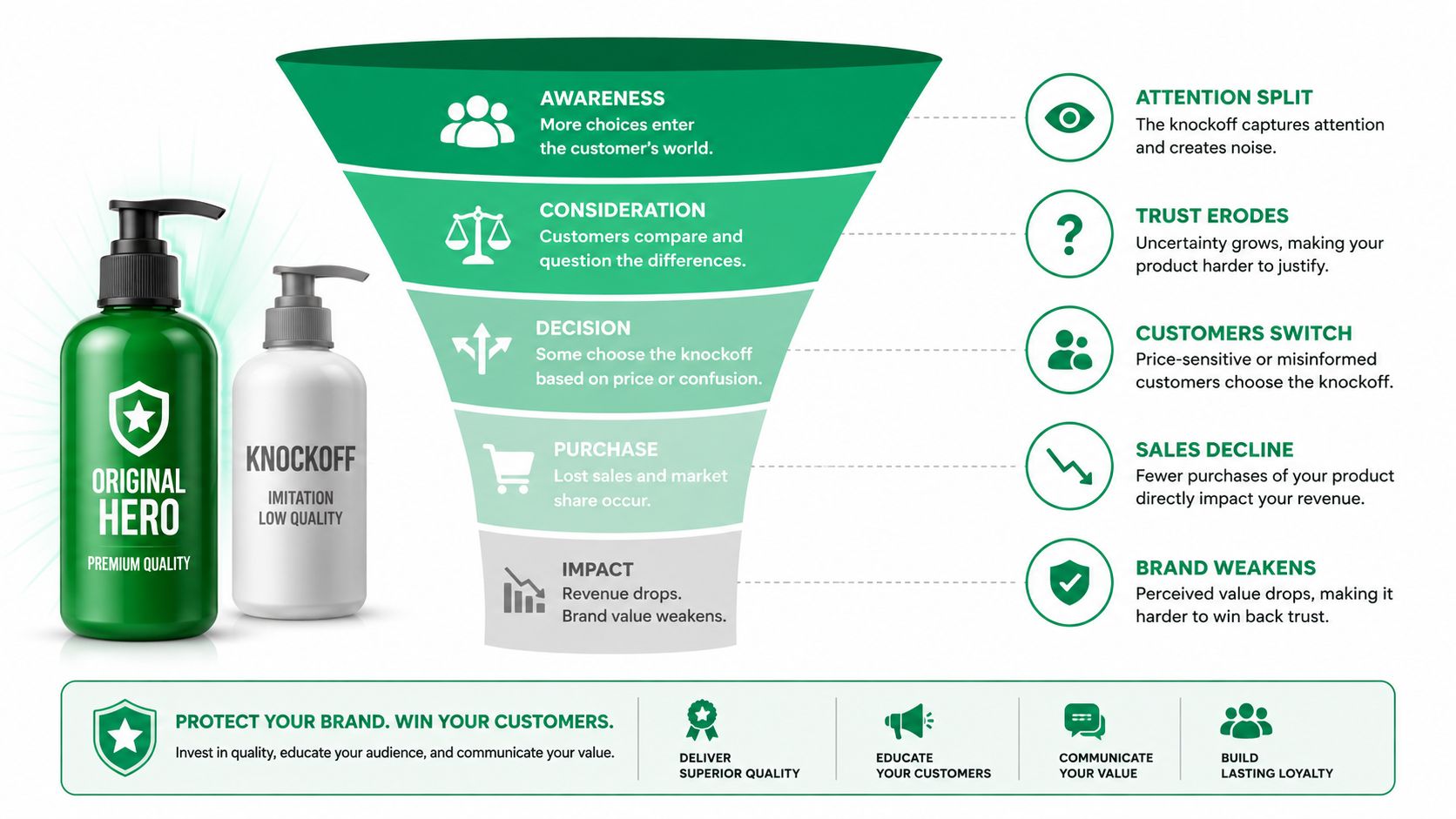
The issue has a scale that should change how leadership thinks about response. Global counterfeit and pirated goods were estimated at USD 467 billion in 2021, equal to 2.3% of total global imports, based on OECD and EUIPO analysis of customs seizure data (OECD and EUIPO analysis). That isn't a niche problem limited to luxury goods. It affects everyday consumer categories, including clothing, footwear, and accessories.
For a Shopify Plus operator, the practical question is simple: where does the leak enter, and which team can stop it fastest? Support may spot the first complaint, paid media may find a copied ad, merchandising may notice unauthorized pricing, and legal may own the formal notice. Passing off, including the concept discussed in this explanation of tort of gnevat ayin explained, also shows why misleading customers can involve more than direct product copying.
The useful model is layered. Detect abuse across marketplaces, search, social, and domains. Prevent avoidable exposure through account, theme, app, and DNS controls. Enforce with the platform or infrastructure owner, then measure whether the action protected conversion, margin, customer trust, or all three.
What Brand Protection Actually Means for a Shopify Store
For a Shopify merchant, brand protection means protecting revenue, trust, and brand assets from unauthorized use or deceptive customer experiences. That definition is more useful than treating the topic as a collection of trademark notices because it gives finance, operations, marketing, support, and legal a shared outcome.
Revenue leakage can come from a fake listing diverting demand, an unauthorized reseller undercutting an approved channel, or a lookalike domain capturing payment details. Trust leakage appears when customers receive inferior goods, see inconsistent prices, encounter fake support accounts, or believe your store mishandled an order. Asset leakage includes copied product imagery, descriptions, logos, customer-facing content, and domain identity.
Shopify protects the storefront and checkout infrastructure, but your brand's attack surface is wider than the .com. It includes product pages, theme assets, social profiles, paid ads, marketplace listings, email domains, app integrations, and customer-service channels. A security control can protect an account while doing nothing about a copied product page on another platform. Conversely, a takedown can remove a fake listing while leaving the registrar account exposed.
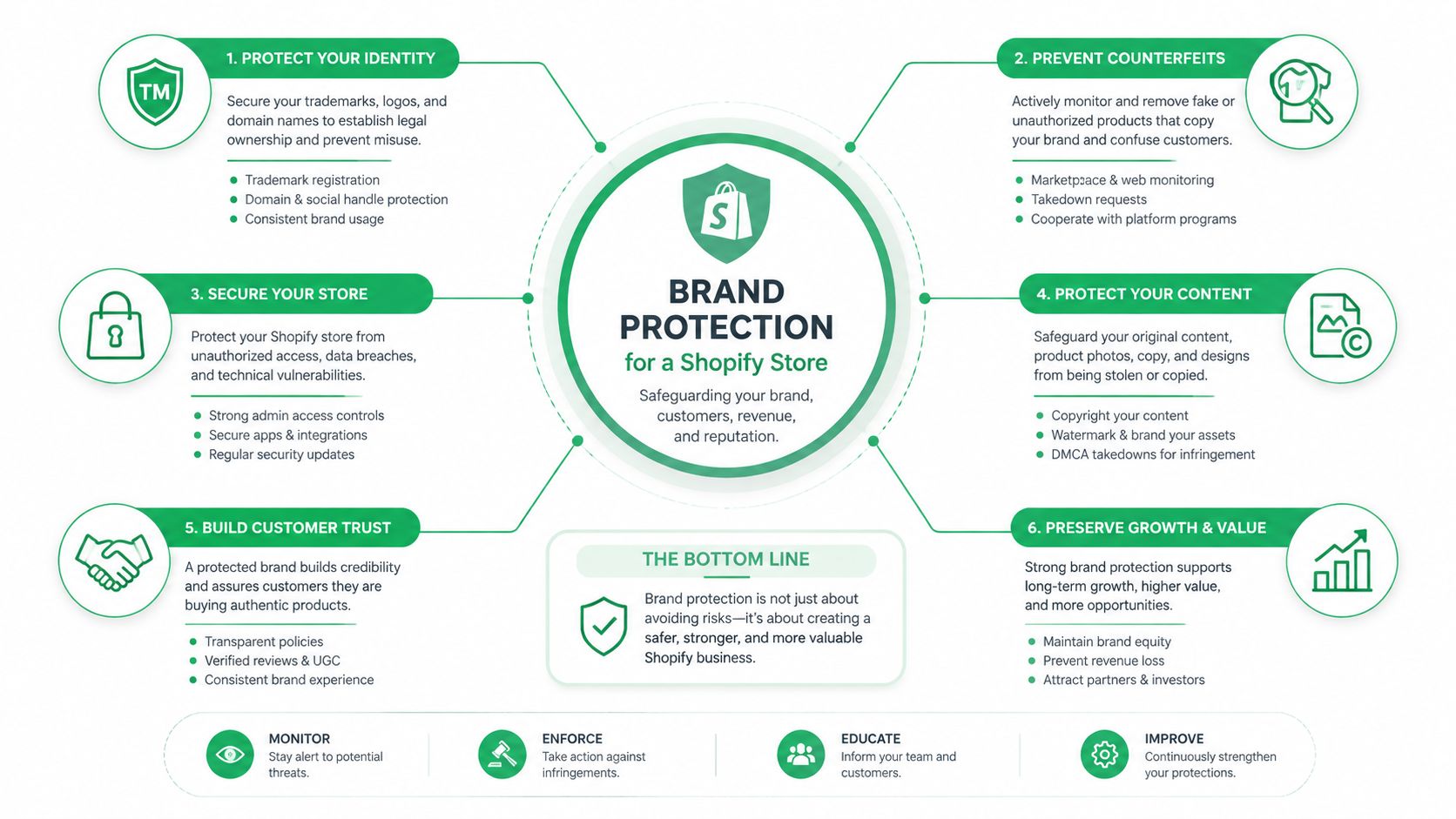
Three control types
Preventive controls make abuse harder. Examples include strong account authentication, limited app permissions, controlled product assets, and domain security.
Detective controls reveal activity that has already started. Marketplace scans, image matching, brand-search listening, review analysis, and DNS monitoring belong here.
Corrective controls remove or contain the abuse. They include marketplace delistings, ad reports, content removals, registrar escalation, and formal domain disputes.
A store needs all three. Prevention alone won't catch a seller who copied your assets before the control existed. Detection without enforcement creates an ever-growing queue. Enforcement without measurement turns into expensive activity with no clear connection to recovered revenue.
The cross-border scale reinforces the need for systems rather than occasional manual searches. Counterfeit and pirated goods represented up to 4.7% of EU imports from the rest of the world in 2021, as noted in the OECD and EUIPO update cited above. For a CFO, the one-sentence explanation is: brand protection is the operating system for reducing sales diversion, customer harm, and unauthorized use of commercial assets.
Teams that want a broader view of how reputation, impersonation, and digital misuse fit together can use this practical guide to modern brand and reputation management as a complementary reference.
The Six Threat Areas Shopify Merchants Face
A useful audit starts with the place where the threat appears, then connects it to the metric that becomes unreliable. The following six categories cover the most common problems a DTC team will encounter around a Shopify storefront.
Counterfeits
A fake product appears on Amazon, TikTok Shop, or another marketplace using your name, photos, or product identifiers. Support usually finds it first through a customer complaint, while marketplace operations may find it through search monitoring. The commercial symptoms include diverted conversions, counterfeit-related refunds, and negative reviews attached to an offer customers associate with your brand.
IP infringement
Another seller copies your product photography, description, packaging design, or campaign language. Paid media and creative teams often notice this when a copied asset appears in an ad, but merchandising may find it through reverse-image searches. The distortion is harder to isolate, because copied assets can reduce the distinctiveness of your offer and weaken paid traffic efficiency.
Unauthorized resellers
A reseller may acquire genuine inventory through an unapproved channel and list it outside your pricing or territory rules. Unlike a counterfeit seller, this party may hold authentic stock, which makes blanket enforcement risky. Channel operations should compare the seller, source, pricing, and agreement status before acting. The P&L pressure usually lands on margin and channel performance.
Trademark abuse
A lookalike brand name, logo, social handle, or support account can make customers believe they're dealing with your company. Customer service and social teams often see this first when shoppers ask whether an account or promotion is genuine. The resulting costs can include diverted sales, fraud complaints, and a higher support burden.
Review fraud
Fake positive reviews can make an unauthorized offer appear credible. Review bombing can also damage a legitimate product after a counterfeit incident or a coordinated dispute. CX teams should compare review timing, language patterns, product references, and complaint themes. The key metric is trust, reflected through conversion behavior, refund requests, and customer sentiment.
Domain squatting
A misspelled or lookalike domain may redirect visitors, imitate your Shopify theme, collect payment information, or host a fake support page. Security or IT may detect the domain, but marketing and support often see the damage first through confused customers. The effect can include lost branded traffic, fraudulent orders, and customer-data exposure.
The important distinction is that these categories overlap without being interchangeable. A counterfeit listing needs marketplace evidence. A cloned storefront needs page, domain, and hosting evidence. An unauthorized reseller requires channel validation, not an automatic infringement claim. That classification determines whether the next step belongs to operations, security, legal, or a shared incident team.
Detecting Threats Before They Drain Revenue
Detection should run on a cadence, not begin after a customer sends a screenshot. A small operations team can start with a watchlist containing brand names, product names, common misspellings, approved domains, official social handles, product images, and known reseller identifiers. The watchlist becomes the input for automated tools, marketplace registries, search checks, and security monitoring.
The first layer is marketplace visibility. Scan Amazon, eBay, TikTok Shop, Walmart, and the marketplaces that matter to your customers for product titles, images, seller names, and unusual pricing. A platform can identify text matches, but image matching often catches a listing whose seller has rewritten the copy. Human review still matters because automation can confuse a legitimate reseller, a used product, and a counterfeit.
A workable monitoring rhythm
- Daily checks: Review brand-search alerts, paid social mentions, high-risk support tickets, and urgent domain or certificate alerts.
- Weekly scans: Run marketplace searches, reverse-image checks, social-account reviews, and review-pattern analysis. Record each finding in a case queue with screenshots and URLs.
- Launch checks: Search every new product name, image set, and campaign phrase after launch. New demand creates new opportunities for copying.
- Viral-moment checks: Increase monitoring as soon as a product or campaign starts spreading. The response window is shorter than a normal weekly cycle.
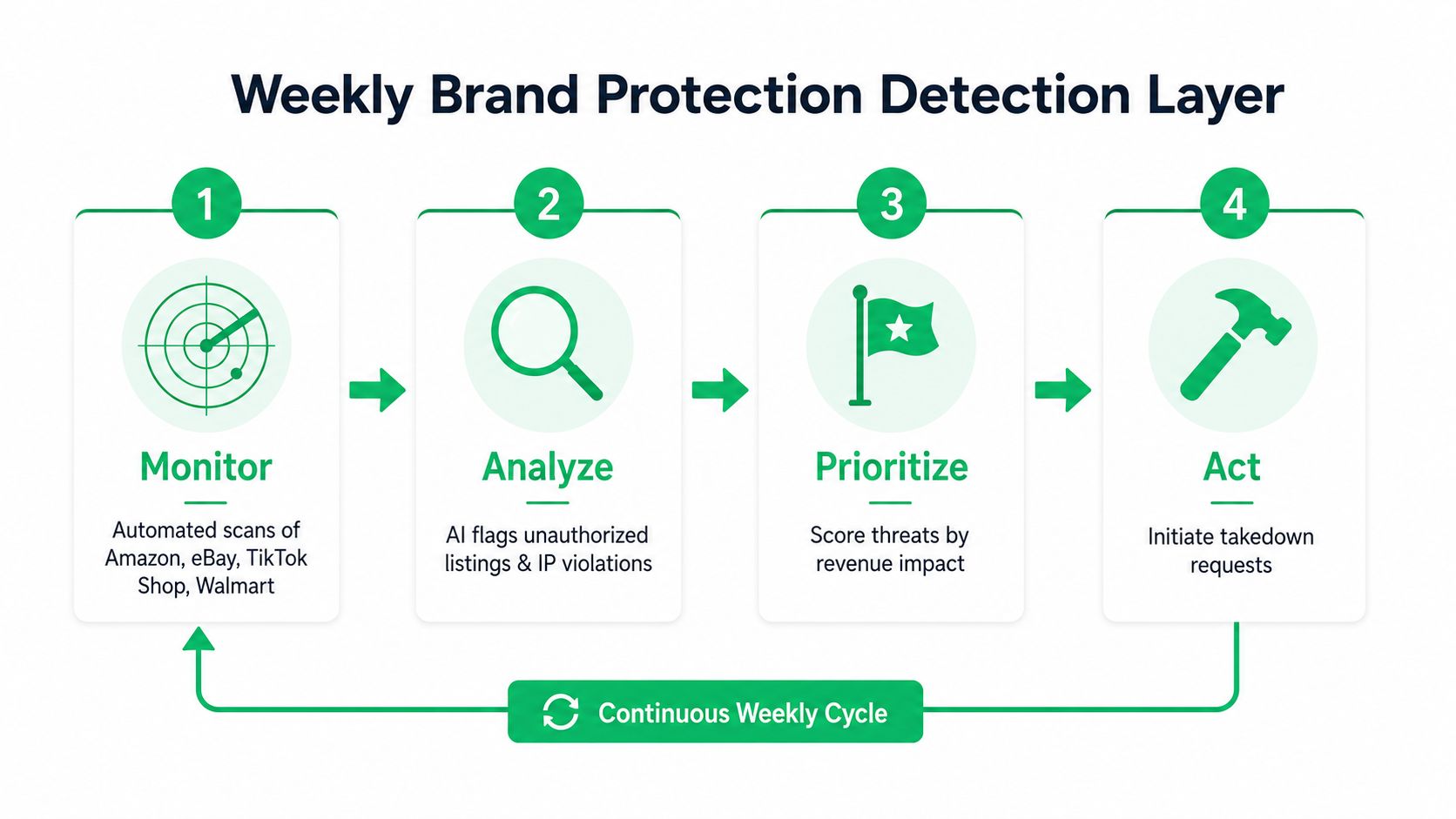
The timing pressure is documented in the 2026 industry report: 57% of brands spotted fakes within one week of a viral moment, while 24% spotted them within 24 to 48 hours (2026 Brand Integrity Report). That finding supports a practical change in workflow. A viral launch shouldn't wait for the next monthly legal sweep.
DNS and certificate monitoring cover a different blind spot. Watch for domains that resemble your brand, unexpected certificate issuance, and changes that could support a cloned storefront or spoofed email flow. DMARC reporting can expose attempts to send email that appears to come from your domain, while DNSSEC and continuous change monitoring help identify unwanted changes to records.
Review analysis needs context. A sudden cluster of complaints about product quality may indicate a counterfeit offer, while repetitive praise on an unfamiliar listing may indicate manipulated reviews. Connect the signal to Shopify data by tagging support conversations, matching product names, and comparing refund reasons. For practical account and storefront hygiene, use these security tips every Shopify merchant should know.
Prevention Controls Built Into the Shopify Stack
The least expensive counterfeit case is the one that never gets traction. Prevention won't eliminate external abuse, but it can reduce the material that gets copied, limit access to sensitive systems, and make a fake experience easier to distinguish from the genuine store.
Start inside Shopify. Keep product titles, descriptions, and image files organized so the team knows which assets are authoritative. Add subtle, brand-consistent identifiers to photography where appropriate, and retain original files with creation dates and usage records. Watermarks aren't a complete defense, because a determined seller can crop or remove them, but they can make casual scraping easier to identify.
Theme structure can also create useful separation. Use controlled theme variables, distinctive copy blocks, and approved content sections rather than leaving every page assembled from generic templates. This won't stop a scraper from cloning the visible page, but it can help your team prove which content was copied and spot a false storefront that reproduces outdated or inconsistent details.
Reduce access and fulfillment abuse
Audit every Shopify app and integration. Remove unused connections, limit staff permissions, require strong authentication, and check whether an app can access customer, order, or product data beyond its job. A compromised app integration can expose information that later supports convincing impersonation or fraudulent support activity. This permission-based access control guide provides useful context for designing those boundaries.
Post-purchase controls matter too. Address validation can catch malformed or undeliverable addresses before fulfillment, reducing avoidable delivery disputes. It won't identify a counterfeit listing on another marketplace, but it can reduce operational noise that makes genuine counterfeit complaints harder to investigate.
Protect the domain perimeter separately from Shopify theme settings. Security specialists recommend two-factor authentication for registrar and DNS accounts, DNSSEC for record integrity, DMARC to reduce email spoofing, CAA records to restrict certificate issuance, and continuous DNS change monitoring (domain security recommendations). Assign an owner for each control and store recovery details securely. A control nobody monitors becomes a false sense of safety.
Finally, publish a clear list of official domains, support channels, and marketplace stores. Customers can only distinguish the authentic channel from an impersonator if the brand gives them a reliable reference point.
Enforcement and Escalation Paths That Actually Close Cases
Enforcement fails when every incident receives the same response. A copied product image, a fake support domain, and a repeat counterfeit seller may involve the same brand, but they need different evidence, owners, and escalation routes.
| Enforcement layer | Best use | Primary owner | Evidence |
|---|---|---|---|
| Primary | High-volume listings, ads, and copied content | Marketplace operations or marketing | URLs, screenshots, rights documentation |
| Secondary | Repeat domains, payment abuse, and persistent sellers | Security, operations, or legal | Domain records, transaction evidence, prior notices |
| Tertiary | Disputed identity, recurring networks, or material harm | Legal and external counsel | Test purchases, chain of custody, trademark records |
Primary actions should handle clear, platform-native abuse first. Submit marketplace brand-registry reports, report copied advertisements, and request content removals from social platforms or hosts. Use a standard evidence packet with the exact URL, seller identity, screenshots, product comparison, ownership records, and a concise explanation of the customer risk. Operations can manage volume, while legal reviews ambiguous claims.
Secondary actions apply when the seller or infrastructure keeps returning. Escalate the domain to the registrar, report payment abuse to the relevant provider, and connect related listings through shared imagery, contact details, or fulfillment clues. The aim is to disrupt the operating layer rather than remove one visible page.
Tertiary actions are slower and more deliberate. UDRP or URS disputes can address abusive domains, while test purchases can establish what the seller ships. Customs coordination and civil litigation may be appropriate when the evidence shows a serious, recurring threat. Before seeking relief, preserve the page, receipt, communications, packaging, and product condition.
Trademark strategy supports this ladder. Merchants expanding across channels can review practical guidance on how to trademark a brand name for omnichannel growth, then keep registration documents ready for platform reports.
AI-generated impersonation makes ownership more complicated. A 2026 fraud study found that only 7% of anti-fraud professionals felt their organizations were more than moderately prepared to detect or prevent AI-fueled fraud, while deepfake social engineering increased for 77% of respondents and GenAI document fraud or forgery increased for 75% (ACFE and SAS study). Assign a fraud-response owner who can coordinate with support, security, legal, and social teams. Customer-data handling also belongs in the playbook, so teams should review customer data protection practices before collecting test-order evidence.
Measuring the Program With Revenue and Trust Metrics
A takedown count is activity, not proof of value. Shopify teams need a scorecard that connects each enforcement event to the customer and financial outcome it was meant to protect.
Track infringing listings removed by marketplace, time to takedown by threat type, and repeat-offender rate. Separate counterfeit removals from copied creative, fake accounts, and domains because each has a different owner and response path. A high removal volume with a high repeat rate may indicate that the team is treating symptoms rather than disrupting the seller network.
Build the commercial view
Compare branded traffic that converts on your Shopify store with branded demand that lands on unauthorized channels. Review refund and chargeback reasons for counterfeit complaints, then tag related support conversations so the cost of customer recovery is visible. If a takedown removes a competing fake offer, compare the relevant product's conversion, refund pattern, and paid-media efficiency before and after the action, while controlling for promotions and stock availability.
Trust metrics complete the picture. Watch review sentiment, NPS movement, complaint themes, and questions about official sellers or support channels. A customer who receives the genuine item may still lose confidence if they had to deal with a confusing marketplace or fake account first.
Report the scorecard in a quarterly business review with three lines of interpretation:
- Revenue protected: Sales recovered or leakage reduced after a documented intervention.
- Customer trust protected: Changes in complaints, refunds, reviews, and sentiment.
- Operating efficiency: Detection coverage, response time, evidence quality, and repeat-case reduction.
Leadership doesn't need a legal activity log. It needs a view of what was found, what was removed, what customers experienced, and where the next investment will reduce exposure.
Treating Brand Protection as a Quarterly Operating Loop
A one-time sweep creates a clean report and an outdated threat model. Product launches, new marketplaces, influencer campaigns, international expansion, and viral moments all change the places where customers can encounter the brand.
Run the program as a quarterly loop. During the first phase, establish the detection baseline and harden the Shopify, app, account, email, and domain perimeter. During the next phase, clear the enforcement backlog, validate reseller agreements, and document repeat offenders. In the final phase, review revenue and trust metrics, then refresh the threat model against the next launch calendar.
A practical quarter can follow this rhythm:
- Weeks 1 through 4: Inventory official brand assets, domains, channels, and approved sellers. Start recurring marketplace, search, social, review, and DNS monitoring.
- Weeks 5 through 8: Prioritize cases by customer and P&L impact. Submit platform reports, escalate repeat infrastructure, and test whether reseller rules are clear enough to enforce.
- Weeks 9 through 12: Compare detection and takedown performance with revenue, refund, support, and trust indicators. Update owners, evidence templates, and launch-specific watchlists.
The projected direction of the market makes this operating discipline more important. Global trade in counterfeit goods is projected to reach $1.79 trillion by 2030, with counterfeits forecast to rise from 3.3% of world trade in 2023 to 5% by 2030, according to Corsearch's projection. The same source characterizes that growth as 3.6 times faster than global economic growth over the period. These are projections, not current outcomes, but they make a one-off legal cleanup an inadequate operating model.
Brand protection should sit beside merchandising, CX, fraud, and channel operations. On Shopify, the strongest program looks less like a distant legal function and more like the operating twin of customer experience. It protects the promise made on the product page, carries that promise through checkout and fulfillment, and removes the alternatives that make customers doubt what they bought.
SelfServe helps Shopify and Shopify Plus teams reduce post-purchase support friction with controlled order edits, multilingual customer workflows, address validation, permissions, and operational approvals. Visit SelfServe to see how a cleaner post-purchase experience can support the trust and revenue controls in your brand protection program.