Dedicated Account Management for Ecommerce Brands
The problem usually shows up on a bad day.
Your returns tool stops syncing during a promotion. Orders are flowing, customer messages are piling up, and your support lead is forwarding screenshots into Slack faster than anyone can answer them. You open a ticket with the vendor, get an automated reply, then spend the next hour explaining your setup to someone who has never seen your storefront, your warehouse rules, or your post-purchase workflow.
That's when most ecommerce operators realize they don't just need software. They need dedicated account management.
For an operations team, this isn't a vague “premium support” add-on. It's a working relationship with a vendor contact who understands your business well enough to prevent avoidable disruption, coordinate internal teams on your behalf, and help your store get more value from the platform after implementation.
One clarification matters because search results often muddy the term. A lot of online content about dedicated account management refers to the Social Security Administration's separate-account rules for child SSI, where funds must be kept apart, used only for disability-related expenses, and not mixed with other money, as described in the SSA representative payee guidance. That's a real and specific legal concept, but it's not what ecommerce teams mean when they ask whether a vendor offers a dedicated account manager.
If you're trying to reduce operational drag after checkout, improve escalations, or stop repeating the same support story every month, you're in the business sense of the term. And if your current vendor relationship still feels like a queue instead of a partnership, it's worth reviewing how strong teams solve customer service problems before those issues spill into the post-purchase experience.
Your Strategic Partner in a Sea of Support Tickets
When a vendor issue hits the post-purchase flow, the damage spreads fast. Customers can't update addresses, warehouse exceptions stack up, and support agents start handling tasks that should've stayed automated. The immediate cost isn't just ticket volume. It's the hours your team loses coordinating between CX, ops, and the vendor.
A dedicated account manager changes that motion. Instead of starting from zero every time something breaks, you have a named person who already knows your order rules, your approval paths, and the operational edge cases that matter to your store.
What changes in practice
A standard support model is built for intake. It's good at collecting issues, assigning priority, and moving requests through a queue. That works fine for simple questions.
It breaks down when your team needs context, internal advocacy, and cross-functional coordination.
A strong dedicated account manager does three things that generic support usually doesn't:
- Holds business context: They know which workflows matter most to your team, such as order edits, fraud review handoffs, or warehouse timing constraints.
- Owns internal routing: They don't just say “engineering is looking at it.” They pull in product, implementation, or technical teams and keep the thread moving.
- Flags risk early: They notice usage patterns, recurring friction, or rollout gaps before they become another fire drill.
Don't pay for a dedicated contact who only forwards tickets. Pay for someone who can translate store operations into vendor action.
Why this matters after checkout
Post-purchase operations are where vendor quality becomes visible. Customers notice when an address can't be fixed, when an add-on doesn't attach correctly, or when a cancellation request falls into a dead end. Your team notices when every exception turns into manual work.
That's why the dedicated account management model matters more in ecommerce than many teams expect. The store doesn't need another friendly check-in. It needs a partner who can reduce avoidable work, tighten service continuity, and make sure your vendor stack behaves like part of your operating system.
What Is Dedicated Account Management in Ecommerce
The simplest way to define it is this. Dedicated account management is a high-touch service model where a vendor assigns a specific person, or sometimes a small pod, to a limited set of important customers. For an ecommerce brand, that person acts less like a help desk rep and more like a concierge who knows your setup, goals, constraints, and internal team.
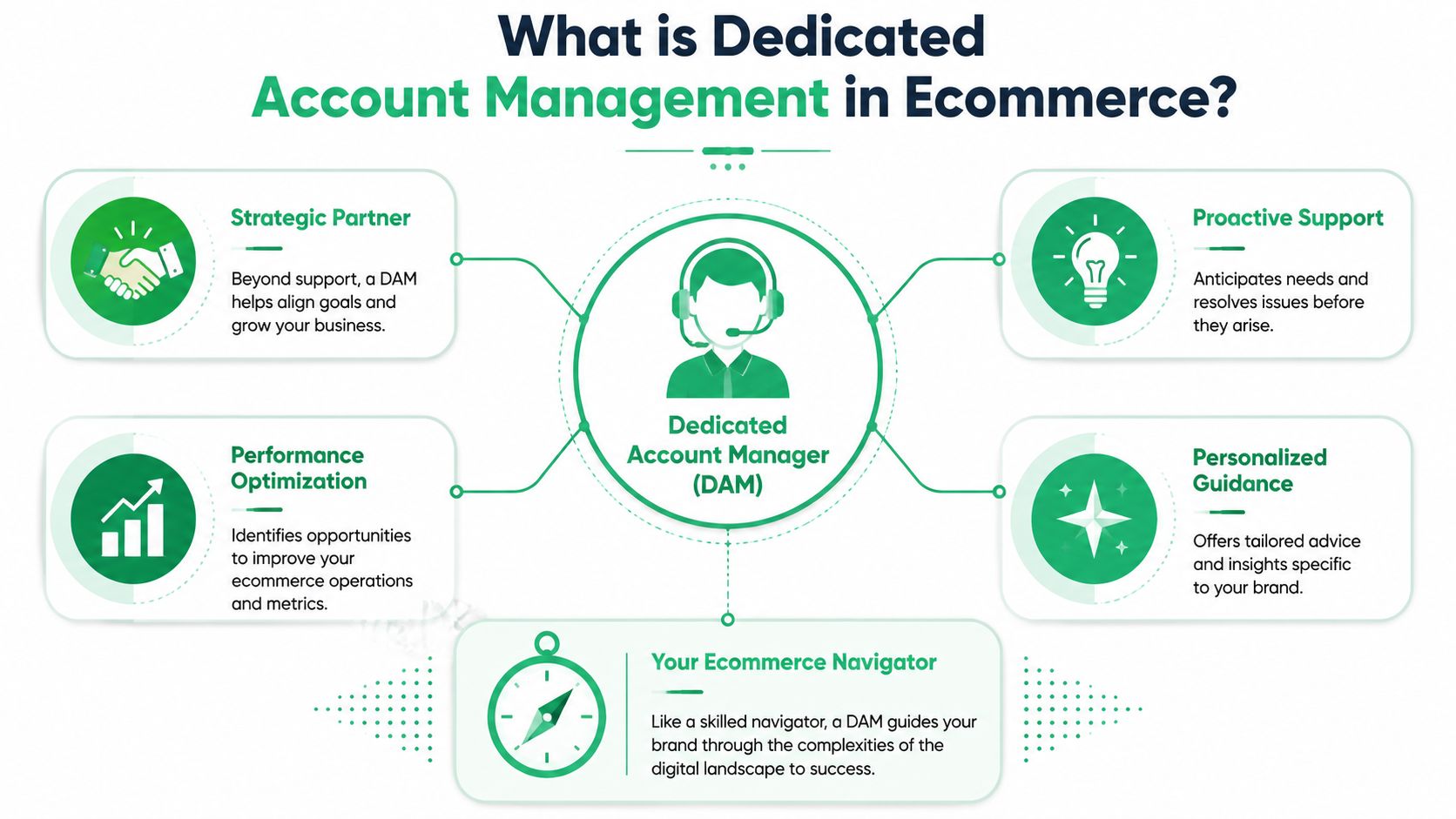
Why vendors offer it
This model exists because vendors don't treat every account the same. In most enterprise B2B businesses, the top 10 to 20% of accounts generate 60 to 80% of total revenue, so companies put deeper coverage on a smaller set of strategic customers rather than spreading the same service level across everyone, according to ARPEDIO's guide to account management.
That's also why portfolio size matters. The same source notes that key account managers often carry 10 to 30 accounts, while a general account manager may carry 50 to 100. In practical terms, fewer accounts means more time for planning, stakeholder mapping, cadence management, and problem prevention.
For ecommerce operators, that difference is obvious. If your vendor contact manages too many accounts, you'll only hear from them when renewal season shows up or when you push hard enough to get attention.
What it is not
A dedicated account manager is not just:
- A support alias with a face on it: If every issue still goes into the same queue with the same response pattern, the title doesn't matter.
- A pure customer success role: Customer success often focuses on onboarding and adoption. Dedicated account management should also include operational alignment, escalation ownership, and growth planning.
- A sales overlay: If the person only appears to upsell, they're not managing the account. They're prospecting inside it.
What good dedicated coverage looks like
The best version feels like having an external operator who knows the product better than you do and your business almost as well as your own team.
You should expect them to understand:
| Area | What the DAM should know |
|---|---|
| Store operations | Your shipping cutoffs, order edit policies, return constraints, and approval logic |
| Team structure | Who owns CX, who approves changes, who handles fulfillment, who needs reporting |
| Commercial goals | Whether the priority is support deflection, cleaner handoff to the 3PL, or post-purchase revenue |
| Risk profile | Which workflows can't fail during launches, promos, or peak periods |
Working definition: In ecommerce, dedicated account management means your vendor assigns real attention, not just a familiar name.
The Business and Operational Benefits of a DAM
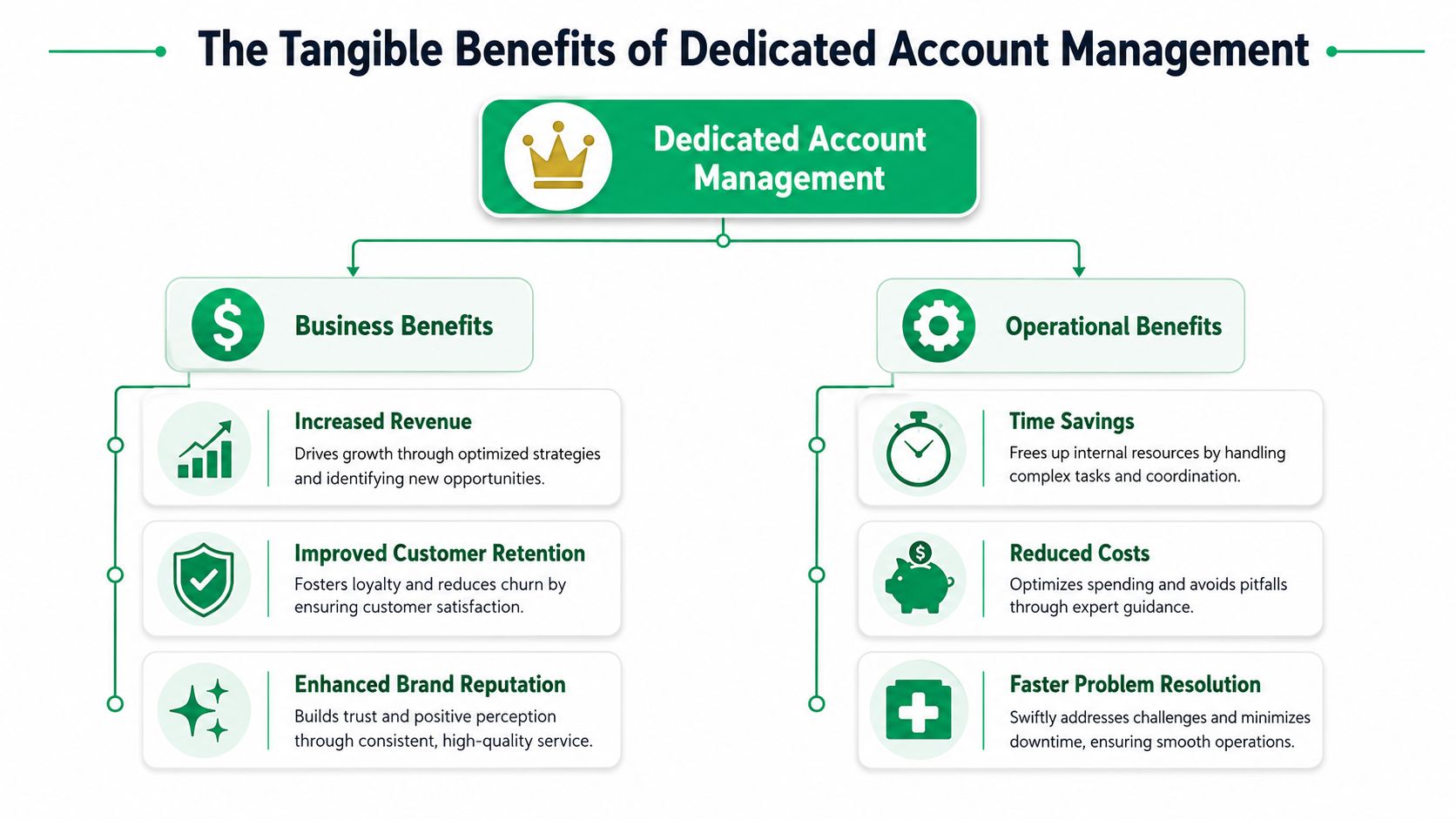
A dedicated account manager earns their keep in three places. They reduce support burden, accelerate escalation, and help your team turn underused product features into operational or commercial gains.
The strategic logic is clear. A 2023 marketing analysis cited by Linear Design says 69% of B2B customers are ready to take their business elsewhere if their experience doesn't meet expectations, which helps explain why vendors use high-touch account coverage to protect and grow important relationships, as outlined in Linear Design's dedicated account manager overview.
Less support drag on your internal team
Most ecommerce teams don't buy a premium vendor tier because they want nicer meetings. They buy it because repetitive friction is expensive.
When your vendor contact understands your workflows, your team spends less time re-explaining known issues, reproducing edge cases, and chasing ownership. That lowers the hidden cost of using the tool.
Common wins look like this:
- Fewer repeated explanations: Your ops lead doesn't have to rewrite the same store rules for each new ticket.
- Better triage: The vendor sees whether a problem is configuration, training, product limitation, or a real defect.
- Cleaner handoff to support: Frontline CX can escalate with a known playbook instead of improvising every time.
Faster escalation when the issue is urgent
This is usually the most obvious value.
When a rule fails in production, you don't want to prove urgency to a queue. You want someone who can take the issue, add technical context, and route it directly to the right internal team. The difference isn't cosmetic. It changes how long your store operates in a degraded state.
Here's the practical test. Ask yourself whether your current vendor contact can do all three of these in a single thread:
- summarize the issue accurately,
- identify the likely internal owner,
- keep your team updated without forcing you to chase them.
If not, you don't have meaningful dedicated coverage.
A useful benchmark is whether your team trusts that contact enough to notify them before the issue gets severe. That's the point where the relationship starts saving time instead of merely responding to damage.
Later in the buying process, this short video is useful if you want a broader look at the role and how vendors position it:
More value from the platform you already pay for
The strongest account managers don't stop at service recovery. They help you use more of the product in ways that matter.
That might mean refining post-purchase offers, tightening configuration rules, spotting unused automation, or suggesting a process change that removes manual approvals. The result is usually simple. Your team extracts more value from software you already bought, instead of adding another tool to cover for weak implementation.
A vendor becomes strategic when they help you remove work, not just answer questions about the work.
What a DAM Service Actually Includes
“Dedicated account management” sounds useful, but the term is broad enough that vendors can hide weak service behind it. Don't buy the label. Buy the operating model.
A real service package should define who owns the relationship, how they work with your team, what cadence they maintain, and what service commitments back it up. If those points are fuzzy, the vendor is selling reassurance, not coverage.
Core deliverables you should expect
At minimum, a serious DAM service should include a named owner and a predictable operating rhythm. For most ecommerce brands, that means a combination of strategic review, operational monitoring, and direct access.
Look for these components:
- Named account lead: One person who owns continuity and knows your account history.
- Regular review cadence: Scheduled business reviews or operational check-ins that focus on open risks, product usage, and upcoming changes.
- Issue coordination: The DAM handles internal follow-through when bugs, implementation gaps, or urgent requests show up.
- Performance visibility: Reporting that translates account activity into actions, not just screenshots of dashboards.
- Change planning: Support when your team launches a new workflow, enters a new market, or adjusts fulfillment logic.
Direct channels matter
The service is stronger when the contact path is explicit. That can be a direct email, Slack channel, shared workspace, or another agreed route that bypasses “submit a ticket and wait.”
This isn't about convenience alone. It's about preserving context. When the same person sees your requests over time, they can spot patterns and connect incidents that a general queue would treat as unrelated.
A good question to ask is: what kinds of requests should go through the DAM, and what still belongs in standard support? Good vendors answer that clearly.
What to lock down in the SLA
If the vendor includes service level commitments, read them carefully. “Priority support” can mean almost anything.
You want to understand:
| SLA area | What to ask |
|---|---|
| Response expectation | How quickly will the DAM acknowledge urgent, high-impact issues |
| Escalation path | What happens if the DAM is unavailable or the issue needs engineering |
| Resolution ownership | Who drives the problem to completion, not just first response |
| Review cadence | How often you'll meet, what gets reviewed, and who attends |
| Change support | Whether complex reconfiguration or rollout planning is included |
If a vendor can't explain the boundary between support, customer success, and dedicated account management, expect confusion once the contract is signed.
What doesn't work
Three patterns usually disappoint ecommerce teams.
First, the “named rep” who has no authority inside the vendor. Second, the quarterly business review that turns into a renewal conversation. Third, the account manager who only appears after your team escalates repeatedly.
A DAM service justifies its cost when it improves execution week to week. If the relationship only becomes visible during contract events or outages, it's too thin.
How a DAM Integrates with Your Post-Purchase Stack
The best account managers sit above the software layer and help your systems behave like one workflow. That's especially important after checkout, where order edits, upsells, fulfillment logic, warehouse timing, and support handoffs all collide.
For ecommerce ops, the post-purchase stack is rarely one tool. It's a chain of systems with edge cases between them. A dedicated account manager adds value by understanding those handoffs well enough to reduce friction across the stack, not just inside a single app.
Where the relationship becomes operational
Take a common post-purchase setup. A customer places an order, wants to change a shipping address, adds a product after checkout, and triggers warehouse logic that depends on timing and order state. The software can support that flow, but only if the rules are configured correctly and exceptions are handled cleanly.
A good DAM helps with questions like these:
- Edit windows: How long should customers be allowed to update shipping details before fulfillment risk increases?
- Upsell rules: Which products belong on the thank-you page versus the order-status page?
- Restriction logic: Which SKUs, shipping methods, or order tags should block self-service changes?
- Approval flow: Which changes should process automatically, and which should route to manual review?
Those aren't generic support questions. They sit at the intersection of CX, fulfillment, margin, and platform behavior.
For teams reviewing the category, it helps to compare vendors that focus on the post-purchase experience platform layer rather than treating post-purchase as a minor app feature.
Human judgment on top of automation
Dedicated account management becomes useful instead of ceremonial when the DAM can look at your support themes, launch calendar, and tool constraints together, then recommend practical adjustments.
Examples include:
- changing how order edits interact with fulfillment timing,
- refining which add-on offers appear for certain order types,
- helping the team document exception handling for customer support,
- coordinating with implementation resources when a workflow needs custom setup.
If your post-purchase operation extends beyond Shopify-native behavior, that coordination gets even more important. Some brands also pair this layer with outside purchasing or sourcing workflows. In those cases, a technical reference like Zinc's guide to programmable Amazon purchases can be useful when your team is mapping how external buying actions connect back to customer-facing operations.
What good integration support feels like
It feels specific.
Your DAM should know which operational metrics matter to your team, where manual work still enters the process, and which exceptions are acceptable versus costly. They should be able to talk to your support lead one minute and your implementation contact the next without losing the thread.
The value isn't that the account manager knows the product. It's that they know how your team uses the product under real operating pressure.
How to Evaluate Vendors and Measure DAM ROI
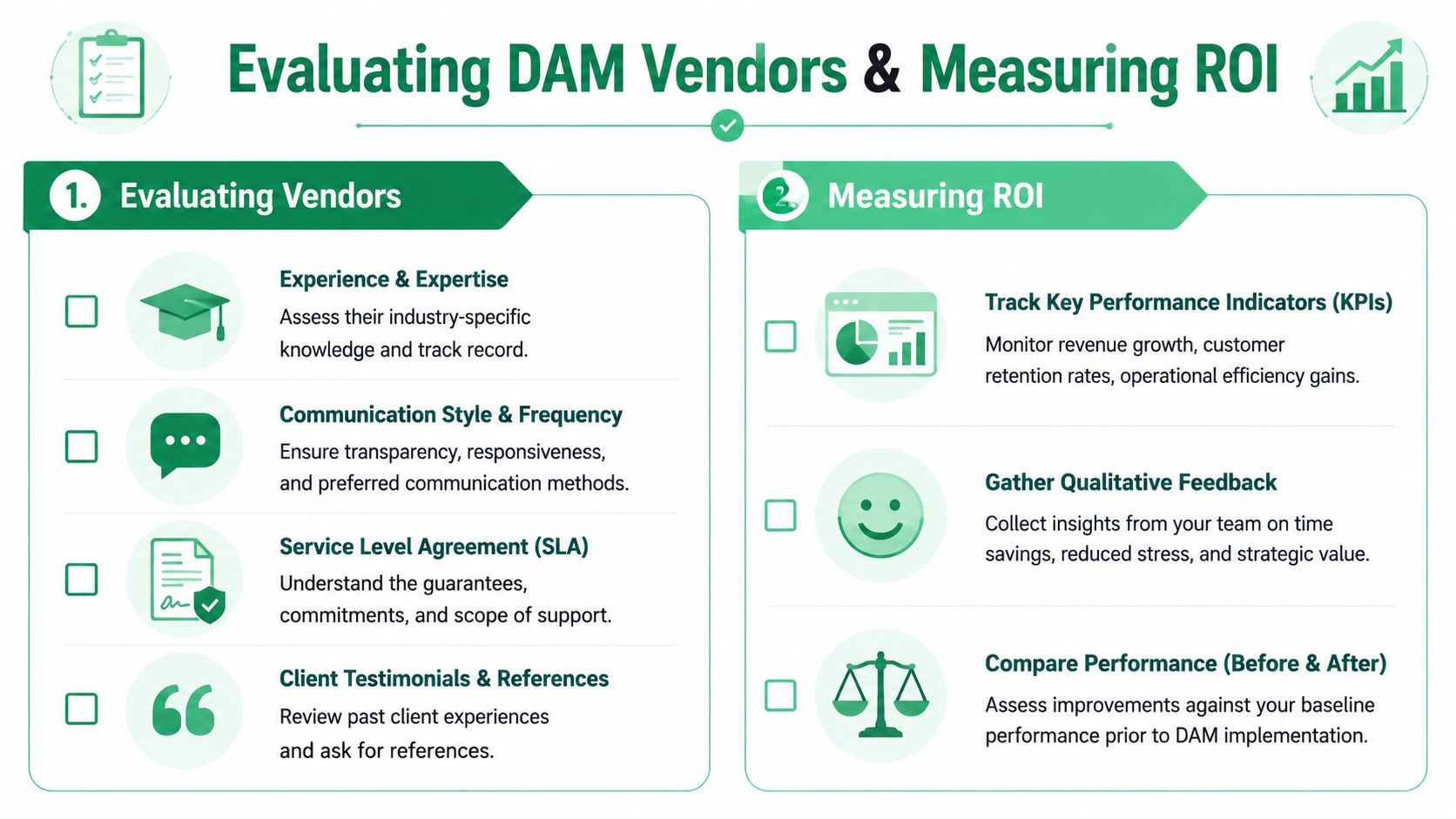
A dedicated account manager is easy to like and hard to evaluate unless you define success before the contract starts. The cleanest approach is to assess the vendor in two layers. First, determine whether the service model is credible. Then decide whether it produces measurable operational value for your store.
What to ask before you buy
Strong account management relies on instrumentation, not memory. SaaS guidance from Custify recommends capturing customer health and operational datapoints in dashboards, segmenting customers by pain points and communication preferences, and triggering alerts when automation assigns or reassigns account segments. That structure matters because account managers often sit across onboarding, implementation, change management, and issue resolution, as explained in Custify's SaaS account management guidance.
That means your vendor should be able to explain exactly what signals they watch and how those signals trigger action.
Here's a practical checklist.
| Category | Question to Ask |
|---|---|
| Ownership | Who is my day-to-day contact, and who covers the account when they're out? |
| Portfolio | How many accounts does that person manage right now? |
| Escalation | What can they escalate directly, and what still goes through normal support? |
| Cadence | How often do we meet, what gets reviewed, and who should attend from our side? |
| Reporting | Which operational and customer-health metrics do you monitor for this account? |
| Implementation | Will the DAM help with workflow changes, or only discuss them? |
| Communication | Which channel is used for urgent issues versus routine planning? |
| Success definition | How do you define success for the account over the next two quarters? |
A similar principle applies when hiring other specialist partners. If you've ever used a framework for agency vetting, this DTC brand email agency selection guide is a good model for the kind of operational questions worth asking before you sign.
How to measure ROI without forcing fake precision
You don't need a perfect financial model on day one. You do need a baseline.
Track before-and-after movement in areas the DAM can influence:
- Support burden: Are post-purchase tickets, internal escalations, or repeat issue reports moving down?
- Time to action: Are urgent vendor issues getting triaged and routed faster?
- Workflow stability: Are fewer exceptions falling into manual cleanup?
- Feature adoption: Is your team using more of the product in a way that removes work or improves commercial outcomes?
- Internal confidence: Do CX and ops know exactly where to go when something needs vendor involvement?
What good ROI usually looks like
It often shows up first as cleaner operations, not a dramatic headline metric. Your team spends less time herding the vendor. Rollouts have fewer surprises. Review meetings produce decisions instead of status updates. The relationship gets calmer because ownership is clearer.
If you're evaluating vendor tools more broadly alongside service quality, a category review like this guide to the best apps for Shopify can help frame whether the DAM is attached to a platform your team will use extensively enough to justify the extra layer.
The important part is discipline. If a vendor claims dedicated account management but can't tie their work to account health, issue handling, configuration progress, or operational continuity, you're paying for availability theater.
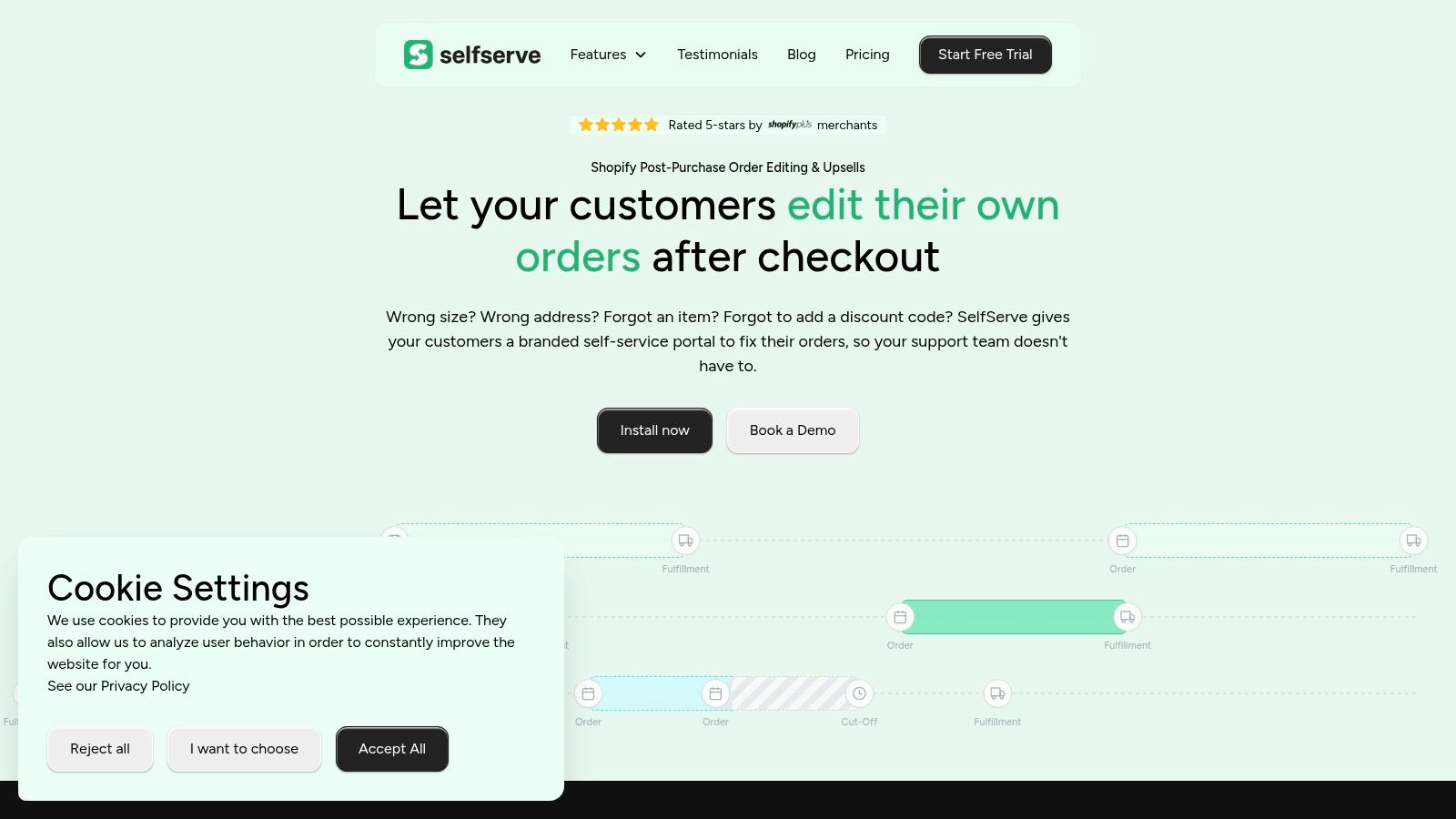
If your team wants fewer post-purchase tickets, smoother order changes, and a vendor partner who can help turn support-heavy workflows into self-service flows, SelfServe is worth a look. It gives Shopify brands practical tools for order editing, multilingual customer self-service, post-purchase upsells, and higher-tier dedicated account management when your operation needs more than a standard support queue.