Ecommerce Customer Retention: The Post-Purchase Playbook
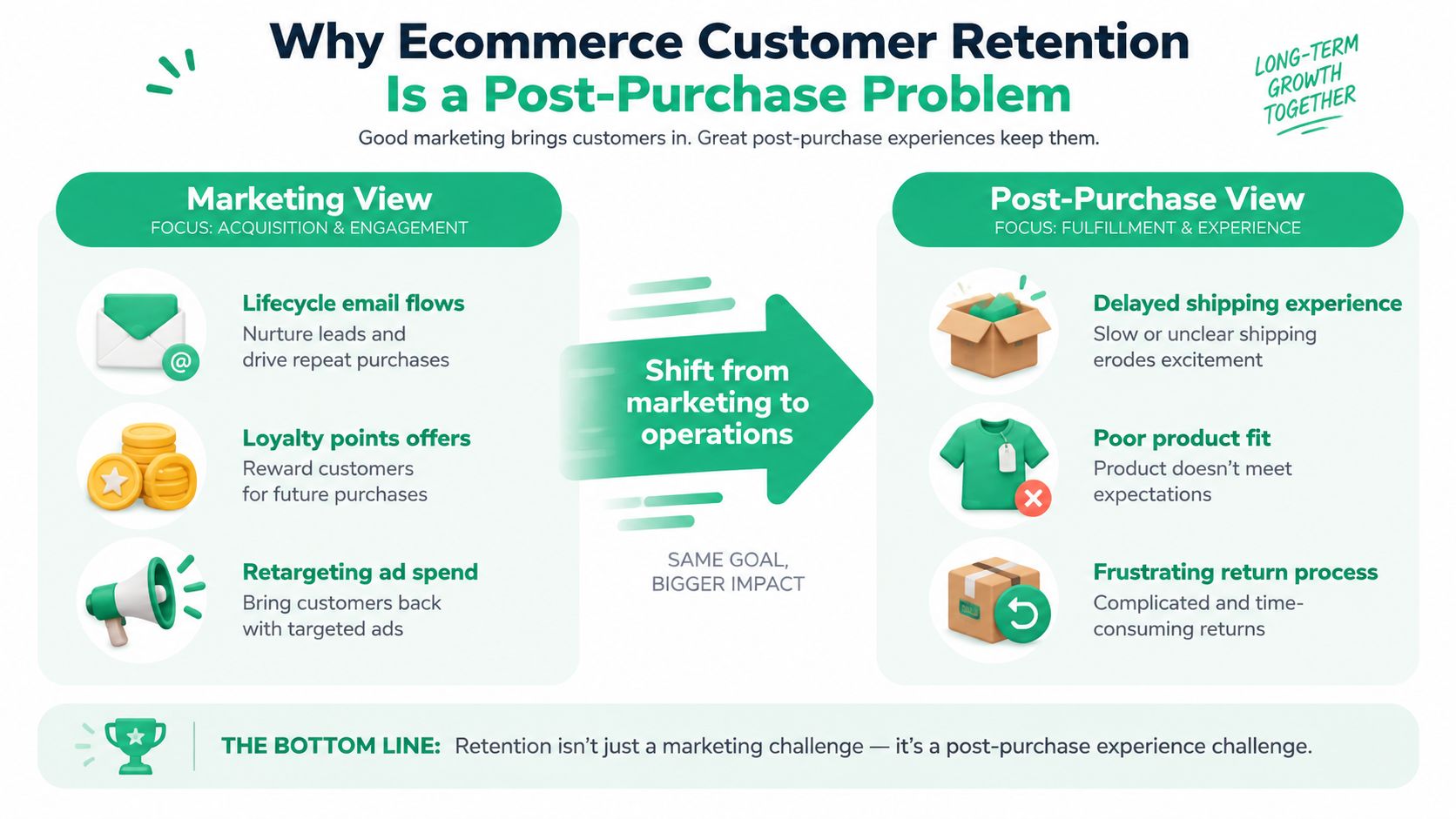
Most ecommerce retention advice starts in the wrong place. It tells you to build more lifecycle emails, add loyalty points, or increase retargeting spend. Those tools can help, but they rarely repair the reason a first-time buyer never places a second order: the package arrived late, the address was wrong, the product didn't match expectations, or getting help became a project.
For Shopify and Shopify Plus operators, ecommerce customer retention is an operational discipline before it's a campaign calendar. The first 90 days after an order create the conditions for a second purchase. Shipping clarity, easy order changes, responsive support, and a return process that preserves trust often matter more than another discount sequence.
The benchmark explains why this deserves attention. Average online retail retention is commonly reported at about 30% to 31%, with broader summaries placing typical ecommerce results around 28% to 38%, depending on category and measurement window, according to LoyaltyLion's customer retention benchmark. Repeat purchase behavior varies sharply by product type, so operators need to diagnose their own customer journey instead of copying a generic loyalty playbook.
Why Ecommerce Customer Retention Is a Post-Purchase Problem
Marketing teams often inherit retention because email, SMS, loyalty, and paid media are visible in the org chart. That ownership can create a narrow definition of the problem. If a customer doesn't return, the default response is another win-back flow, another points reminder, or another offer.
An operator starts earlier. The operator asks whether the buyer could change an address before fulfillment, whether tracking information was accurate, whether the return label was easy to obtain, and whether support could resolve an issue without forcing the customer to repeat the order details. Those moments shape the buyer's judgment of the brand before the next campaign arrives.
The first order is an operating test
The order confirmation page is not the end of conversion. It's the beginning of a period in which the customer is deciding whether the purchase was smart. Silence creates room for buyer's remorse. A vague delivery promise makes every delay feel worse. An incorrect product page turns a reasonable return into a trust failure.
A post-purchase workflow should therefore answer practical questions before the buyer asks them:
- Where is the order? Show useful fulfillment and tracking updates.
- Can I change something? Provide controlled editing windows for shipping details, contact information, or variants.
- What happens if it doesn't work? Make returns, exchanges, and eligibility clear.
- Who can help? Give customers a direct route to support with order context attached.
Research summarized in a study of post-purchase service quality points to returns, shipping, support responsiveness, and issue resolution as direct drivers of satisfaction and repeat purchase behavior. That reframes retention. The email flow may remind a customer to return, but the underlying service experience determines whether the reminder has any credibility.
Practical rule: Don't use a discount to compensate for a process your team could fix.
Incentives work after trust
Loyalty points can encourage a satisfied customer to consolidate purchases. They can't make an unresolved ticket feel resolved. A post-purchase upsell can increase basket value when the first order went smoothly, but it can irritate a buyer who's still waiting for a delayed shipment.
This is why the post-purchase customer experience deserves ownership across operations, support, merchandising, and retention marketing. The most impactful question isn't “Which message should we send next?” It's “What prevented this customer from feeling confident after purchase?”
Core Retention Metrics Every Shopify Operator Should Track
A blended retention number is useful for orientation, but it's weak for diagnosis. A high-volume Shopify store can show a stable overall rate while losing most first-time buyers and relying on a small group of frequent customers to carry the result.
Start with a fixed window and a defined cohort. Benchmark guidance recommends measuring the share of customers with two or more orders across a fixed lookback period, commonly 90 or 365 days, and treating repeat purchase rates below 20% as a warning sign, while 30% or higher is generally strong for non-subscription ecommerce, as outlined by BS&Co's repeat purchase benchmark guidance.
The operator's metric set
| Metric | Formula | Benchmark Range | Key Question It Answers |
|---|---|---|---|
| Retention rate | Retained customers ÷ starting customers, with new customers excluded from the retained count | About 28% to 38% for many online retail measurements | Are existing customers remaining active within the chosen period? |
| Repeat purchase rate | Customers with two or more orders ÷ total customers | 25% to 30% is a common cross-category 12-month median | What share of buyers has crossed the second-order threshold? |
| Churn rate | Customers lost ÷ customers at the start of the period | No universal ecommerce range | Where are customers leaving, and after which event? |
| Customer lifetime value | Average order value × purchase frequency × customer lifespan | Segment-specific, not a single storewide benchmark | Which cohorts justify more service or acquisition investment? |
| Cohort retention | Customers from the same acquisition or first-order cohort who reorder within a fixed window | Compare cohorts rather than use one universal target | Did a change improve behavior for comparable buyers? |
The cross-category repeat purchase benchmark is around 25% to 30%, and one 2026 compilation reports a 28.2% DTC ecommerce average, with top performers above 35%, according to Propel's 2026 retention benchmarks. Treat those figures as orientation, not a target detached from category, buying cycle, and product durability.
Read the metric behind the metric
Repeat purchase rate can rise because customers buy sooner, because a small high-value segment expanded, or because a campaign pulled forward orders that would have happened later. Pair it with time to second purchase, AOV by order number, refund behavior, and support contact history.
Cohort analysis is the most useful diagnostic layer. Break first-time buyers into monthly cohorts, acquisition channels, product families, geography, and fulfillment outcome. Then compare first-to-second-order conversion instead of asking whether “customers” are retained in the abstract.
For teams turning feedback into action, an agency feedback playbook can help structure collection, categorization, and follow-through. Pair qualitative feedback with order and ticket data, then connect recurring complaints to specific operational changes. Your customer satisfaction metrics should explain why a customer feels friction, not only report a score after the fact.
Root Causes of Churn in High-Volume Ecommerce Stores
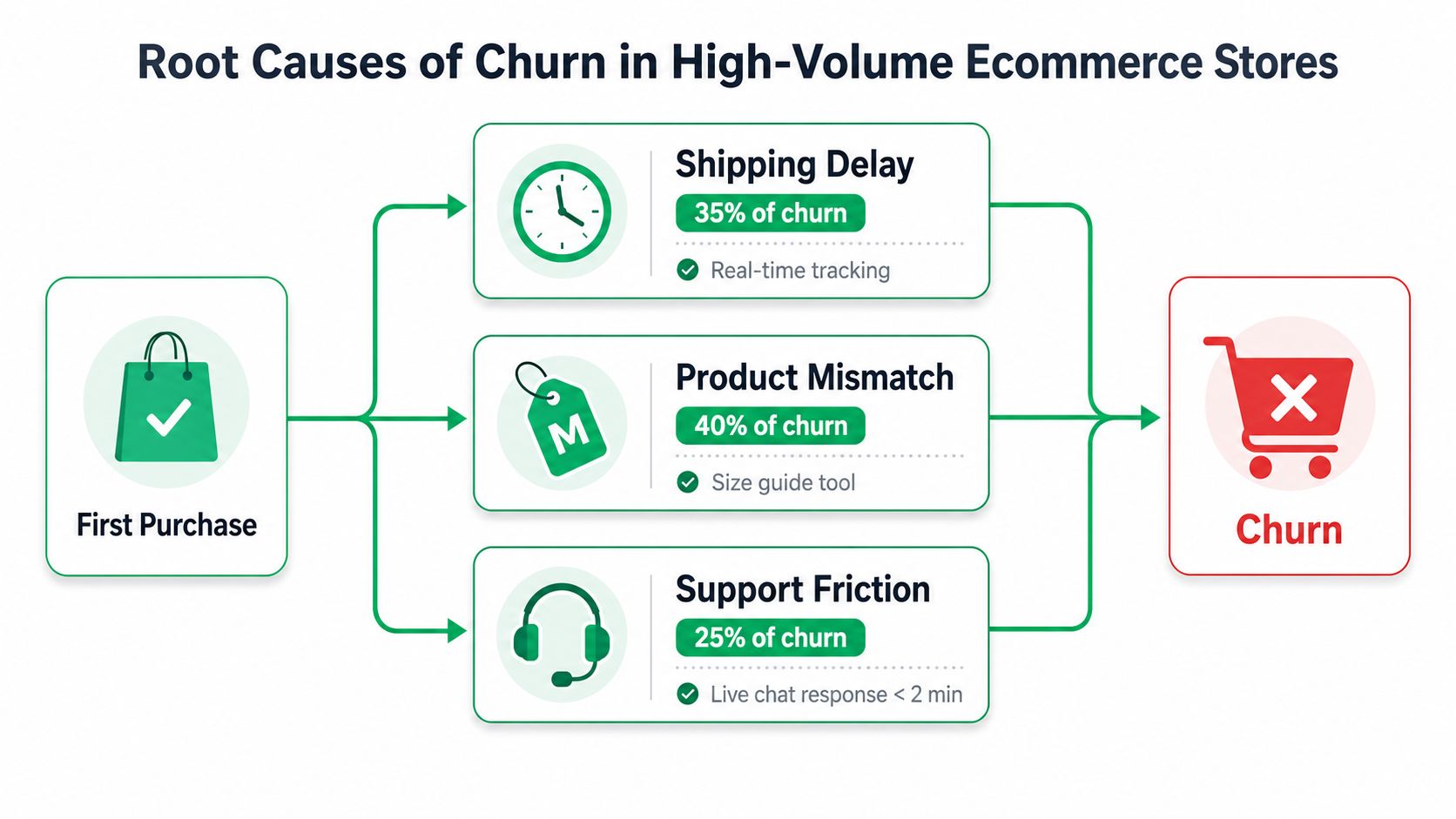
Churn rarely begins with a customer deciding that the brand is bad. It usually develops through a sequence of small failures. The store promises one experience, fulfillment delivers another, and support adds more effort when the buyer asks for help.
The first distinction matters: first-time buyer churn and repeat-buyer expansion aren't the same problem. A new customer needs confidence that the original purchase was worthwhile. A repeat customer needs reasons and convenience to buy more often, explore another product, or increase basket size.
Where the journey breaks
Opaque delivery expectations create anxiety even when the parcel eventually arrives. If the order status page doesn't explain what happened, the customer contacts support, checks the carrier independently, or assumes the brand has lost control.
Address and order errors are especially damaging because many are preventable. A customer may notice a typo immediately after checkout, but if the store offers no controlled editing window, the only available options may be a support ticket, a cancellation, or an undeliverable shipment.
Product-to-expectation mismatch begins before fulfillment. Inaccurate measurements, weak product photography, unclear compatibility information, or incomplete usage guidance make a return more likely. The return itself may be reasonable, but a restrictive or confusing process can turn a recoverable issue into permanent churn.
Support friction compounds every other problem. Limited channels, slow replies, missing order context, and repeated explanations tell the buyer that resolution will require effort. That effort changes the customer's willingness to risk another purchase.
Why returns and communication have unusual leverage
A return is a retention event, not merely a cost line. The customer has already demonstrated purchase intent, and the brand still has an opportunity to preserve trust through a fast exchange, a clear refund path, or useful product guidance.
Post-purchase communication works the same way. A delivery update, an honest delay notice, or a proactive explanation of the next step reduces uncertainty. It doesn't need to be elaborate. It needs to arrive before the customer starts chasing answers.
A failed delivery update can create the support ticket. A failed return can create the churn.
Discounts and points address the customer's future economics. Operational fixes address the customer's present confidence. For first-time buyers, confidence usually comes first. Measure friction events against second-order behavior, and you'll see which failure points deserve engineering time instead of another promotional send.
Strategic Pillars for Building Repeat Purchase Behavior
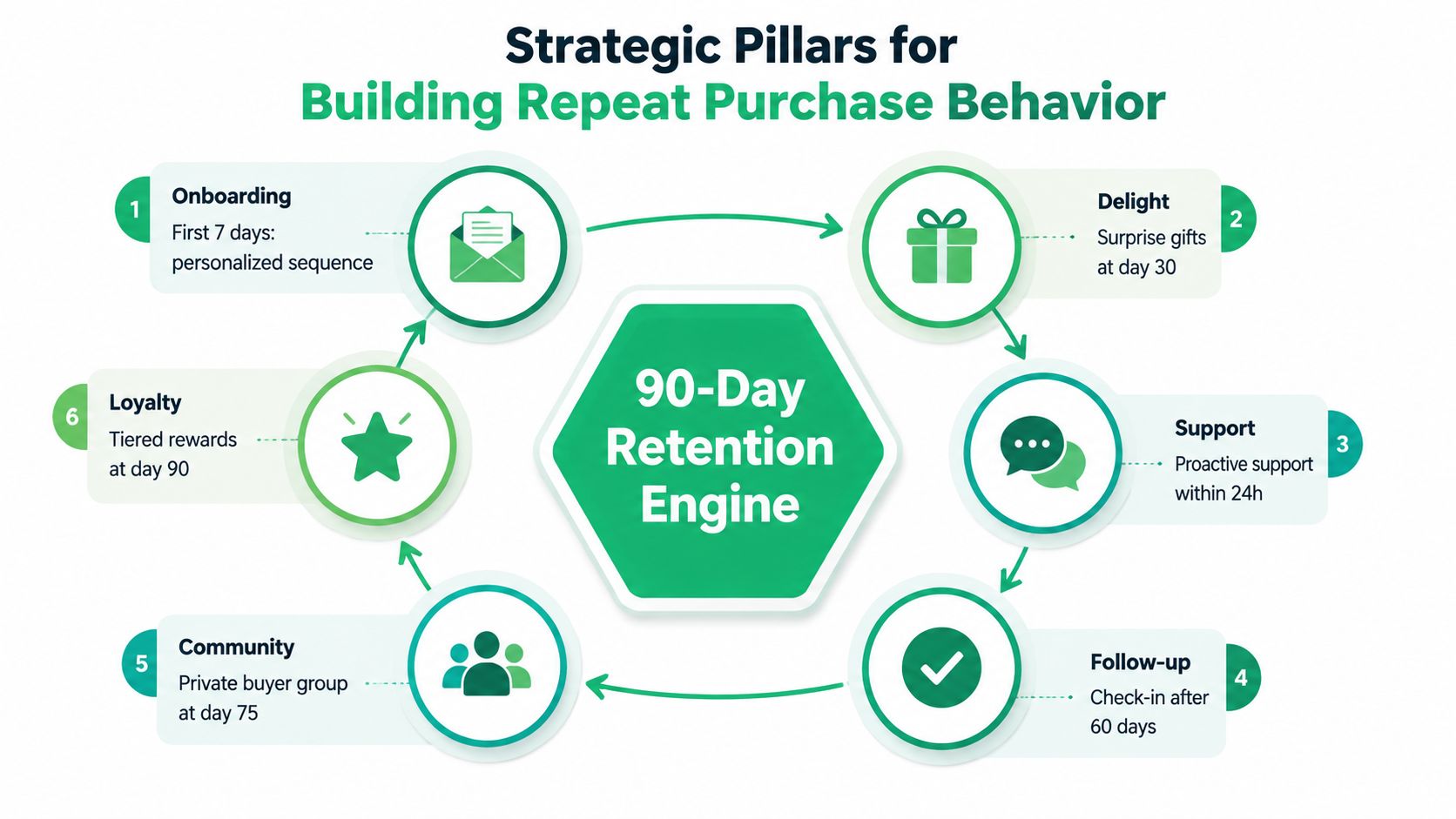
A durable retention engine combines marketing triggers with operational control. The six pillars below should work together across the first 90 days, but they shouldn't all receive equal investment at once.
Set expectations before the order creates doubt
Onboarding begins with the confirmation experience. Show what happens next, provide a reliable status path, explain product use where relevant, and give the customer a route to correct an error. Shopify Flow can coordinate tags and operational triggers, while email and SMS platforms handle communication.
Delight should support the product, not distract from a broken process. A useful care guide, accessory recommendation, or contextual thank-you can make the first order easier to use. A surprise has value only after the basics work.
Turn service into a retention lever
Support should identify risk from events, not wait for an angry message. A late fulfillment scan, a delivery exception, or a return request can trigger an internal task and a customer-facing update. Helpdesk tools such as Gorgias or Zendesk can attach order history and status to the conversation, reducing repetitive questions.
Follow-up should reflect the customer's actual experience. A product-use check-in makes sense for education-heavy categories. A replenishment reminder makes sense only when purchase timing supports it. Don't send a generic “we miss you” message while a return remains unresolved.
Use loyalty and personalization with restraint
Loyalty works best when the behavior you reward aligns with margin and customer value. Rewarding a second purchase, an exchange, a review, or a referral can be more useful than awarding points for every low-intent interaction. Shopify Functions can support custom discount logic, but finance and merchandising teams need to approve exclusions and margin limits.
Personalization should use purchase history, product compatibility, cohort behavior, and service state. A customer with an open complaint shouldn't receive an aggressive cross-sell. A customer who bought a core product may appreciate a complementary item when the timing and use case are clear.
Build or buy based on operational complexity
Native Shopify features are usually the fastest starting point for checkout and order data. Apps reduce development effort but add vendor dependencies and data coordination. Custom extensions give Plus merchants more control, yet they require ownership after launch.
The build-versus-buy decision should follow the failure cost. If a process affects address accuracy, returns, or fulfillment timing, prioritize reliability and auditability over a visually impressive interface.
The following video provides another perspective on designing post-purchase flows:
Tactical Playbook for Shopify and Shopify Plus Merchants
Start with interventions that remove customer effort without giving up operational control. A customer should be able to correct a shipping detail during a defined window, understand the order's status, and receive a relevant next offer without contacting support.
Put order control in the customer's hands
Use Shopify order data and fulfillment events to create a controlled editing workflow. Let customers modify eligible shipping or contact details before fulfillment, restrict changes after a warehouse cutoff, and record every change for support and operations.
For apparel, variant swaps can preserve revenue when the customer catches a size issue early. For consumables, delivery changes may prevent an unwanted shipment. The key is permission design. Customers need flexibility, while the warehouse needs a clear point after which changes stop.
Treat the post-purchase page as a commerce surface
Shopify's post-purchase checkout extensions and order status surfaces can present a one-click offer after the initial transaction. Use cart composition, product compatibility, inventory, and margin rules to determine eligibility. Keep the offer subordinate to order clarity. A customer shouldn't have to dismiss a promotion to find tracking information.
A practical Shopify post-purchase upsell should complement the original order and preserve fulfillment simplicity. Test the offer against incremental gross margin, cancellation behavior, and support contacts, not just clicks.
Coordinate messages with real fulfillment events
Trigger communication from shipped, out-for-delivery, delivered, return-created, and return-resolved events. Email can carry detail, while SMS works for concise alerts when the customer has opted in. Localize language and timing by market, and suppress promotional messages while a service issue remains active.
Subject lines still affect whether useful information gets seen. Teams reviewing their messaging conventions can consult this guide to email subject line capitalization before standardizing templates.
| Tactic | Platform Requirement | Implementation Effort | Expected Lift | Primary Metric Impacted |
|---|---|---|---|---|
| Customer order edits | Shopify order data, permissions, fulfillment cutoff | Medium | Qualitative improvement in avoidable cancellations and tickets | Second-order conversion, support contacts |
| Self-service returns | Returns platform or custom portal | Medium | Qualitative improvement in exchange retention and resolution experience | Refund rate, exchange rate |
| Post-purchase upsell | Checkout extensibility or order status integration | Medium | Test incrementally, with no assumed lift | AOV, incremental margin |
| Fulfillment-triggered messaging | Shopify events plus email or SMS platform | Low to medium | Qualitative improvement in delivery confidence | Support contacts, delivered-order satisfaction |
| Custom discount logic | Shopify Plus and Functions development | High | Depends on margin and eligibility rules | AOV, contribution margin |
Measurement Plan and Sample Retention Dashboards
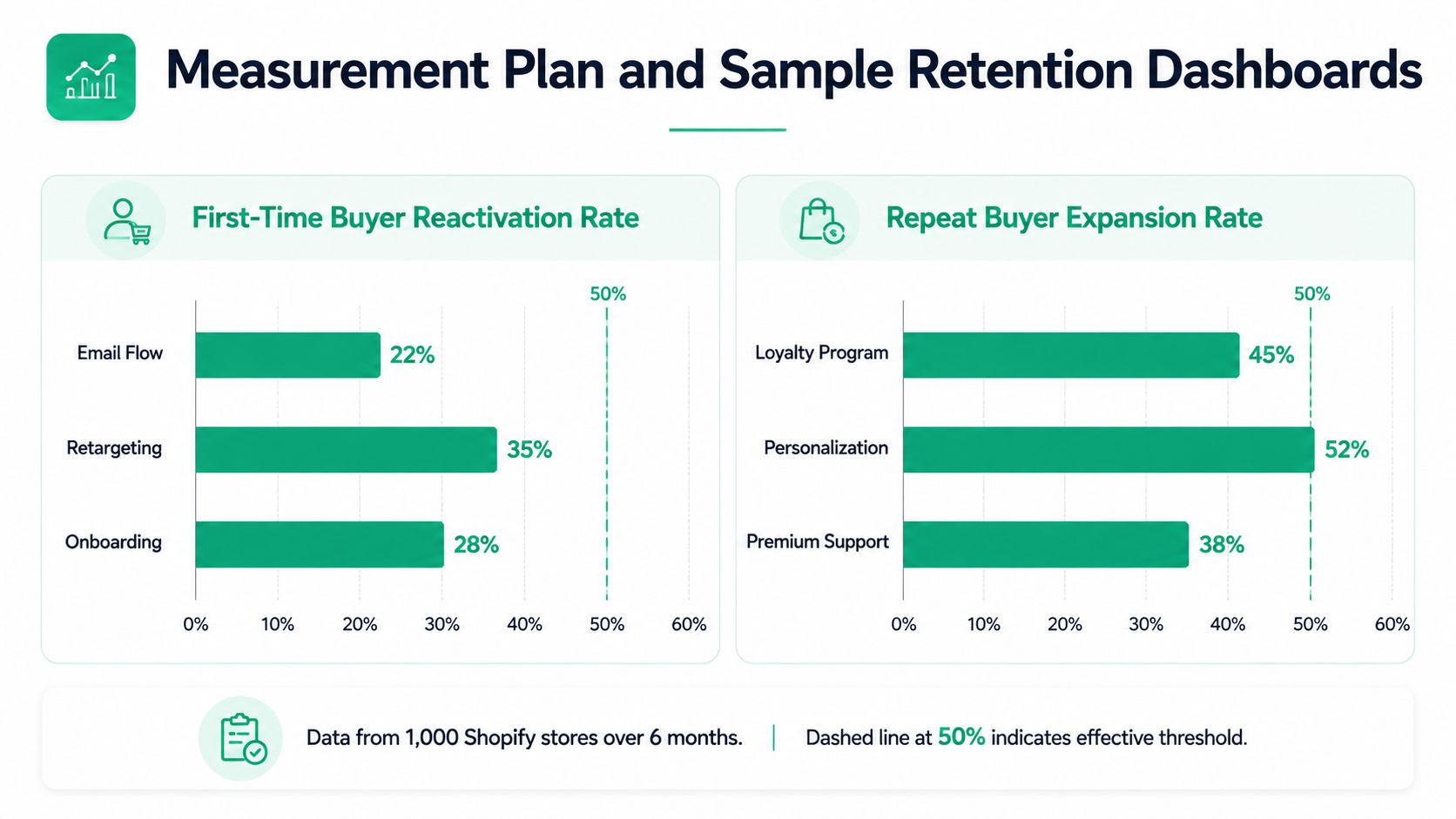
A useful dashboard separates two questions. Did a first-time buyer return? And did an existing repeat buyer expand? Combining them hides the intervention that should change.
Track each first-order cohort at 30, 60, and 90 days, using the same definitions each time. The core fields are second-order conversion, time to second purchase, AOV by purchase number, return status, support outcome, fulfillment exceptions, and cohort-based LTV.
Dashboard one, cohort retention
Build a heatmap by first-order month and age since purchase. Add filters for product family, acquisition source, market, new versus returning status, and fulfillment outcome. The key query is simple: customers in the cohort who placed a second order within the window, divided by customers in the starting cohort.
Don't let an all-customer line replace the heatmap. The aggregate view can remain stable while a recent product launch, warehouse change, or acquisition channel produces a weaker first-to-second-order curve.
Dashboard two, friction attribution
Join order, fulfillment, returns, and support data around the customer ID or order ID. Flag events such as late delivery, address correction, return initiated, unresolved ticket, refund, exchange, and chargeback. Compare second-order behavior for customers who experienced each event with a comparable group that did not.
This isn't proof of causation by itself. It is a prioritization tool. If customers with unresolved tickets repeatedly underperform, service leaders have a stronger case for workflow changes than a generic complaint report would provide.
Dashboard three, expansion revenue
Track AOV and gross margin across first, second, and subsequent orders. Segment repeat buyers by product category, discount exposure, loyalty status, and support history. A rising order count with falling margin may represent expensive discount dependency rather than healthy retention.
Set alerts around meaningful deviations from each cohort's baseline, especially after changes to shipping, returns, checkout, or product pages. The dashboard should trigger an owner, an investigation, and a decision. Passive monitoring doesn't improve customer behavior.
Prioritized Experiments and Implementation Checklist
Retention work should start with friction that customers already experience. Don't begin with a complex predictive model if buyers still need support to correct a shipping address.
| Experiment | Effort | Expected Lift | Timeline |
|---|---|---|---|
| Post-purchase order editing | Low to medium | Qualitative improvement in avoidable errors and cancellations | First sprint |
| Self-service returns and exchanges | Medium | Qualitative improvement in resolution and retained revenue | Early implementation |
| Relevant post-purchase upsell | Medium | Test against AOV and margin, without assuming a result | Early implementation |
| Tiered loyalty program | Medium to high | Depends on purchase cycle and reward economics | Later phase |
| Cohort-based churn alerts | Medium | Improves intervention timing and diagnosis | Middle phase |
| Predictive replenishment | High | Potentially valuable where repeat timing is predictable | Mature program |
| Internationalized post-purchase experience | High | Expands consistency across markets | Dedicated project |
A practical 90-day sequence
- Weeks 1 to 2: Define first-time and repeat-buyer cohorts, document fulfillment cutoffs, audit returns, and establish baseline second-order conversion.
- Weeks 3 to 4: Choose the order-editing and returns workflows, map Shopify events, and assign owners across operations, support, and marketing.
- Weeks 5 to 6: Launch customer-facing status updates, controlled order edits, and self-service returns for a limited segment.
- Weeks 7 to 8: Add a relevant post-purchase offer, with product restrictions and margin rules.
- Weeks 9 to 10: Build the cohort, friction attribution, and expansion dashboards.
- Weeks 11 to 12: Compare cohorts, review support and refund outcomes, remove weak interventions, and scale the changes that reduce effort.
The post-purchase experience is the most practical retention lever because it improves the reason customers return, not merely the reminder that they could return. Shopify operators should fix service friction before increasing loyalty spend.
SelfServe gives Shopify merchants a controlled self-service portal for eligible post-purchase order edits, address validation, and post-purchase upsell modules on Thank You and Order Status pages. Visit SelfServe to see how your team can reduce avoidable support work while making the first 90 days easier for customers.