Your Guide to Building a Profitable Ecommerce Subscription Business
At its heart, an ecommerce subscription business is about turning one-time buyers into loyal, long-term customers. Instead of constantly chasing individual sales, you create a system where customers pay a recurring fee—weekly, monthly, or quarterly—to receive products or access services on a set schedule. It’s a fundamental shift from hunting for sales to farming a sustainable business.
Why Predictable Revenue Changes Everything
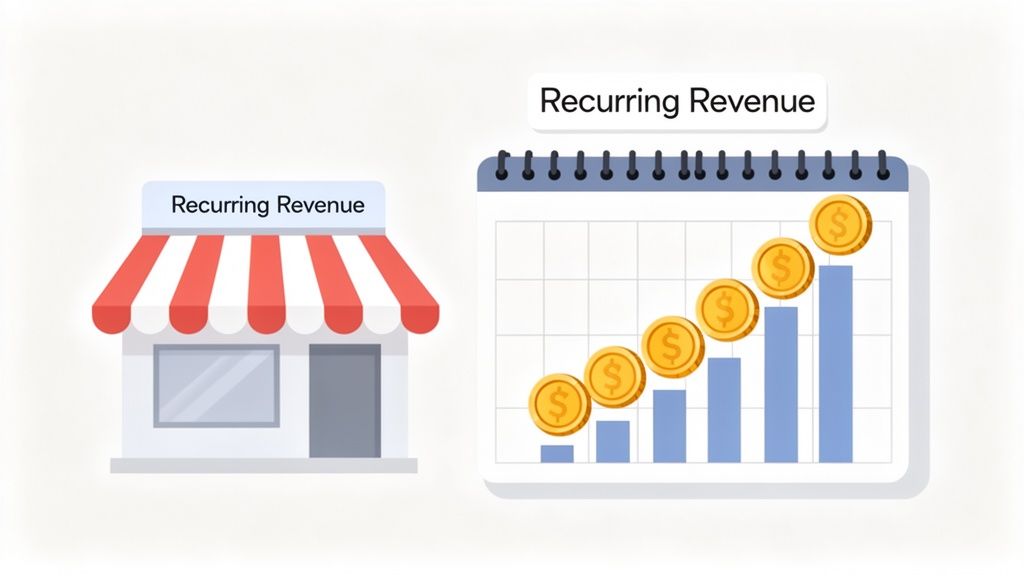
The real magic of the subscription model is predictable revenue. This isn't just a business term; it's the key to unlocking financial stability that traditional retail models can only dream of. Most ecommerce brands are on a rollercoaster, with sales spiking one month and plummeting the next.
Imagine trying to forecast your inventory or set a marketing budget when you have no clue what next month's sales will be. It's a stressful guessing game. Subscriptions smooth out those wild peaks and valleys, giving you a much clearer picture of your future cash flow.
The Foundation for Smarter Growth
When you know how much money you can count on each month, you can stop reacting and start planning. This newfound predictability is the bedrock for building a more resilient and scalable direct-to-consumer brand.
Here’s what that stability really means for your business:
- Improved Cash Flow: With a steady stream of income, managing daily expenses like payroll and paying suppliers becomes far less of a headache.
- Better Inventory Management: You can forecast demand with incredible accuracy, which means less money tied up in unsold stock and fewer frustrating "out of stock" notices for your customers. For a brand like Better Booch, where 70% of orders are from subscriptions, this provides a powerful demand signal.
- Enhanced Customer Loyalty: The subscription model forces you to think about long-term value, not just a quick sale. This focus on building a relationship naturally increases customer loyalty and lifetime value (LTV).
This shift from one-off transactions to recurring relationships is fundamental. It allows businesses to move beyond simply selling products and start building a dedicated community around their brand.
This solid financial footing isn't just about feeling secure; it's about fueling intelligent growth. Knowing your baseline revenue lets you confidently invest in acquiring new customers, developing exciting new products, and perfecting the customer experience. This is how a small ecommerce subscription business truly scales into a household name.
Picking the Right Subscription Model for Your Business
Let’s get one thing straight: not all subscription models are the same. This is probably the most critical decision you'll make when launching your subscription offering. The model you choose has to make sense for your products and what your customers actually want. It's like picking the right key for a lock; the wrong one just won't work, no matter how hard you try.
This choice will ripple through your entire business, influencing everything from how you manage inventory to the promises you make in your marketing. Most successful subscriptions fall into one of three buckets: replenishment, curation, or access. Getting to the heart of what makes each one tick is the secret to building a subscription that people stick with for the long haul.
The Replenishment Model: "Never Run Out"
This is the bread and butter of subscriptions, built entirely around convenience. It’s perfect for those everyday essentials people burn through and need to reorder constantly—think coffee, vitamins, skincare, or dog food. The pitch is simple and powerful: "Set it and forget it."
You're basically taking a recurring chore off your customer's to-do list. Slap on a "subscribe and save" discount, and you’ve solved a real problem for them while locking in predictable, recurring revenue for you. Dollar Shave Club basically wrote the playbook on this, making sure guys never had to use a dull razor again. This model thrives when your product meets a consistent, predictable need.
The Curation Model: "Surprise and Delight"
If replenishment is about convenience, curation is all about discovery. With this model, your subscribers are signing up for a little bit of magic—they don't know exactly what's coming, and that surprise is the whole point. It's a natural fit for categories like beauty samples, artisanal snacks, books, or even kids' toys, where variety is a huge part of the appeal.
A great curation box turns a simple transaction into a memorable experience. Every delivery feels like a hand-picked gift, forging an emotional bond that builds incredible brand loyalty.
Look at a company like Stitch Fix. They've nailed this by sending out personalized clothing picks based on a customer's unique style profile. To win with curation, you have to get really good at consistently wowing your subscribers with products that feel both new and perfectly suited to them. You're not just moving inventory; you're delivering a thoughtfully crafted experience.
The Access Model: "Join the Club"
Lastly, the access model isn't so much about getting a box of products as it is about getting exclusivity and perks. Customers pay a recurring fee to become a member, which unlocks a whole world of benefits. We're talking members-only discounts, first dibs on new product launches, or access to a private community and content.
Think of it as a VIP pass to your brand. Amazon Prime is the ultimate example, bundling perks like fast, free shipping with a massive library of streaming content. This model is a powerhouse for building a tight-knit community. It's often used as a hybrid, where a replenishment or curation subscription also comes with access-level benefits. It’s a fantastic way to reward your best customers and make them feel like true insiders—which is a retention strategy that's tough to beat.
So, how do you decide which path is right for you? It really comes down to your products and the value you want to provide. This table should help clarify which model aligns best with your business goals.
Which Subscription Model Fits Your Business?
Ultimately, the best model feels like a natural extension of your brand. Replenishment works for essentials, curation for experiences, and access for community. Choose the one that lets you deliver consistent value, and you'll have a foundation for a thriving subscription business.
Understanding the Metrics That Actually Matter
Running a subscription business is a different ballgame than traditional retail. Instead of chasing one-time sales, you're building long-term relationships. This shift means you need to track a whole new set of numbers—metrics that tell you the real story about the health and predictability of your business.
Think of Monthly Recurring Revenue (MRR) as the pulse of your company. It’s the predictable income you can count on every single month. To calculate it, you just multiply your total number of active subscribers by their average monthly payment. This isn't some vanity number; it's the financial bedrock that lets you forecast accurately and invest in growth with confidence.
Measuring Subscriber Value
From there, we drill down into Average Revenue Per User (ARPU). This metric tells you exactly what an individual subscriber is worth to you each month. It's fantastic for seeing how different pricing tiers or add-ons are performing. If you see your ARPU climbing, it’s a great sign that customers are finding more and more value in what you offer.
But the real magic happens when you look at the entire customer journey. That's where Lifetime Value (LTV) comes in. LTV estimates the total revenue you can expect to earn from a single customer throughout their entire time with you.
The single most important calculation for any subscription business is your LTV to CAC ratio. A healthy, sustainable business should see an LTV that's at least 3x higher than its Customer Acquisition Cost (CAC)—the money you spend to get that customer in the door.
If you’re spending more to acquire a customer than they'll ever spend with you (a high CAC and low LTV), you're basically paying people to take your product. That's a fast track to going out of business. You can get a much deeper handle on this by tracking your Shopify analytics for smarter decisions.
The subscription model you choose—whether it's replenishment, curation, or access—has a direct impact on these numbers.
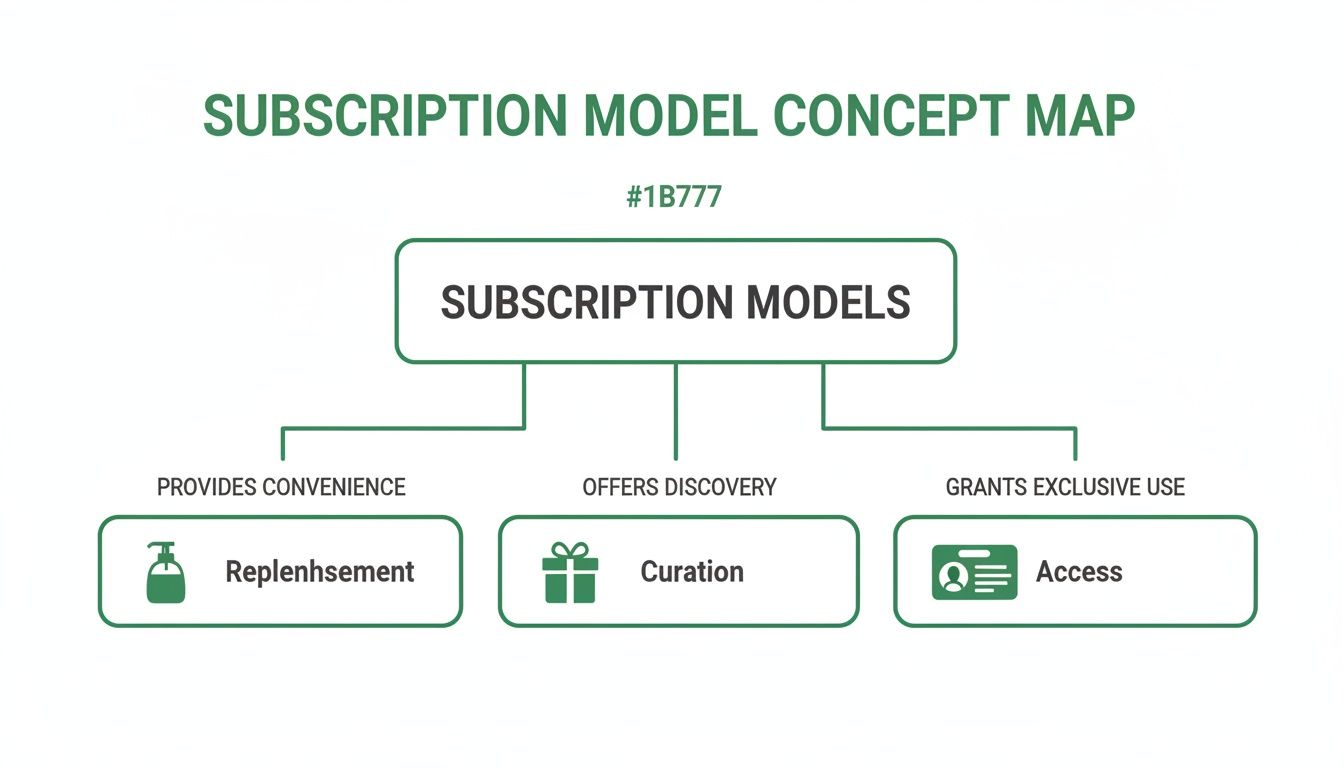
Each of these models attracts a different kind of customer, which in turn influences how much they spend and how long they stick around.
Plugging the Leaks in Your Business
Finally, you have to keep a close eye on Churn Rate. Churn is the percentage of subscribers who cancel in a given period, usually a month. I always think of it like a leaky bucket. You can pour new customers in the top all day long, but if you have holes in the bottom, you'll never actually fill it up.
That's why focusing on reducing churn is often way more powerful than just acquiring new customers. Keeping that number low is the key to a stable MRR and a healthy LTV. It's this potential for long-term, predictable growth that has the subscription ecommerce market projected to hit an incredible $5.35 trillion by 2030. You can dig into the numbers in the full subscription market report.
Getting Your Subscription Tech Stack Right
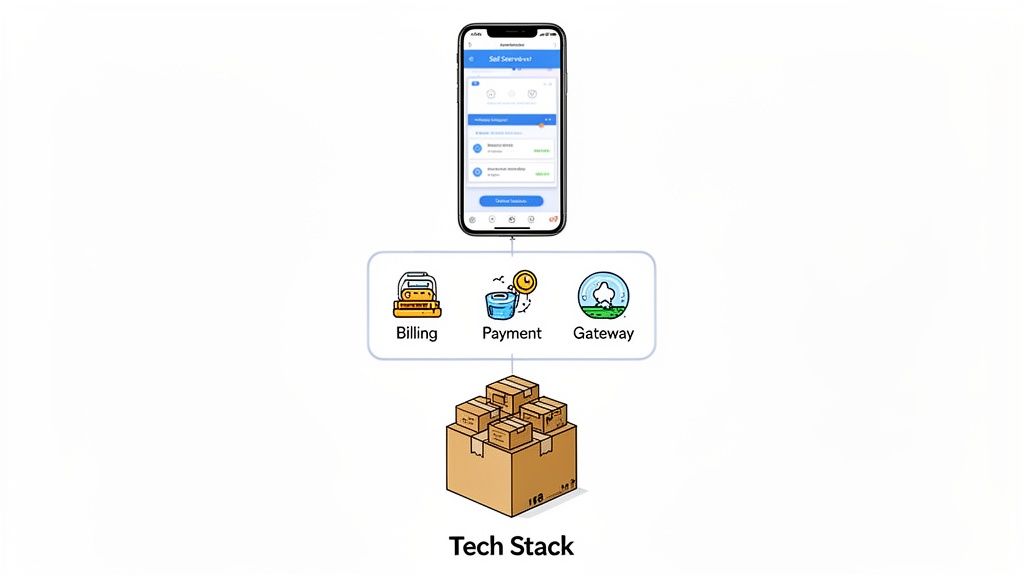
Think of your tech stack as the engine room of your subscription business. Get it right, and everything runs smoothly. Get it wrong, and you're in for a world of headaches. The foundation for most brands is their ecommerce platform, and for a huge number of them, that's Shopify.
But here’s the catch: Shopify doesn't do recurring billing out of the box. That’s where a dedicated subscription management app comes in. This app is the real workhorse, integrating with Shopify's checkout to handle the nitty-gritty of billing cycles, payment processing, and all the logic that makes your subscription models tick.
Beyond that core app, you’ll need a few other key pieces to complete the puzzle:
- Payment Gateways: You'll need a processor that's built for recurring payments. Look for features like automatic card updaters—they're lifesavers for preventing churn from expired cards.
- Fulfillment & Inventory: Subscribers create predictable demand, but your systems need to keep up. This means tight integration with a 3PL or inventory software that can handle recurring order cadences without overselling.
- Customer Support: Your team needs tools that plug directly into subscription data. Nothing is more frustrating for a customer (or your agent) than a support system that can't see their subscription history.
Give Customers Control with a Self-Serve Portal
If there's one secret weapon in your tech stack, it’s the customer portal. This is your subscriber's home base, and it can single-handedly slash your support tickets while building incredible loyalty. A clunky portal is a fast track to a canceled subscription.
An intuitive self-serve portal turns a passive subscription into an active, engaging relationship. When customers feel in control, they stick around.
A great portal is all about one-click actions. Skipping a shipment, swapping a product, or changing an address should be effortless. This simple empowerment keeps customers happy and frees up your support team from answering the same questions over and over again. You can see what a truly powerful Shopify order management system looks like in action.
Design Everything for Mobile First
Finally, every single piece of your tech stack, especially the customer portal, must be designed for a mobile phone. This isn't just a "nice to have" anymore; it's the main event.
Smartphones now account for 69% of all online shopping orders globally. Your customers expect to manage their lives from the palm of their hand, and that includes their subscriptions. A portal that forces them to pinch and zoom is a portal that's bleeding subscribers. As you can read in these ecommerce trends on Coursera, every interaction, from signing up to making a post-purchase tweak, has to feel natural on a small screen.
Proven Tactics for Growth and Retention
Getting a new subscriber feels great, but keeping them is where the real business is built. The long-term health of your subscription program boils down to a one-two punch: getting customers in the door and then giving them every reason to stay.
For growth, the most reliable tool in the shed is the classic "subscribe and save" model. It's a straightforward value exchange. Offering a discount, usually somewhere in the 10-20% range, gives a potential customer a clear, financial reason to commit right now instead of making a one-off purchase.
Another smart play is to build out tiered subscription plans. Think "good, better, best." This lets you meet different customers where they are, both in terms of their needs and their budget. It also creates a natural upgrade path, allowing you to grow your revenue per customer over time.
The Two Faces of Customer Churn
Once you've got a subscriber, your world shifts to retention. And the biggest threat to retention is churn. It’s not a single problem, though; it actually comes in two very different flavors.
- Voluntary Churn: This is when a customer makes the conscious decision to hit the 'cancel' button. Maybe their needs changed, they weren't happy with the product, or they're just tightening their budget.
- Involuntary Churn: This one is the silent killer. It’s when a subscription ends because of a technical hiccup, most often a failed payment from an expired or maxed-out credit card.
A great post-purchase customer experience is your best weapon against voluntary churn, but involuntary churn is a different beast—one that’s best tamed with technology.
Keeping churn in check is non-negotiable. Healthy subscription businesses aim for an annual churn rate somewhere between 5-7%. One of the biggest advances in fighting involuntary churn has been the widespread adoption of credit card tokenization.
Modern payment tokenization is a lifesaver here. It works behind the scenes to keep card details up-to-date automatically, stopping payment failures before they ever happen. Data from Visa shows that using tokens can slash fraud by as much as 28% and dramatically reduce the number of subscriptions lost to expired cards. You can dive deeper into these subscription trends at Frisbii.com.
Finally, don't underestimate the power of flexibility when fighting voluntary churn. Instead of making cancellation the only option, give customers the ability to "skip a month." It's a simple, low-stakes alternative that gives them control, and it can be the one thing that prevents them from leaving for good.
Your Top Questions Answered
Diving into subscriptions can feel like a big step, and you probably have a few questions. Let's tackle some of the most common ones that come up when merchants are getting started.
What’s the Toughest Nut to Crack in a Subscription Business?
Hands down, the single biggest challenge is customer churn. It's thrilling to get new subscribers, but keeping them is where the real work—and profit—lies. You can have the best product in the world, but if the experience is clunky, people will leave.
Success isn't just about what's in the box; it's about making life easy for your customers. Think flexible options like skipping a shipment or swapping a product with just a few clicks. If you’re losing customers as fast as you’re gaining them, you’re just spinning your wheels. Retention is everything.
The customer relationship doesn't end at checkout—it begins there. A frustrating post-purchase experience where customers can't easily update an address or change a product is a top reason for cancellation.
Can I Add Subscriptions to My Existing Store?
Absolutely. In fact, it's one of the smartest ways to grow. You don't have to flip a switch and turn your entire business into a subscription-only model overnight.
A great way to start is by adding a "subscribe and save" option to your best-selling products. This creates a hybrid model, letting you dip your toes into recurring revenue without a massive overhaul. Modern Shopify apps make this incredibly simple to set up, giving your loyal customers a new way to buy while you gather valuable data on what works.
Why Does Everyone Keep Talking About the Post-Purchase Experience?
Because it's where loyalty is truly built or broken. Think about it: once a customer signs up, their primary interaction with your brand happens in their account portal. This is your chance to shine.
When you give customers easy, self-serve tools to manage their own subscriptions, you’re not just cutting down on support tickets. You're giving them a sense of control and building trust. The ability for a shopper to update their address, swap a product, or skip a month without having to email you is no longer a "nice-to-have"—it's a core part of a winning subscription strategy.
Empower your shoppers and slash support tickets with a seamless post-purchase experience. SelfServe gives your customers the control they crave to edit orders, update addresses, and add upsells—all on their own.