Expedited vs Standard Shipping A Guide for Ecommerce Growth
When it comes to shipping, every merchant faces the classic dilemma: speed or savings? The answer lies in understanding the difference between expedited and standard shipping, and it's much more than just a delivery timeline. It’s a core strategic choice that shapes customer perception, conversion rates, and your bottom line.
At its heart, the difference is straightforward. Expedited shipping is all about speed, promising delivery in 1-3 business days for a higher price. In contrast, standard shipping is your reliable, everyday option, getting packages to customers in about 3-7 business days without breaking the bank.
More Than Just a Timeline
For your business, this isn't just a logistics setting. Standard shipping is the workhorse of ecommerce. It’s the cost-effective baseline that most customers expect, and it's what makes those popular "free shipping" offers possible. It keeps your operations smooth and your budget in check for the majority of orders.
Expedited shipping, on the other hand, is your conversion-booster. It’s for the last-minute birthday gift, the urgent restock, or simply the customer who values speed above all else. By offering a faster option, you capture sales you might otherwise lose and cater to high-intent buyers willing to pay for convenience.
Think of them as two different tools for two different jobs. One isn't inherently better; a smart shipping strategy uses both to meet different customer needs at checkout.
This visual helps frame the core trade-off you're offering customers.
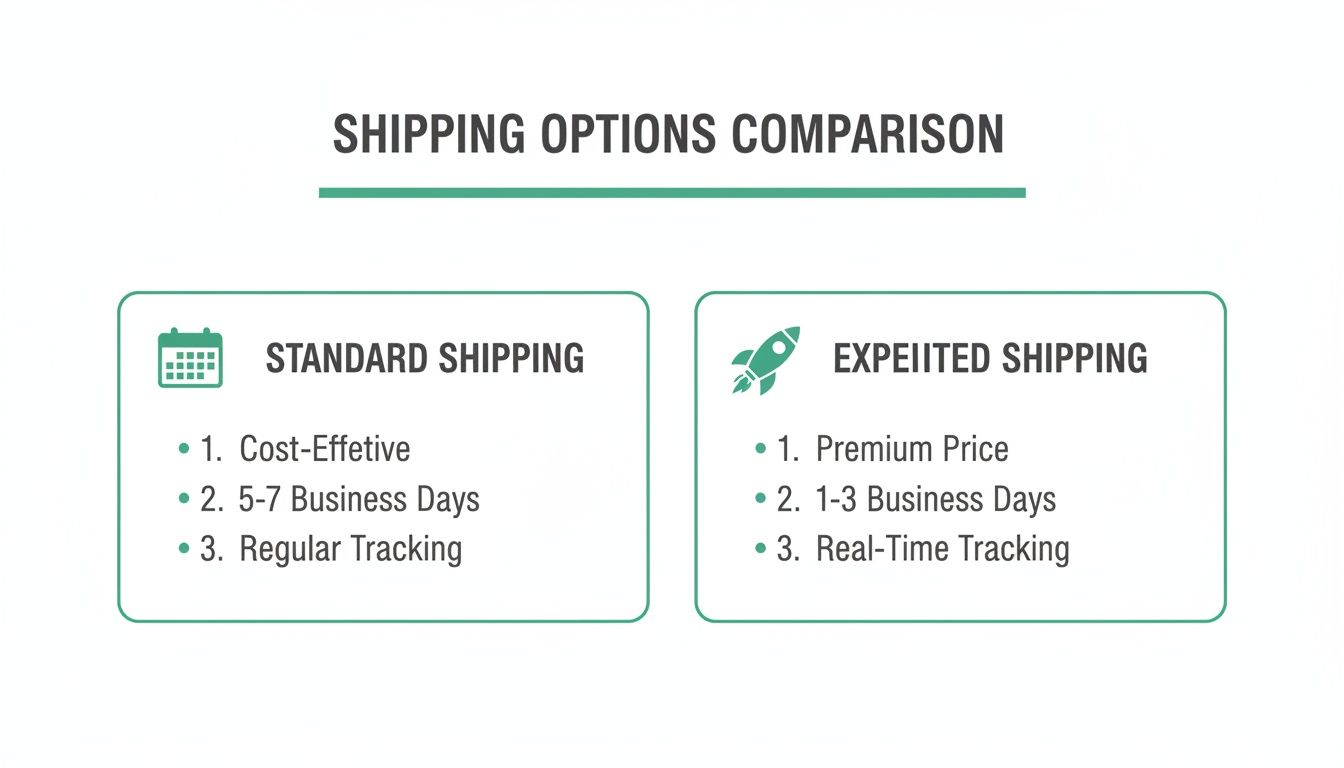
You’re giving shoppers a clear choice: a reliable, cost-effective journey or a first-class, rapid delivery.
Core Differences at a Glance
To make the best decision for your store, it helps to see the two services side-by-side. This table offers a quick summary comparing the fundamental characteristics of standard and expedited shipping to inform your ecommerce strategy.
Looking at this, you can see how each option serves a distinct purpose and customer.
While this covers the two most common options, some merchants go even further with budget-friendly choices. To see how that fits in, check out our guide on economy shipping vs standard shipping. A truly effective strategy treats each shipping tier as a lever you can pull to improve everything from customer satisfaction to average order value.
The Financial Impact on Your Margins and AOV
Deciding on your shipping options isn't just a logistics problem—it's a financial one that hits your profitability right where it counts. On one side, you have the higher costs of premium shipping services eating into your product margins. On the other, you have the potential revenue boost that comes with offering them.
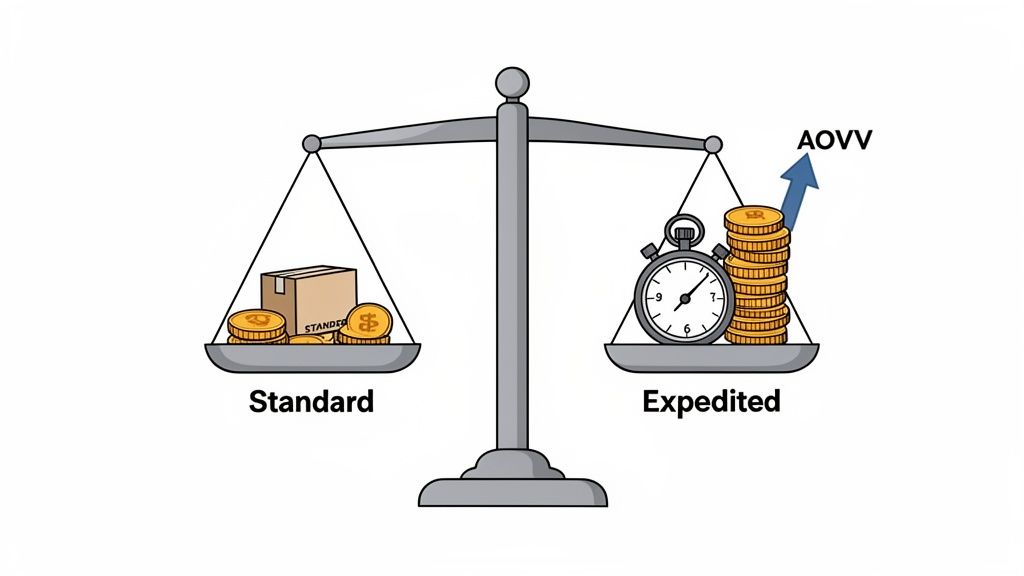
It's a classic tug-of-war. Standard shipping is your go-to for protecting margins with its lower costs, but expedited shipping can be a powerful tool for driving up your Average Order Value (AOV). The real trick is learning how to use both to build a shipping strategy that keeps customers happy and your finances healthy.
Calculating the True Cost of Shipping
To get a real handle on the financial impact, you have to look past the sticker price from the carrier. The "true cost" of any shipping option is a mix of direct and indirect expenses that can quietly chip away at your margins if you're not paying attention.
With standard shipping, the low price is the obvious win. But the slower transit times can bring on hidden costs you might not expect. The most common one? A flood of "Where Is My Order?" (WISMO) support tickets. Every one of those tickets costs you money in staff time, pulling your team away from tasks that actually grow the business.
Expedited shipping, of course, has a much higher upfront cost. But it’s not just the base rate. Carriers often tack on surcharges for fuel, residential drop-offs, or weekend deliveries. You absolutely have to bake these extra fees into your pricing, or you risk losing money on every fast shipment you send.
The real challenge isn't just absorbing shipping costs; it's understanding the total cost of delivery for each service tier. This includes the operational burden of slower shipping and the premium carrier fees for faster options.
How Each Option Affects Margins and AOV
Your shipping menu is a constant balancing act between protecting your profit margins and finding new ways to generate revenue. Each option you offer plays a very different role in that dynamic.
A smart approach uses both to your advantage:
- Standard Shipping as a Margin Protector: Offering an affordable—or even free—standard option is how you win over price-sensitive shoppers. It protects your baseline profit on every sale and should be the reliable workhorse of your shipping strategy.
- Expedited Shipping as an AOV Driver: The simple act of offering a faster option encourages customers to spend more. Some will pile more items into their cart just to hit a free shipping threshold, which you can then reinvest into offering even better expedited rates.
And don't forget, expedited shipping is a lifeline for capturing sales from high-intent buyers who need something now. Think last-minute gifts or urgent replacements—these are shoppers who care more about getting the item on time than they do about the shipping cost.
The Global Market and Customer Loyalty
The financial logic here is backed by what we're seeing in the global market. While standard shipping handles the sheer volume of ecommerce orders because it's cheap, expedited options are what build loyalty with your best customers. Expedited freight rates often run 2 to 5 times higher than standard ground services, which can sometimes take up to 10 days for non-urgent packages.
The numbers don't lie. The entire express and small parcel market is projected to skyrocket from USD 437.9 billion in 2025 to USD 713.3 billion by 2035, with premium services leading that charge. You can find more details on these future shipping trends on cogisticstransportation.com. This massive growth sends a clear signal: customers want speed, and they're creating a huge revenue opportunity for merchants who can give it to them profitably.
How Shipping Speed Shapes Customer Decisions
Let's be honest—shipping is no longer just a line item on an invoice. For today's online shoppers, who have been trained by the likes of Amazon to expect things fast and free, your shipping options are a core part of your brand's promise. It's often the first real test of whether you can deliver, both literally and figuratively.
The moment a customer hits your checkout page, they’re making a final judgment call. A slow or vague delivery estimate can introduce just enough friction to make them second-guess their entire purchase. This is where your shipping strategy stops being about logistics and starts being a powerful tool for conversion.
The Psychology of Speed and Cart Abandonment
The real force at play here isn't just a customer's actual urgency—it's their perception of your brand's capability. Simply seeing a faster shipping option available provides a sense of control and security, even if they ultimately choose the cheaper, standard route.
Research backs this up time and again. A staggering 23% of online shoppers will abandon a cart if they feel the delivery timeline is too slow. Think about that for a moment. You could lose nearly a quarter of your sales not because of your product or price, but because of a weak shipping offer. Failing to offer an expedited option doesn’t just cost you a potential upgrade; it can cost you the entire sale.
Offering a faster shipping option sends a powerful signal that you’re a professional, customer-focused operation. It tells shoppers you're equipped to meet their needs, building the confidence they need to click "buy."
This is especially true for first-time buyers. The presence of an express option assures them you're a serious business that can follow through on its promises. It can be the single factor that tips the scales, earning you their trust and their money.
From Transaction to Relationship: Shipping as a Loyalty Play
Fast shipping isn't just about closing one sale; it's about earning the next one. A great post-purchase experience, starting with a delivery that's on time or even early, is one of the most potent retention strategies you have. When a package lands on a customer's doorstep faster than they expected, it creates a moment of genuine delight—and people remember that feeling.
Consider how shipping speed can directly forge loyalty:
- The Last-Minute Lifesaver: A customer who gets their order just in time for a birthday or holiday doesn't just see you as a store. You solved a real problem for them, making them far more likely to return and recommend you.
- The Premium Experience: For high-value items, slow shipping can cheapen the entire experience and lead to buyer's remorse. Fast, secure delivery reinforces the product's quality and justifies the customer's investment.
- The Trust Builder: When you consistently meet or beat your delivery estimates, you build a reputation for reliability. That's the bedrock of repeat business.
This is how your shipping policy moves from the operations column to the marketing column on your P&L.
Why Clear Expectations Matter More Than Anything
While speed is a huge factor, nothing kills a sale faster than uncertainty. Vague timelines like "Ships in 5-10 business days" are a massive source of friction and a primary driver of cart abandonment. Today's customers don't want estimates; they want dates.
To build trust and head off frustration, you have to be crystal clear. Displaying specific delivery dates (e.g., "Arrives by October 26") for all your shipping tiers lets customers make an informed decision that balances their budget and their timeline. This transparency is also fundamental to creating a smooth post-purchase experience, setting the stage for the final delivery. You can dive deeper into this topic by reading about the importance of last-mile tracking in our detailed guide.
By framing your shipping choices with clarity and purpose, you take what could be a point of friction and turn it into another reason for customers to trust and love your brand.
Aligning Your Operations for Multiple Shipping Speeds
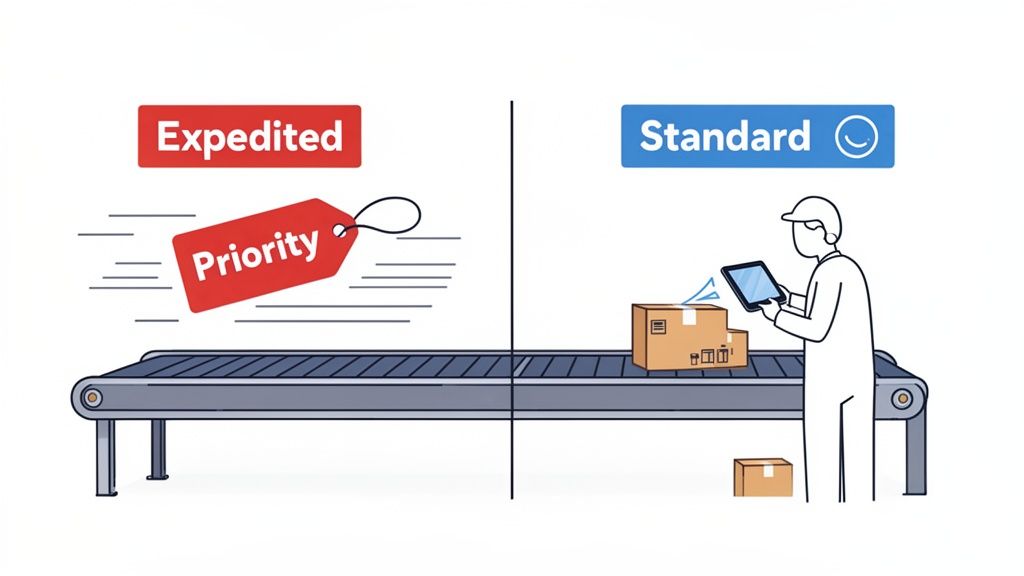
Adding an expedited shipping option isn't just a tweak to your checkout page. It’s a promise to your customer, and that promise has to be backed by some serious operational muscle. To make it work, your warehouse needs to learn how to move at two speeds at once. Get it wrong, and you'll have angry customers with late "expedited" orders, completely defeating the purpose.
The real trick is pulling those urgent orders out of the standard queue without throwing your entire fulfillment workflow into chaos. This means having clear, foolproof processes in place from the moment the order hits your system to the second it’s on the truck. Winging it is a recipe for disaster that will burn through labor costs and destroy your on-time delivery record.
Building a Two-Track Fulfillment System
First things first: you need a system that immediately tells your team which orders are a top priority. In a busy warehouse, guesswork isn't an option. This is where you lean on your tech stack and set some firm ground rules.
Here’s how to build a reliable two-track system:
- Automated Order Flagging: Your Order Management System (OMS) or Warehouse Management System (WMS) has to do the heavy lifting. Configure it to automatically flag all expedited orders with a clear visual cue—a color code, a priority tag, a special icon—anything that screams "pick me now!"
- Dedicated Pick Paths: If you’re running a larger operation, think about creating separate pick paths or even dedicated zones for your expedited orders. This prevents a hot order from getting stuck behind a massive batch of standard shipments.
- Priority Packing Stations: Set aside a specific packing station just for expedited orders. Keep it stocked with any premium materials you use and make sure it’s always staffed to clear priority picks as they arrive.
By engineering these distinctions right into your physical and digital workflows, you create a system that naturally funnels orders into the right lane. This segregation is the bedrock of any successful dual-speed operation.
The single most critical piece of the puzzle is a non-negotiable daily cut-off time for same-day processing. An order that comes in at 2:01 PM after a 2:00 PM cut-off has to automatically fall into the next day's fulfillment batch. This rule needs to be automated and communicated clearly at checkout to manage expectations.
Fine-Tuning Your Pick, Pack, and Ship Process
Once you’ve got a system for identifying priority orders, it’s time to dial in the physical workflow. Efficiency on the warehouse floor is a game of minutes, and every small optimization can be the difference between hitting that expedited delivery window and missing it.
Think about making these practical improvements:
1. Smarter Order Batching
Picking one order at a time is rarely efficient. You can group your standard orders into large, economical picking runs. Expedited orders, on the other hand, should be batched into smaller, more frequent runs throughout the day to keep them flowing without delay.
2. Proactive Carrier Management
Your relationship with your carriers is everything here. You need to have scheduled, reliable pickups for both standard and expedited shipments. Your shipping software must be configured to automatically select the right service level and print the correct label—eliminating any chance of human error that could accidentally downgrade a priority shipment.
Getting this right turns your shipping options into a true competitive advantage instead of a logistical nightmare. Your warehouse stops being a single-lane road and starts operating like a multi-lane highway, with every package moving at exactly the speed the customer paid for.
Implementing a Smart and Profitable Shipping Strategy
Building a shipping strategy that keeps customers happy without wrecking your profit margins is a balancing act. The secret isn't picking one option over the other; it’s about strategically using both standard and expedited shipping to meet different customer needs and unlock revenue at every turn.
The smartest approach for most brands is to set free or low-cost standard shipping as the baseline. This satisfies the majority of shoppers who prioritize value. From there, you can position expedited shipping as a premium, paid upgrade for those who value speed over savings.
Setting Profitable Shipping Prices
Once you’ve decided on your offerings, you have to price them right. Get this wrong, and you could be losing money on every single order. A solid pricing model needs to cover all your costs while still feeling fair to the customer.
Here are a few proven models you can use to price your shipping:
Real-Time Carrier Rates: This is the most straightforward and transparent way to do it. Your checkout integrates directly with carriers like UPS or FedEx to pull the exact shipping cost for each order. You pass the true cost to the customer, so you're never undercharging.
Tiered Flat Rates: This method is all about simplicity. You create a simple pricing structure based on order value or weight. For instance, you could charge a flat $5 for standard shipping on orders under $75, with a $15 expedited option. Customers love the predictability, which is great for conversion rates.
Free Shipping Thresholds: This is a classic for a reason—it works. Offering free standard shipping for orders above a specific value (say, $100) is a powerful incentive for customers to add just one more item to their cart. It's a direct lever to pull to increase your Average Order Value (AOV), while expedited shipping can still be offered as a paid choice.
The most successful brands often blend these approaches. A great combo is offering free standard shipping over $100 while also giving customers the option to pay for real-time carrier rates for expedited services. This gives shoppers the best of both worlds and protects your margins.
The Power of the Post-Purchase Upgrade
One of the most powerful, and often overlooked, tactics in the playbook is the post-purchase shipping upgrade. Think about it: a customer has already committed to a purchase with standard shipping. You then give them a simple, one-click opportunity to get their order faster for a small fee. It's a fantastic way to capture extra revenue without complicating the initial checkout experience.
This offer usually pops up on the Thank You page or the Order Status page. A customer who just selected free standard shipping might see a message like, "Your order will arrive by October 30th. Want it sooner? Upgrade to 2-Day Shipping for just $9.99 and get it by October 26th!" Because they've already bought in, the offer feels less like a hard sell and more like a helpful last-minute option.
To make this work at scale, you need to automate it. This is where post-purchase experience tools really shine.
For example, this is what it looks like to set up a post-purchase shipping upgrade using a tool like SelfServe.
The tool gives merchants a simple interface to build an upsell flow, defining the exact price and conditions for the expedited shipping offer that customers see after they've paid.
This kind of automation turns a static order confirmation page into an active revenue generator. By presenting a timely, convenient offer to upgrade from standard to expedited, you cater to your customer's sense of urgency, boost your AOV, and cut down on the "Where is my order?" tickets your support team has to handle.
Navigating International Expedited and Standard Shipping
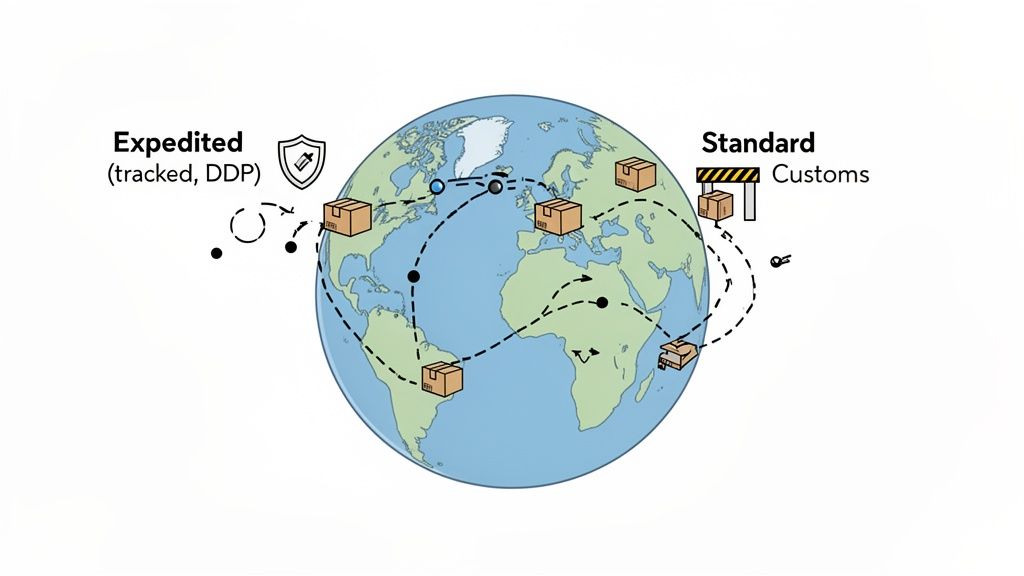
When you start shipping internationally, the conversation around expedited vs. standard shipping gets a lot more serious. You’re no longer just dealing with a few extra days in transit. Now, you’re facing unpredictable customs delays, long-haul logistics, and last-mile delivery in a foreign country where one small error can leave a package stuck in limbo for weeks.
For any global merchant, the core lesson is this: international shipping isn’t just about speed, it’s about reliability.
Standard international mail, while tempting for its low cost, can quickly become a customer service nightmare. These services often pass packages between different national postal systems. The result? Tracking numbers that go dead the moment a parcel leaves its origin country. This lack of visibility is a direct line to anxious customers, a flood of support tickets, and broken trust when delivery estimates are inevitably missed.
The Expedited Advantage in Global Commerce
This is precisely where international expedited services prove their worth. They aren't just faster—they offer a fundamentally more secure and transparent delivery from start to finish. Carriers like DHL, UPS, and FedEx control the entire journey, providing a single, reliable tracking number that works all the way from your warehouse to your customer’s doorstep.
Even better, these premium services typically include customs brokerage. This means the carrier handles all the complex paperwork and communicates with customs officials for you, dramatically cutting the risk of delays. For merchants, that kind of peace of mind is invaluable.
International expedited shipping is really a risk-management tool. You're not just paying for speed; you're paying for end-to-end tracking, customs expertise, and a vastly improved customer experience that standard international mail simply cannot match.
The market demand for this reliability is exploding. The global international express delivery market was valued at USD 67.47 billion in 2025 and is projected to hit USD 138.44 billion by 2034. With over 45% of consumers expecting international orders to arrive within a week, as detailed in recent booming international delivery trends on fortunebusinessinsights.com, offering an expedited option is often the only way to meet modern expectations.
DDP and Enhancing the Customer Experience
To truly win over international customers, you need to address duties and taxes upfront. Offering Delivered Duty Paid (DDP) shipping is a game-changer. When a customer pays all import fees at checkout, you eliminate those nasty surprise bills upon delivery—a leading cause of refused shipments and costly chargebacks. Expedited carriers are perfectly equipped to handle DDP shipments.
But a great delivery experience doesn't stop there. Your post-purchase communication has to be just as seamless. For instance, a customer in Germany should see their order status and tracking updates in German, not English.
- SelfServe makes this easy by automatically showing post-purchase pages in the shopper's local language.
- This simple step removes language barriers and reduces confusion around delivery timelines.
- It gives international customers the power to track their own orders without ever needing to contact your support team.
By combining the reliability of expedited carriers with clear DDP pricing and localized communication, you create a loyal global customer base. While the initial cost is higher, the reduction in support tickets, lost packages, and customer complaints often makes it a smart investment. If you're looking to fine-tune your cross-border strategy, our guide on the cheapest way to ship from the US to the UK offers more specific insights.
Frequently Asked Questions About Shipping Strategy
When you're running an ecommerce business, shipping questions always seem to bubble up. You're constantly trying to strike the right balance between speed, cost, and keeping your customers happy.
Let's tackle some of the most common questions I hear from merchants and get you some straight, practical answers.
When Should I Absolutely Offer Expedited Shipping?
There are a few non-negotiable times to have an express option ready. High-value orders are a big one, as are gift purchases. Think about the holiday rush—urgency is everything. Not offering a faster option is like turning away last-minute shoppers at the door.
In fact, studies show 23% of users will abandon their cart if they think delivery is too slow. An expedited option is your key to capturing those high-intent sales. It’s also a fantastic tool for customer service recovery. If something goes wrong, offering a free upgrade to expedited shipping can completely turn a bad experience around.
Can I Offer Expedited Shipping Without Hurting My Margins?
Absolutely, as long as you're smart about your pricing. The simplest way is to use real-time carrier-calculated rates at checkout. This passes the exact cost directly to the customer, so you're never left covering the difference for premium speed.
A savvy and very profitable strategy is to offer expedited shipping as a paid upgrade on orders that already qualify for free standard shipping. This frames the cost as a small fee for convenience, not a huge shipping bill. It protects your margin on the free shipping offer while adding pure, incremental revenue.
You can also offer a post-purchase upsell right on the order status page. This catches customers who decide they want it faster after they’ve already paid, making it an easy profit-add that doesn't clutter your checkout process.
What Is the Best Way to Reduce Shipping-Related Support Tickets?
Proactive communication is your best defense against a flood of "Where is my order?" emails. It all starts at checkout with clear, accurate delivery estimates for every shipping tier, from expedited to standard. From there, make sure you're using services that provide reliable, end-to-end tracking, especially for your faster and international shipments.
Even better, put the power in your customers' hands with a self-service portal. When shoppers can track their own orders and even edit shipping details themselves within a certain window, it’s a game-changer. They feel in control, and you drastically reduce support tickets and prevent costly delivery mistakes.
Empower your customers and streamline your operations with SelfServe. Offer post-purchase upgrades, reduce support tickets, and boost your AOV. Learn more and start your free trial.