Your Guide to UPS International Shipping Costs in 2026
Figuring out your UPS international shipping cost can feel like you're trying to nail jelly to a wall. The price shifts based on a whole cocktail of factors—package size, where it's headed, how fast it needs to get there—and the final bill is almost never just the base rate. It's that base price plus a whole host of surcharges and fees. Getting a handle on this formula is the first real step to controlling your global shipping budget.
Breaking Down Your UPS International Shipping Bill
Have you ever stared at a UPS international bill, completely baffled by what you’re actually paying for? It’s a maze of line items that can leave even seasoned Shopify merchants wondering if they’re getting a fair shake or just bleeding profit on every cross-border sale. You're not alone in that frustration.
Think of your total shipping cost like a fancy coffee order. The base rate is your simple shot of espresso. But the price you actually pay is often double that, once you add the extra syrup pumps, the oat milk, and all the other little service charges. Your UPS international shipping bill works exactly the same way, with surcharges and other variables acting as those costly add-ons.
To give you a clear view of what goes into your final price, here's a quick summary of the main components.
Quick View of Your UPS International Cost Components
| Cost Component | What It Is | Why It Matters for Your Business |
|---|---|---|
| Billable Weight | The greater of your package's actual weight and its dimensional weight (a measure of its size). | A light but large item can cost you way more than you expect. Optimizing box size directly cuts costs. |
| Shipping Zone | A number (e.g., Zone 201) that represents the distance from your origin to the destination. | This is the primary driver of your base rate. The higher the zone number, the more expensive the shipment. |
| Service Level | The delivery speed you choose, from express to standard. | This is your main trade-off between speed (customer happiness) and cost (your profit margin). |
| Surcharges & Fees | Extra charges for fuel, residential delivery, handling oversized packages, and more. | These can easily add 20-40% or more to your bill. Ignoring them means you're miscalculating your true costs. |
| Duties & Taxes | Fees imposed by the destination country's customs authority. | If you don't account for these, your customer gets hit with a surprise bill, leading to refused packages and a terrible experience. |
Understanding these pieces is the key to turning a confusing bill into a predictable expense you can actually manage.
The Four Pillars of Pricing
To really dig in, we can group the main cost drivers into four core components. These "pillars" are the foundation of your shipping rate, and mastering them gives you the power to spot overcharges and find savings.
The four pillars are:
- Billable Weight: This is a classic "gotcha" in shipping. It’s not just how heavy your box is. UPS looks at both the actual weight and the dimensional weight (a formula based on length, width, and height) and charges you for whichever is higher.
- Shipping Zone: This is how UPS prices distance. Instead of miles, they use zones to group destinations. A shipment from New York to London will have a different zone (and price) than one from New York to Sydney.
- Service Level: This is all about speed. Are you sending it with a premium service like UPS Worldwide Express® for next-day delivery, or a more budget-friendly option like UPS Worldwide Expedited®?
- Base Rate: This is the starting price you get when you combine the first three pillars, before any of the extra fees and surcharges get tacked on.
Once you see how these parts connect, the final number on your bill stops feeling so random. It becomes a calculation you can influence.
A small change in one area—like switching to a slightly smaller box to reduce your billable weight—can have a surprising ripple effect, lowering your total UPS international shipping cost significantly.
Now, we’re going to get into the details of each of these pillars. We'll explore why a light-but-bulky puffer jacket can be so expensive to ship and how to pick a service level that keeps both your customers and your accountant happy. This is the foundation you need to build a smarter, more profitable international shipping strategy.
The Four Core Factors Driving Your UPS International Rates
If you want to get a real handle on your UPS international shipping costs, you first need to understand what actually goes into the price. Forget guesswork. Once you know how UPS builds its rates, you can start making strategic decisions that directly impact your bottom line.
Your base shipping rate boils down to three key things: how big or heavy your package is, where it's going, and how fast you need it to get there. Let's break down each one.
Factor 1: Billable Weight
Here’s the first thing that trips up a lot of merchants: UPS doesn't just care about the actual weight of your package. They care just as much about the amount of space it takes up in their trucks and planes. This leads to the concept of Billable Weight.
UPS looks at two numbers: the actual weight (what your scale says) and the dimensional weight (a calculation based on the box's length, width, and height). They will then charge you for whichever of those two numbers is greater.
Let's say you're shipping two very different products:
- Product A: A small, heavy box of steel hardware that weighs 20 lbs.
- Product B: A big, puffy winter jacket in a large box that only weighs 5 lbs.
You'd think the hardware would cost more to ship, right? Not necessarily. If that big jacket box has a dimensional weight of 25 lbs because of its size, UPS will bill you for 25 lbs, not the actual 5 lbs. That "light" jacket just became a whole lot more expensive to send.
This is probably the single biggest source of surprise shipping fees for online stores. If you're not accounting for dimensional weight, especially for bulky but light items, you're almost certainly underestimating your costs.
Factor 2: Shipping Zone
Next up is the Shipping Zone. This isn't just about a simple mileage count. Instead, UPS has mapped the world into zones. A zone number represents the specific pairing of where a package starts and where it's headed.
The rule is simple: the higher the zone number, the higher the cost.
For example, sending a package from New York City to Toronto might fall into a low-numbered zone. But shipping that same package from New York to Sydney, Australia, will push it into a much higher—and more expensive—zone. This system is how UPS standardizes its pricing for shipments traveling across the globe.
Factor 3: Service Level
The third factor is your choice of Service Level. This is where you have to balance speed against cost. How quickly does that package really need to reach your international customer?
You'll generally see these main options for international shipping:
- UPS Worldwide Express®: This is the top-tier, fastest service, usually promising delivery in 1-3 business days with a time-of-day guarantee. It's also the priciest.
- UPS Worldwide Expedited®: A great, more budget-friendly option that gets packages there in 2-5 business days, but without the specific time-of-day commitment.
- UPS Worldwide Saver®: This option strikes a nice balance. You still get delivery in 1-3 business days, but it's by the end of the day, making it a bit cheaper than the full Express service.
Picking the right service is a crucial business decision. While offering next-day international delivery is an amazing customer experience, the cost can be eye-watering. For perspective, the 2026 rate sheets show that shipping even a tiny 1 lb package with UPS Worldwide Express® can start at over $113. For many products, a fee like that can wipe out your entire profit margin.
These three core factors—billable weight, zone, and service level—all work together to create your base rate. The diagram below shows how they, along with other details, combine to form your final bill.
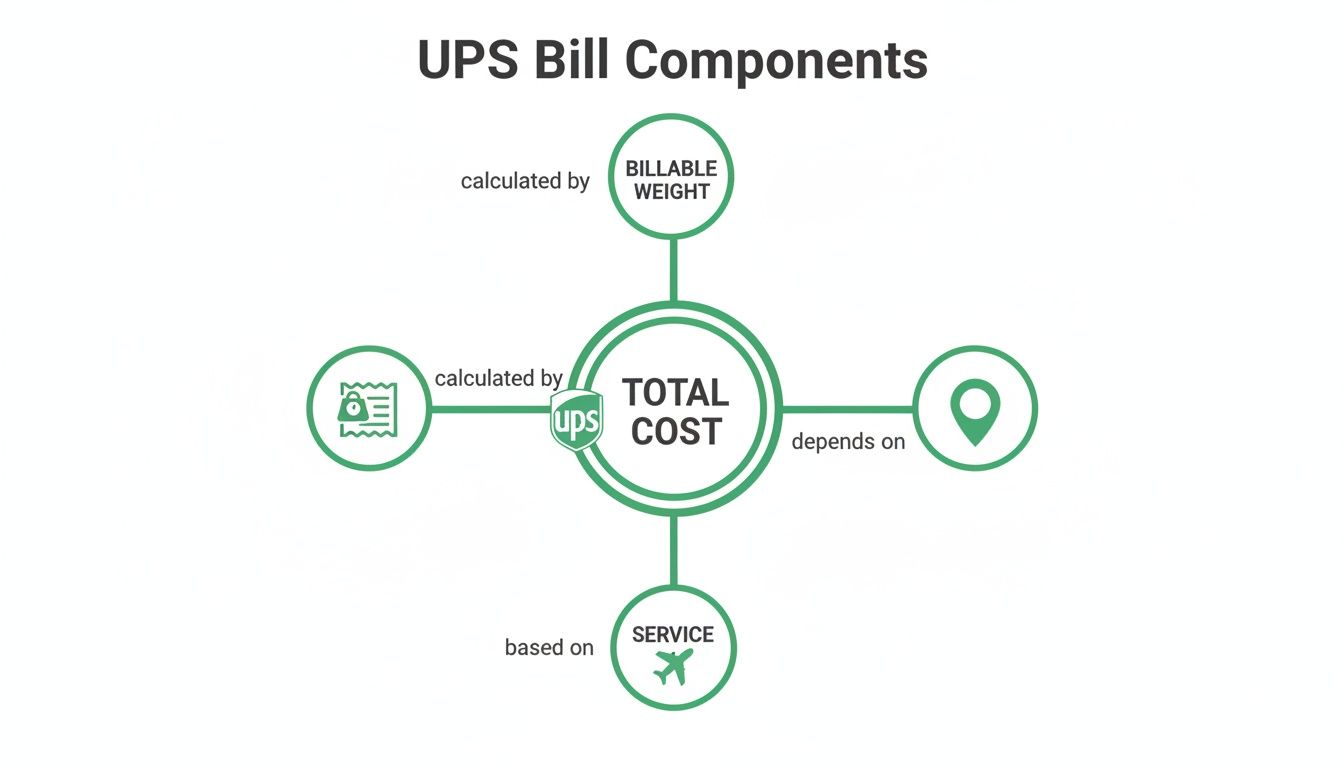
As you can see, your final price is a direct result of how these elements interact. But it's vital to remember that this is just the starting point. We haven't even talked about the various surcharges and other fees that can be added on top. And if you're curious about how UPS stacks up against other major players, our guide on the differences between UPS and USPS is a great place to start.
What Surcharges and Hidden Fees Really Cost You
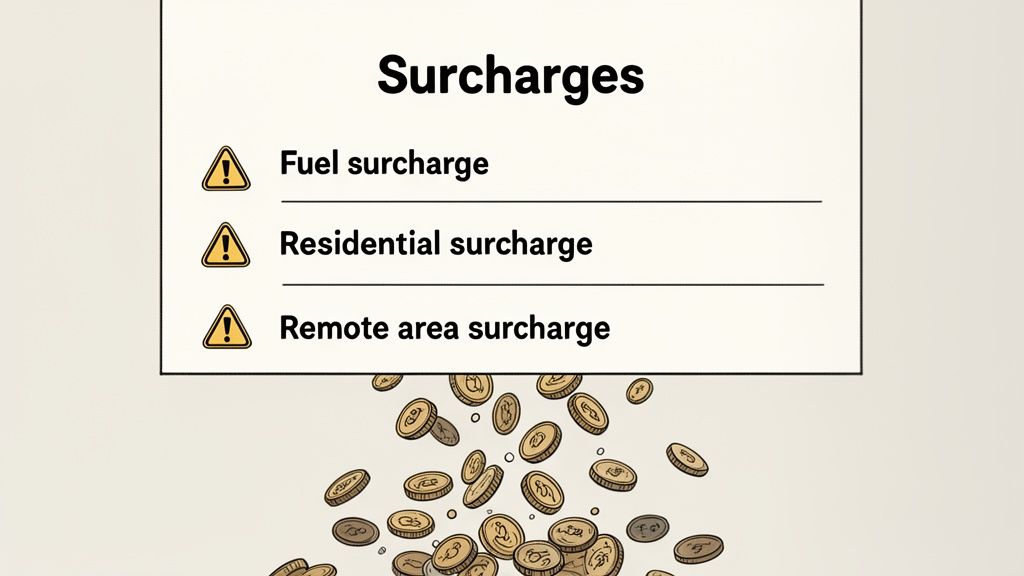
The shipping rate you see after plugging in a package’s weight, destination zone, and service level is just the starting point. The real number—the one that actually hits your invoice—is often buried under a pile of surcharges that can inflate your final cost by 20-40% or even more.
These fees aren't arbitrary punishments. From UPS's perspective, they’re necessary adjustments for anything that requires extra effort, complicates logistics, or accounts for volatile costs like fuel. For a Shopify merchant, though, they’re margin killers hiding in plain sight. A simple typo in a customer's address can be all it takes to turn a profitable order into a loss.
The Most Common Surcharges to Watch For
Let's break down the usual suspects you'll find on your UPS international invoices. Knowing what triggers them is the first step to getting your costs under control.
Fuel Surcharge: This is a big one. It's a variable percentage that UPS adjusts weekly or monthly based on global fuel prices. Since international shipping leans heavily on air freight, this surcharge alone can easily add 10-15% to your base rate. You can't avoid it, but you absolutely have to account for it in your pricing strategy.
Residential Surcharge: If you’re a direct-to-consumer brand, you can pretty much count on seeing this fee on every single shipment. Delivering to a home address is simply less efficient for UPS than dropping off a truckload of packages at one commercial building. So, they charge you for it.
Delivery Area & Remote Area Surcharge: This is the surcharge that catches so many merchants off guard. UPS applies a Delivery Area Surcharge (DAS) for addresses in less-populated ZIP codes—even if they’re technically part of a major metro area. The Remote Area Surcharge (RAS) is the more expensive version for places that are genuinely far-flung.
Imagine your customer's suburb is classified as an "extended" delivery area. Boom—an extra fee of over $15 gets tacked onto your bill just to cover that last mile. If your profit margin on that order was only $12, you've just paid to ship that product.
Beyond the Basics: Customs, Handling, and Annual Hikes
It doesn’t stop there. For international shipping, your final UPS cost is also shaped by how your package is handled and how it crosses the border.
Additional Handling: Your packaging choices can come back to haunt you here. If your box is an odd shape (like a tube), isn't completely wrapped in cardboard, or is over certain weight or size limits, it requires manual sorting. UPS will charge you for that extra labor.
Customs Brokerage, Duties, and Taxes: Every cross-border shipment needs to clear customs. UPS can act as the customs broker to handle the paperwork, but that service has a fee. More importantly, you have to decide who pays the import duties and taxes levied by the destination country. Do you absorb the cost for a seamless customer delivery (DDP - Delivered Duty Paid)? Or do you pass it to the customer (DDU - Delivered Duty Unpaid) and risk them refusing the package and lighting up your support channels?
These fees become even more painful when you factor in annual price increases. For instance, UPS announced a 5.9% average General Rate Increase (GRI) for 2026, which makes all of these surcharges more expensive. The Remote Area Surcharge, for example, jumped by 7-8% in a recent hike, pushing that fee well into the $15 to $17 range on many routes.
For a Shopify store, a last-minute address correction that shifts a delivery into one of these zones can instantly add a $15+ charge to your invoice. That’s a huge blow to profitability, especially on international orders. You can see a more detailed analysis of these annual carrier adjustments and their impact on e-commerce shipping.
Practical Ways to Cut Your UPS International Costs
Knowing why your UPS international shipping cost is so high is one thing. Actually doing something about it is another. So, let’s move past the theory and get into a handful of proven tactics you can put to work today to protect your profit margins on every single cross-border order.
These aren't just one-off tricks to find a cheaper rate. They're about making your entire fulfillment operation smarter—from how you pack a box to how you handle customer service long after the sale is complete.
Master Your Packaging to Beat DIM Weight
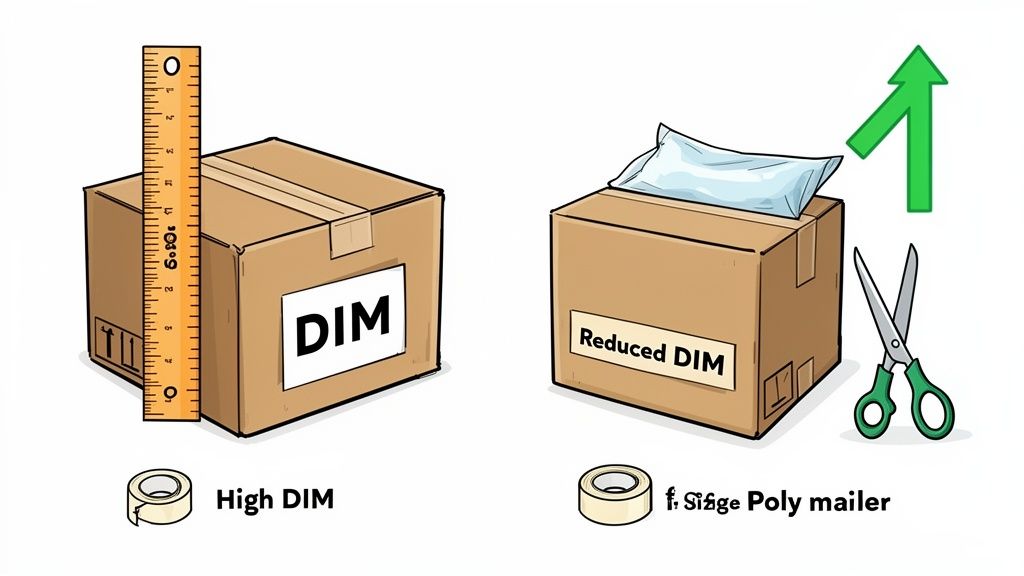
If there's one silent margin-killer in e-commerce, it's dimensional (DIM) weight. Since UPS bills for the greater of a package's actual weight and its DIM weight, every oversized box is like shipping cash to your customers. The fix is simple, but it requires discipline: optimize your packaging.
Think of it like this: every cubic inch of empty space inside your box is space you're paying to ship. By shrinking that wasted space, you directly lower your billable weight and, with it, your base shipping rate.
Here’s a simple game plan:
- Right-Size Your Boxes: Take a hard look at your product lineup and build a small, corresponding set of standard box sizes. The goal is to find a box that fits each product combination snugly, leaving just enough room for essential padding.
- Embrace Poly Mailers: For anything durable and non-fragile—think t-shirts, accessories, or soft goods—ditch the box altogether. Poly mailers are incredibly lightweight, take up almost no space, and can slash your billable weight.
- Consider Custom Packaging: If you move a high volume of standard-sized products, investing in custom-fit boxes can pay for itself surprisingly quickly. That initial upfront cost is often dwarfed by the long-term savings on every package you ship.
Strategically Choose the Right Service Level
The fastest shipping option is almost never the most profitable one. While a service like UPS Worldwide Express® gets packages delivered at lightning speed, its premium price tag can easily wipe out your entire profit on an order. The real key is matching the service level not just to the customer's desire for speed, but to your own financial reality.
For a lot of direct-to-consumer brands, UPS Worldwide Expedited® hits that sweet spot. It offers a reliable 2-5 business day delivery window at a cost that’s far more manageable than the express options. By setting clear delivery expectations at checkout, you can gently guide customers toward this more cost-effective choice. If you want a deeper dive, our guide on the cheapest way to ship from the US to the UK has some great, specific examples.
Don't offer a service level you can't actually afford. It’s far better to be transparent about a 5-day delivery window and stay profitable than to offer 2-day delivery and lose money on every international sale.
Negotiate Your Carrier Contract
As soon as your shipping volume starts to grow, you gain leverage. Never assume the standard retail rates you see online are the only rates available. If you're shipping consistently, it’s absolutely time to talk to UPS about a custom contract.
A dedicated UPS account representative can work with you to build a pricing plan that reflects your unique shipping patterns. This can unlock several major benefits:
- Lower Base Rates: Straight-up discounts on the specific service levels you use most.
- Surcharge Reductions: The ability to negotiate down common fees like the Residential Surcharge or Delivery Area Surcharge.
- An Improved DIM Factor: A higher dimensional weight divisor makes your packages less likely to be billed based on their size instead of their actual weight—a huge win.
This is a non-negotiable step for Shopify Plus merchants and other high-volume stores, where even a tiny percentage discount translates into thousands of dollars in savings each year. Don't be afraid to start the conversation. The worst they can say is no, and the potential upside is enormous.
How Post-Purchase Operations Control Shipping Expenses
Thinking you can relax once a package is out the door? Think again. Some of the biggest (and most avoidable) hits to your bottom line happen after the customer clicks "buy." Simple slip-ups, like a typo in an address or a last-minute order change, can quickly spiral a profitable international sale into a logistical money pit.
But here’s the good news. By tightening up your post-purchase operations, you're not just creating happier customers; you're actively defending your profit margins. It's time to stop seeing post-purchase as a cost center and start treating it as a strategic tool for financial health.
Eliminate Reshipments with Address Validation
There's no faster way to burn money on shipping than having a package returned because of a bad address. A single mistyped postal code can send your product on an expensive round-trip journey right back to your warehouse. When that happens, you’re not just out the original shipping cost—you have to pay it all over again to reship the order.
Suddenly, you've paid double the shipping for a single sale. Even worse, international returns often rack up extra processing fees and customs headaches, grinding your profits down even further. This whole mess is a massive, and totally unnecessary, drain on your budget.
The answer is to catch these mistakes before they ever become a problem by using real-time address validation.
By plugging a tool like the Google Maps API into your checkout or order management page, you can have addresses checked and corrected on the fly. This one simple move all but eliminates undeliverable shipments, saving you from the sky-high cost of reshipments and the customer support nightmare that comes with them.
Prevent Rerouting Fees with Customer Self-Edits
What happens when a customer spots a typo in their shipping address just moments after placing an order? It usually triggers a frantic email to your support team, which then has to race against the clock to fix the order before it ships. If they're too late, you're looking at costly rerouting fees from UPS or, worse, a completely lost package.
There’s a much smarter way: let customers fix their own mistakes. Give them a short, self-service window—maybe 30-60 minutes after purchase—to edit their shipping details. This empowers shoppers to make corrections without ever needing to contact your team.
The financial payoff is huge:
- You dodge rerouting charges that UPS applies for in-transit address changes.
- You cut down on support tickets, freeing up your team for more important work.
- You prevent lost packages and the cost of replacing both the product and the shipping.
Giving customers this brief window of control provides a huge layer of security for your operations and directly slashes preventable shipping costs.
Absorb High Costs with Post-Purchase Upsells
Let's be real: even with the best discounts, international shipping will always cost more than domestic. A great way to cushion that blow is by increasing your Average Order Value (AOV). When each order brings in more revenue, your business can absorb that higher UPS international shipping cost without blinking.
One of the best tactics for boosting AOV is the post-purchase upsell. Right after a customer has paid, you can hit them with a compelling, one-click offer to add a related item to their order. It's a fantastic way to increase the total sale without adding any friction to the original checkout. For Shopify merchants looking to set this up, exploring how a multi carrier shipping solution can help is a great starting point.
By transforming your thank you and order status pages into sales opportunities, you turn a dead end into a revenue stream. That extra income acts as a buffer, making those steep international rates feel a lot more manageable.
Operational Leaks vs. Strategic Fixes
Many Shopify merchants unknowingly let small operational issues drain their profits, especially with complex international orders. These "leaks" seem minor on their own, but they add up to significant losses over time. The key is to plug them with proactive, strategic fixes.
Here’s a breakdown of common costly problems and how you can solve them before they ever start.
| Costly Problem | How It Inflates Shipping Costs | The SelfServe Solution |
|---|---|---|
| Address Typos | The package is returned as undeliverable. You pay for the return trip and have to pay again to reship it. | Automatic Address Validation checks and corrects addresses in real-time, preventing failed deliveries. |
| Wrong Order Placed | Customer requests a return or exchange, forcing you to pay for return shipping and a new shipment out. | Self-Serve Order Edits let customers fix their own order (size, color, etc.) within a set time, avoiding returns. |
| "Where Is My Order?" Tickets | Customers tie up support agents with tracking questions, increasing your operational overhead. | A Branded Tracking Page gives customers all the info they need, reducing support tickets by up to 70%. |
| Last-Minute Changes | Customer emails support to change an address post-shipment, resulting in costly carrier rerouting fees. | A Customer-Facing Edit Window lets shoppers fix their own address before it ships, eliminating these fees entirely. |
By addressing these operational challenges head-on, you're not just saving a few dollars on shipping. You're building a more resilient, efficient, and profitable business from the moment an order is placed until it's safely in your customer's hands.
Your Top UPS International Shipping Questions, Answered
Even after you’ve got the basics down, a few tricky questions always seem to pop up when you start shipping globally. Let’s tackle some of the most common ones we hear from merchants grappling with UPS international shipping costs.
Getting clear on these points can be the difference between a healthy profit margin and a surprise loss on an order.
How Can I Get an Accurate Cost Estimate?
For a quick, ballpark figure, the official UPS "Calculate Time and Cost" tool is your best starting point. You'll need the package's exact weight, its dimensions (L x W x H), and the customer's full address to get a decent baseline. If you're on Shopify, an integrated shipping app is even better, as it can pull real-time rates for you right at checkout.
Crucially, remember to add a buffer of 15-30% to any base rate you see. This is the expert move. An initial quote rarely includes things like fuel surcharges, residential delivery fees, or other potential costs. Without that buffer, you're almost guaranteed to undercharge for shipping.
What Is the Difference Between Worldwide Express and Expedited?
This question really boils down to a classic trade-off: speed versus cost.
- UPS Worldwide Express®: Think of this as the premium, white-glove service. It’s the fastest option, promising delivery in 1-3 business days, often by a specific time of day. It’s fantastic for urgent shipments but comes with the highest price tag.
- UPS Worldwide Expedited®: This is the workhorse service for most e-commerce businesses. It offers a solid delivery window of 2-5 business days without the strict time-of-day guarantee. For most brands, it hits the sweet spot between keeping customers happy and keeping costs in check.
Why Was I Charged a Remote Area Surcharge for a City Address?
This one trips people up all the time. A "remote area" isn't defined by how rural a place looks on a map; it's defined by UPS's own logistics network. Some suburban or even urban-adjacent postal codes are simply more time-consuming or expensive for their drivers to get to, so they get tagged with an extended area surcharge.
This is precisely why address validation tools are so valuable. They can flag a postal code that falls into one of these surcharge zones before you finalize the shipment, saving you from an unexpected fee that can easily top $15. Even a simple typo can sometimes trigger this charge, making accurate address data your best defense against surprise costs.
By letting customers manage their own orders after purchase, SelfServe helps you slash support tickets, stop costly shipping mistakes before they happen, and even boost revenue with smart upsells. Take charge of your post-purchase experience by visiting getselfserve.com to start your free trial.