Flat Rate vs Priority Mail: Your Ultimate 2026 Shipping Guide
When you're trying to figure out your shipping strategy, one of the first questions you'll hit is: USPS Flat Rate or standard Priority Mail? The right choice really just depends on two key things: your package's weight and its destination.
For small, heavy items headed across the country, a Flat Rate box is almost always your best friend. But for lighter packages or anything shipping to a nearby state, the weight-based pricing of standard Priority Mail will usually save you a good bit of cash.
Your Decisive Answer to the Shipping Dilemma
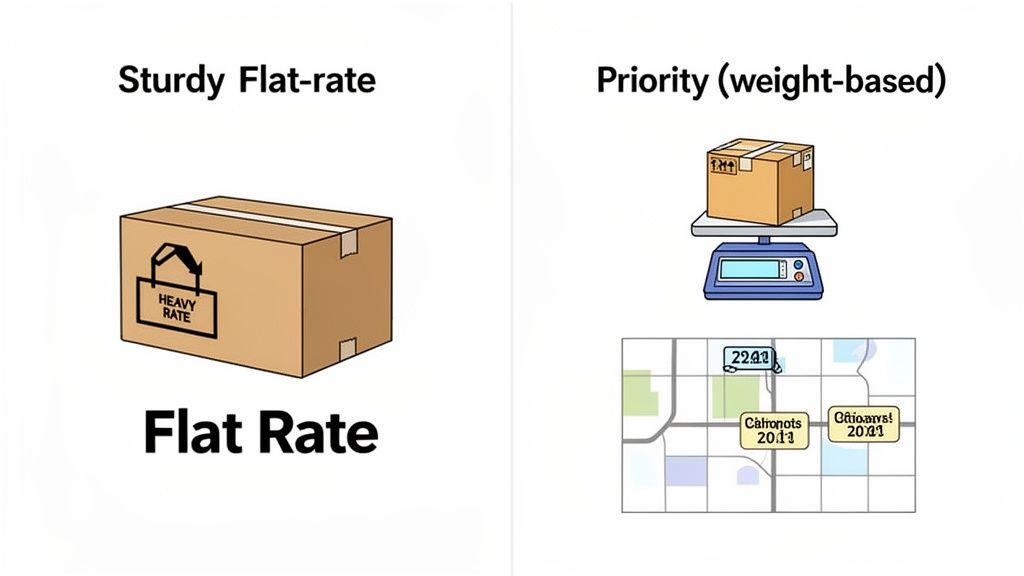
Getting this right isn't just a small detail; it's a core skill for any ecommerce store owner. This single decision can directly eat into—or protect—your profit margin on every order you ship. At its core, the choice is between a fixed-rate shipping cost versus a variable one.
With USPS Priority Mail Flat Rate, you ship for one set price. The only rules are that your item has to fit inside one of the official Flat Rate boxes and weigh less than 70 pounds. On the other hand, the price for standard Priority Mail is calculated based on how much the package weighs and how far it has to travel (its shipping zone).
Making the Right Choice
This difference creates some very clear-cut situations where one service is the obvious winner.
Let's say you're shipping something dense, like a 5-pound set of cast-iron coasters. Sending that package from New York to California would get pricey with weight-based shipping. But if you can get it into a Small Flat Rate Box, you pay one predictable price no matter the distance. Simple.
Now flip that around. Imagine you're shipping a lightweight t-shirt that's only 8 ounces to a customer one state away. In this case, standard Priority Mail will be significantly cheaper. Paying for a Flat Rate box here would just be throwing money away on postage you don't need.
The core principle is straightforward: use Flat Rate for heavy items going far and standard Priority Mail for light items going short distances. Mastering this rule is key to optimizing your shipping budget.
To make it even clearer, here’s a quick breakdown of how the two services stack up against each other. Understanding these factors is the first step toward building a smarter shipping strategy that protects your margins and keeps your customers happy.
| Feature | USPS Flat Rate | USPS Priority Mail (Weight-Based) |
|---|---|---|
| Pricing Model | Fixed price per box size | Variable price by weight and zone |
| Packaging | Must use official USPS Flat Rate boxes | Can use your own custom packaging |
| Weight Limit | Up to 70 lbs for a single price | Priced per pound up to 70 lbs |
| Best For | Heavy, dense items and long distances | Lightweight items and short distances |
| Budgeting | Highly predictable and easy to forecast | Requires calculation for each order |
Understanding the Mechanics of Each Shipping Service
Before you can pick the right shipping option, you need to know how USPS actually prices these services. The whole flat rate vs priority mail choice boils down to one thing: how the cost is calculated. Think of it as a decision between a variable cost and a fixed one.
Standard Priority Mail is the variable option. The price you pay is determined by two simple things: the package's actual weight and the shipping zone it's heading to. Put simply, the lighter the item and the closer the destination, the less you'll pay.
If you’re sending a small, light product to a customer just one state over, standard Priority Mail will almost always be the cheaper way to go. The cost lines up directly with how much work it takes to get the package there.
How Flat Rate Changes the Game
This is where USPS Flat Rate flips the script. It works on that famous “if it fits, it ships” principle. You get one set price to ship anything you can cram into an official Flat Rate box, as long as it’s 70 pounds or less.
With Flat Rate, weight and distance are thrown right out the window. A 5-pound package costs the exact same to ship as a 65-pound one. A box traveling across town has the same postage cost as a box going clear across the country.
It's crucial to understand that Flat Rate is not a separate, slower service. It is a pricing structure within the Priority Mail service. This means both options share the same estimated delivery window of 1-3 business days and include identical features like USPS Tracking and included insurance.
Many merchants miss this detail. When you're choosing between the two, you aren't giving up speed or features—you’re just picking the pricing model that saves you the most money on that specific shipment. Getting this right is the key to making smarter, more profitable shipping decisions. For a deeper look at the specific sizes and rates, our complete guide to USPS Priority Mail boxes and rates has you covered.
The Role of Packaging
This is the one rule you can't afford to get wrong: the box you use is everything. It’s the critical difference between the two pricing models and a place where new merchants often make expensive mistakes.
Priority Mail (Weight-Based): You’re in control here. Feel free to use your own custom-branded boxes, poly mailers, or whatever packaging fits your product and brand aesthetic. This is perfect for creating a unique unboxing experience.
Priority Mail Flat Rate: You must use the official, co-branded USPS Flat Rate boxes or envelopes. You can get them for free from USPS, but they are not optional. If you use your own box—even one with the same dimensions as a Flat Rate box—you’ll be charged the standard (and likely more expensive) weight-and-zone Priority Mail rate.
You have to get this packaging rule right. It’s the specific barcode printed on the official Flat Rate box that tells the USPS system to apply the fixed price. No special box, no special price. It's that simple.
Unpacking the Real Costs: A Detailed Comparison
When you're trying to decide between USPS Flat Rate and Priority Mail, it all comes down to the numbers. The real trick isn't just knowing the basics; it's about pinpointing the exact moment one service becomes a better deal than the other. This "break-even" point isn't fixed—it shifts based on your package's weight and how far it has to travel.
Let’s get into the specifics of when and why you'd pick one over the other, using real-world pricing to make the decision clear.
Finding the Break-Even Point for Weight and Distance
For any online seller, the million-dollar question is simple: at what weight does a Flat Rate box save you money over standard Priority Mail? The answer, as any logistics pro will tell you, is "it depends." For a package going just a few towns over, you can ship something fairly heavy before Flat Rate makes sense. But for a coast-to-coast shipment, Flat Rate becomes a bargain for even surprisingly light items.
This chart gives you a great visual of how the costs can separate.
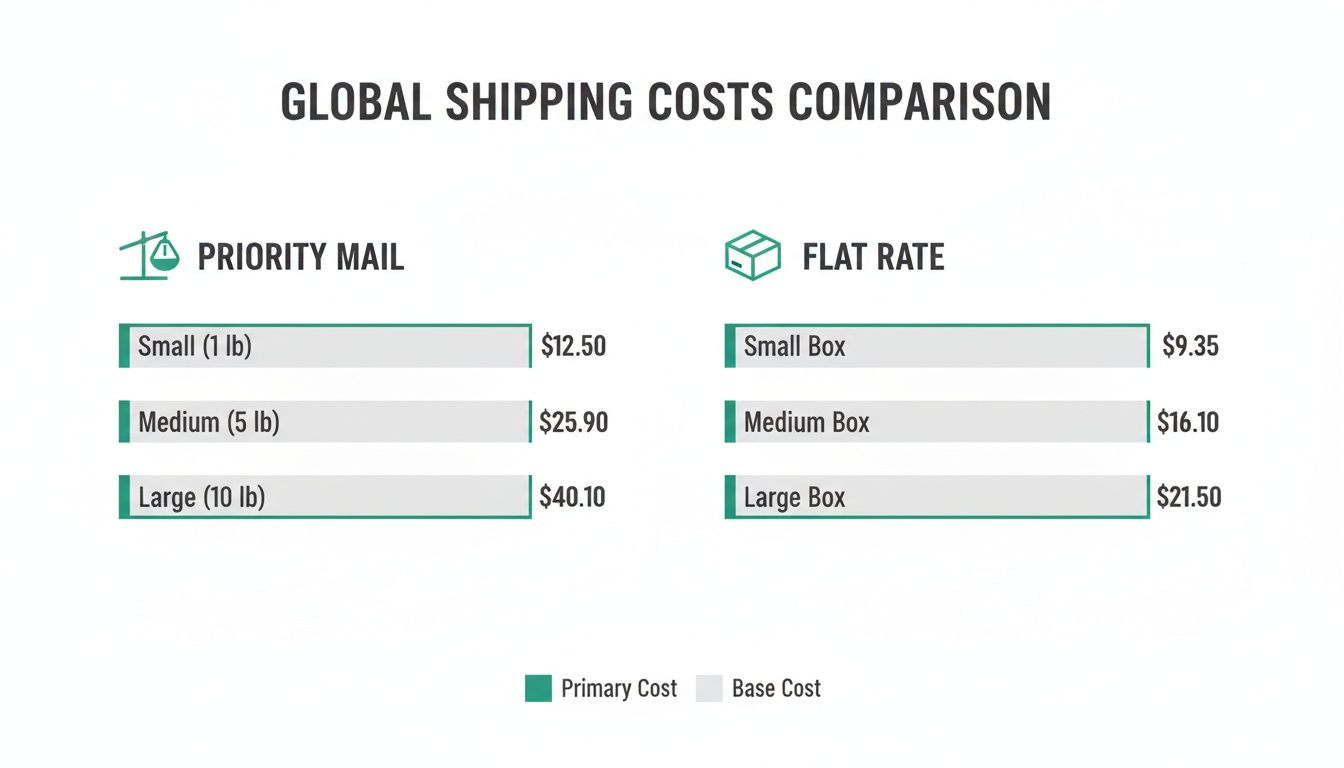
As you can see, standard Priority Mail costs creep up with every pound and every shipping zone crossed. Flat Rate, on the other hand, is your predictable constant, making it a lifesaver for heavy products going long distances.
The rule of thumb I always share with merchants is this: distance makes Flat Rate valuable. A 2-pound package might be cheaper to send locally with standard Priority Mail, but that exact same package is almost certainly better off in a Flat Rate box if it's heading across the country.
So, where is that tipping point? For local shipments (Zones 1-2), you’ll find that standard Priority Mail is usually cheaper until you hit the 2-3 pound mark. But for a cross-country shipment to a distant zone, that break-even point can drop to just over 1 pound.
For instance, shipping a 2-pound package locally might cost you around $9.85 with standard Priority Mail, while a Medium Flat Rate Box would be a pricey $19.60. The tables turn dramatically for longer trips; once a package hits 11 pounds or more, a Medium Flat Rate Box is almost always the cheaper choice for distant zones compared to weight-based Priority Mail.
Why You Absolutely Need Commercial Pricing
Here’s a non-negotiable for any business that’s serious about shipping: you cannot afford to pay retail rates at the Post Office counter. Commercial pricing, the discounted rate you get through shipping software, is essential for protecting your profit margins.
These discounts are significant, often shaving 15-20% or more off the cost of both Flat Rate and standard Priority Mail. Over hundreds or thousands of orders, those savings can be the difference between a struggling business and a thriving one.
To help you see the differences at a glance, here’s a quick breakdown of the core features.
USPS Flat Rate vs. Priority Mail Feature Comparison
| Feature | USPS Flat Rate | USPS Priority Mail (Weight-Based) |
|---|---|---|
| Pricing Model | Fixed price based on box size, regardless of weight or distance. | Price varies based on package weight, dimensions, and shipping distance (zones). |
| Packaging | Must use the official USPS-branded Flat Rate boxes or envelopes. | Use your own branded boxes, poly mailers, or any custom packaging. |
| Delivery Speed | 1-3 business days. | 1-3 business days. |
| Weight Limit | Up to 70 lbs for all boxes and envelopes. | Up to 70 lbs. |
| Tracking | USPS Tracking included. | USPS Tracking included. |
| Insurance | Up to $100 of insurance included. | Up to $100 of insurance included. |
| Best For | Heavy, dense items traveling long distances. Predictable shipping costs. | Lightweight items, shipments to nearby zones, and using custom branded packaging. |
As the table shows, the core service features are nearly identical. The decision really boils down to cost and packaging.
Key Service Differences to Know
Beyond the price, a few operational details will steer your choice.
Packaging Rules
- USPS Flat Rate: This is rigid. You must use the official, free, USPS-branded Flat Rate packaging. The specific barcode on those boxes is what locks in the fixed price. If you use your own box, you'll be charged the standard weight-based Priority Mail rate, even if it’s the same size.
- USPS Priority Mail (Weight-Based): You have total freedom here. Use your own branded boxes to create a memorable unboxing experience, or stick with plain poly mailers for efficiency. The choice is yours.
Delivery Speed
This is a frequent point of confusion, so let's be crystal clear: both services offer the same estimated delivery window of 1-3 business days. Flat Rate is just a pricing structure within the Priority Mail service, not a different, slower product. Your choice is about cost, not speed.
Insurance and Tracking
Both Flat Rate and standard Priority Mail come with USPS Tracking and up to $100 of included insurance. The service level and security are exactly the same, which simplifies things. This consistency means you can focus purely on the economics. When you start looking at other service tiers, these features often change, as you'll see when comparing economy shipping vs standard shipping options.
By getting a handle on these break-even points and operational details, you can stop guessing and start building a smarter, more cost-effective shipping strategy for every single order.
Strategic Use Cases for Ecommerce Merchants
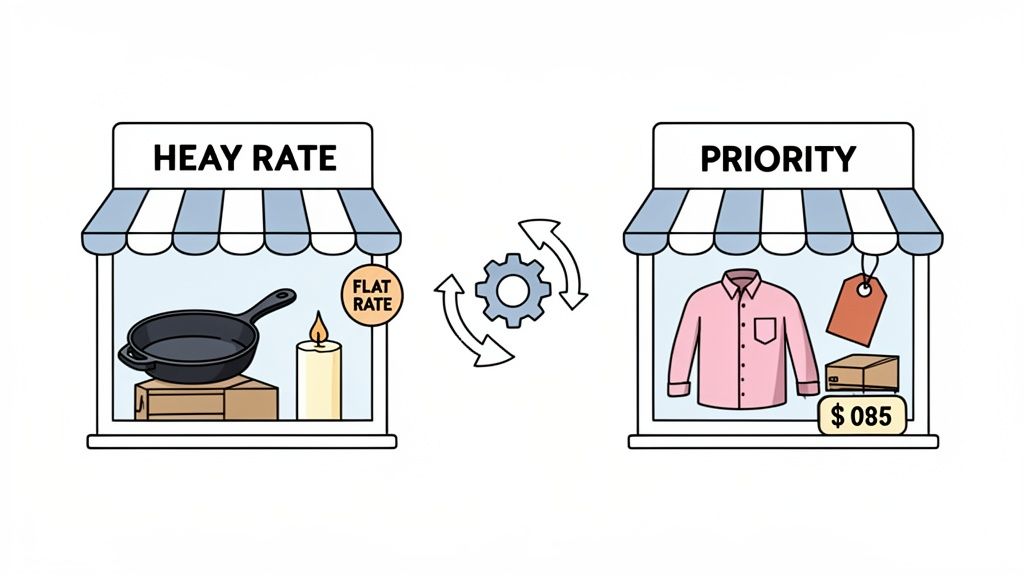
Knowing the difference between Flat Rate and Priority Mail is just the start. The real skill is knowing when to use each one to protect your profit margins. The right choice depends entirely on what you’re selling and where you’re sending it.
Honestly, choosing the wrong shipping service is like throwing money away on every single order. When you match your products to the right service, you build a smarter, more profitable business. Let’s get into the practical playbooks for when each service makes the most sense.
The Flat Rate Playbook for Heavy or Dense Goods
For some merchants, USPS Flat Rate is more than just another shipping option—it's a core part of their business model. If you sell products that are heavy but relatively compact, Flat Rate should be your go-to. Having one predictable shipping price, no matter the weight or destination, is a game-changer for simplifying your finances.
Take a DTC brand selling cast-iron cookware. A single 10-pound skillet would cost a fortune to ship across the country using standard, weight-based rates. But if that skillet fits neatly into a Medium or Large Flat Rate Box, the cost is suddenly fixed and manageable. This is how brands can confidently offer competitive, or even free, shipping nationwide.
This strategy is a perfect fit for anyone selling items like:
- Artisanal Candles: The combination of heavy wax and glass makes these surprisingly dense, and they often fit perfectly in Flat Rate boxes.
- Tools and Hardware: Heavy metal items are a no-brainer for Flat Rate, as they quickly become expensive to ship with weight-based options.
- Books and Paper Goods: A box full of books can easily top 5 pounds, making Flat Rate the obvious winner.
- Small Batch Food Products: Think jars of sauce, honey, or preserves. They're heavy, and a fixed shipping cost protects your margins.
The real power of Flat Rate is that it transforms a wildly variable shipping expense into a predictable, fixed cost. For businesses selling heavy items, that predictability is a massive advantage for forecasting and crafting irresistible shipping offers.
By standardizing your shipping costs this way, you can bundle products, run promotions, and calculate your profitability without constantly worrying about where the package is headed.
The Priority Mail Advantage for Lightweight Items
On the flip side, if your inventory is light, standard Priority Mail is where you'll find the best value. One of the most common mistakes I see is merchants forcing lightweight items into a Flat Rate box. You end up paying for weight you aren't using, which directly cuts into your profit on every sale.
Imagine an apparel brand shipping a single t-shirt. The package might only weigh 8 ounces. Using weight-based Priority Mail, especially for a local delivery, would be extremely affordable. Shoving that same t-shirt into a Flat Rate Padded Envelope could easily double or even triple your shipping cost.
Merchants who will almost always save money with standard Priority Mail include those selling:
- Apparel and Fashion: T-shirts, socks, and other light garments are perfect for your own poly mailers.
- Art Prints and Stationery: Lightweight paper goods shipped in rigid, flat mailers are cheap to send.
- Small Accessories: Think jewelry, phone cases, and other small products that don't weigh much.
For these kinds of businesses, using your own branded packaging is another huge plus. Custom boxes and mailers create a memorable unboxing experience—a critical touchpoint for building customer loyalty that you just can't get with the required USPS-branded Flat Rate packaging.
Implementing a Hybrid Shipping Strategy
The truth is, the most successful merchants don't pick just one service. They use both. The ultimate goal is to build a hybrid strategy where your system automatically chooses the cheapest option for every single order. This ensures you are never, ever overpaying.
Most modern ecommerce platforms, like Shopify, can be set up to do exactly this. Once you input your product weights and the dimensions of your preferred boxes, the platform’s shipping calculator can check real-time rates for both standard Priority Mail and the available Flat Rate options. It then automatically selects the most cost-effective one for that specific cart.
For example, a subscription box company might have a light box one month with tea samples and a booklet, but a heavy box the next with a ceramic mug and coffee beans. A hybrid setup would automatically ship the light box via Priority Mail and the heavy one via Flat Rate, optimizing the cost every time without anyone lifting a finger. This dynamic approach to the flat rate vs priority mail decision is how high-volume stores save thousands of dollars a year.
Optimizing Your Post-Purchase Experience
Thinking your shipping strategy ends once the customer clicks "buy" is a common and costly mistake. The reality is that your shipping choices ripple all the way through the post-purchase experience, where they can either build loyalty or become a serious operational headache.
One of the quickest ways to frustrate a happy customer is with surprise shipping fees, especially when they try to edit an order they just placed. Picture this: a customer is so excited about their purchase that they decide to grab an extra item from your post-purchase upsell offer on the Order Status Page. This should be a clear win. But if adding that item causes the shipping cost to jump unpredictably, that excitement can quickly turn into confusion and cart abandonment.
This is where your decision between USPS Flat Rate vs. Priority Mail becomes so important for customer satisfaction.
Making Post-Purchase Edits and Upsells Seamless
If you’re giving customers the power to edit their own orders with a tool like SelfServe, you absolutely need a predictable shipping framework. When a customer adds another product, the system has to figure out what to do with the shipping cost. If you're only using weight-based Priority Mail, that cost can swing dramatically, creating a confusing experience that kills the upsell.
A much smoother way to handle this is by using Flat Rate pricing. When a customer adds that extra item, instead of a strange new price, they see a simple, fixed-rate shipping upgrade. That kind of transparency is what makes for a great customer journey.
The goal is to make a post-purchase upsell feel like a seamless addition, not a penalty. A predictable Flat Rate option gets rid of the sticker shock from a recalculated weight-based fee, encouraging more customers to complete the add-on purchase and boosting your average order value.
This doesn't just make customers happier; it also dramatically cuts down on the support tickets your team has to field. When the final cost is clear and easy to understand, customers have no reason to reach out with complaints.
This screenshot shows how a solution like SelfServe can integrate directly into the post-purchase flow, creating opportunities for these kinds of seamless edits and upsells.
By presenting clear options right on the order status page, you empower customers to make changes themselves, turning a potential support burden into a new revenue stream.
Reducing Support Tickets with Predictable Costs
Unexpected shipping fees are one of the biggest drivers of customer support tickets and refund demands. Getting your shipping strategy right, particularly for modified orders, can have a huge impact on your team's workload.
For Shopify merchants enabling post-purchase edits, communicating a fixed, predictable shipping cost is essential for cutting down on refund requests and "why did my shipping change?" tickets. In fact, merchants who switched to Flat Rate pricing for these scenarios saw a 30-40% reduction in shipping-related customer service inquiries. It just works—customers instantly understand the final cost without needing to worry about complex zone calculations. You can see more on how merchants are improving post-purchase transparency over on Shippo's blog.
By setting up these rules, you can automate the entire process. The system can be configured to offer a Flat Rate option automatically whenever an order's weight or dimensions change, which protects your margins while keeping the customer happy. This kind of automation is a cornerstone of an efficient business, freeing up your team from answering simple shipping questions.
Finally, a great post-purchase experience is directly tied to effective order tracking. You can learn more by reading our guide on how to choose the right track package software. Ultimately, a smart shipping setup makes your entire post-purchase flow more profitable and easier to scale.
Common Questions About USPS Shipping
Even with a solid shipping strategy, a few persistent questions always seem to pop up, especially when deciding between USPS Flat Rate and Priority Mail. Let's tackle some of the most common points of confusion I hear from merchants so you can get your orders out the door with confidence.
One of the biggest tripping points for new sellers is packaging. Can you use your own branded box and still get the Flat Rate price?
The answer is a hard no. To qualify for that fixed Flat Rate price, you must use the official, co-branded USPS Flat Rate boxes or envelopes. That specific packaging is what tells the system to apply the flat rate.
If you use your own box, the package automatically defaults to the standard, weight-based Priority Mail rate. This can lead to a nasty surprise with underpaid postage, creating a bad experience for you or, even worse, your customer. Think of the packaging as the service itself—you can't have one without the other.
Are Flat Rate and Priority Mail the Same Speed?
Another common assumption is that Flat Rate must be slower because it's often cheaper. That's a myth.
Flat Rate isn't a separate, slower service; it's just a different way to pay for Priority Mail. Both standard Priority Mail and Flat Rate shipments have the exact same delivery window of 1-3 business days. When you're choosing between them, you're only making a decision about pricing, not speed.
Handling Oversized or Non-Conforming Items
So, what happens when your product just won't squeeze into a Flat Rate box without bulging or breaking the seams?
It's simple: if it doesn't fit, you can't ship it Flat Rate. You'll need to pack the item in your own box and send it using the standard weight-based Priority Mail service. The final cost will then depend on the package's weight, dimensions, and how far it’s traveling.
How Shipping Zones Are Calculated
That brings us to the final piece of the puzzle: shipping zones. Merchants often ask how to figure out a customer's zone to calculate those weight-based costs. While USPS does have a Domestic Zone Chart for manual lookups, you really shouldn't have to touch it.
Thankfully, this is something your store platform or shipping software handles for you. When a customer types in their address at checkout, your system automatically compares your origin address to their destination and calculates the zone in an instant. This ensures you're always showing the right rate without any manual work.
Ready to eliminate shipping confusion for good and empower your customers? SelfServe allows shoppers to manage their own post-purchase changes, from editing addresses to adding upsells, all while reducing your support workload. With a smart shipping setup, you can make these edits seamless and profitable. Start your 30-day free trial of SelfServe today and see how easy post-purchase can be.