
Global Ecommerce Solutions: Scaling Brands Guide

Global ecommerce is already too big to treat as an experiment. By 2025, worldwide online sales are projected to sit somewhere between $6.4 trillion and $7.4 trillion, and online channels are expected to handle about 20.5% of total retail sales before rising to 22.5% by 2028 Shopify's global ecommerce statistics. At that scale, the winners aren't just translating product pages, they're building operational systems that can survive payment differences, carrier exceptions, language shifts, and the mess that starts after checkout.
That last part is where many brands still underbuild. Selling internationally is easy compared with keeping the experience smooth once a shopper has already paid. If your stack can't handle address edits, delivery fixes, localized support, and post-purchase upsells without creating more work for your team, you don't have a global ecommerce solution, you have a collection of separate tools held together by process debt. The practical question isn't whether to expand. It's whether your infrastructure can absorb that expansion without turning every market into a support problem.

Why Global Ecommerce Solutions Matter Now
The market is large enough that small operational failures become expensive fast. Trade.gov says global B2C ecommerce revenue is expected to reach $5.5 trillion by 2027 at a 14.4% CAGR, while the ecommerce platform market is projected to grow from $9,078.2 million in 2025 to $16,506.9 million by 2030 at a 12.7% CAGR Trade.gov ecommerce forecast. That combination matters because it shows demand is rising while the software layer underneath it is also getting more complex, more specialized, and more competitive.
Scale changes the job of your tech stack
At domestic scale, teams can often patch problems manually. A customer support rep can correct an address, a marketer can localize a campaign by hand, and operations can absorb a few exceptions. Once you're selling across borders, those workarounds stop being harmless because the volume of exceptions grows with each region, carrier, and language.
Global ecommerce solutions exist because the old model, one storefront, one payment flow, one fulfillment logic, breaks when local expectations diverge. Teams need systems that can adapt content, currency, tax handling, and checkout logic without forcing the entire brand to move at the pace of the slowest market. That's why localization guidance like global ecommerce localization best practices matters so much, it's not cosmetic work, it's operational design.
International shoppers expect local behavior
A global storefront only feels global when it behaves like it was built for the market the shopper is in. That means local payment methods, localized messaging, accurate shipping expectations, and customer support that doesn't feel outsourced or delayed. It also means the brand has to think beyond acquisition, because a shopper who completes checkout but can't fix a mistake quickly can become a support ticket instead of a repeat buyer.
Practical rule: if a market needs special handling during checkout, it usually needs special handling after checkout too.
Global ecommerce has also become more mobile-first and regionally uneven. The market mix is not identical from one geography to another, so the stack has to support different buying habits without making the merchant rebuild the business every time it enters a new country. That's the core shift. International commerce is no longer a side channel. It's part of the operating system.
Core Components of a Global Ecommerce Stack
A strong global stack is less about stacking more tools and more about making each layer do one job well. The best setups separate content adaptation, payment handling, logistics, compliance, and analytics so a failure in one area doesn't cascade into the others. That's where architecture stops being abstract and starts affecting margin, support load, and launch speed.
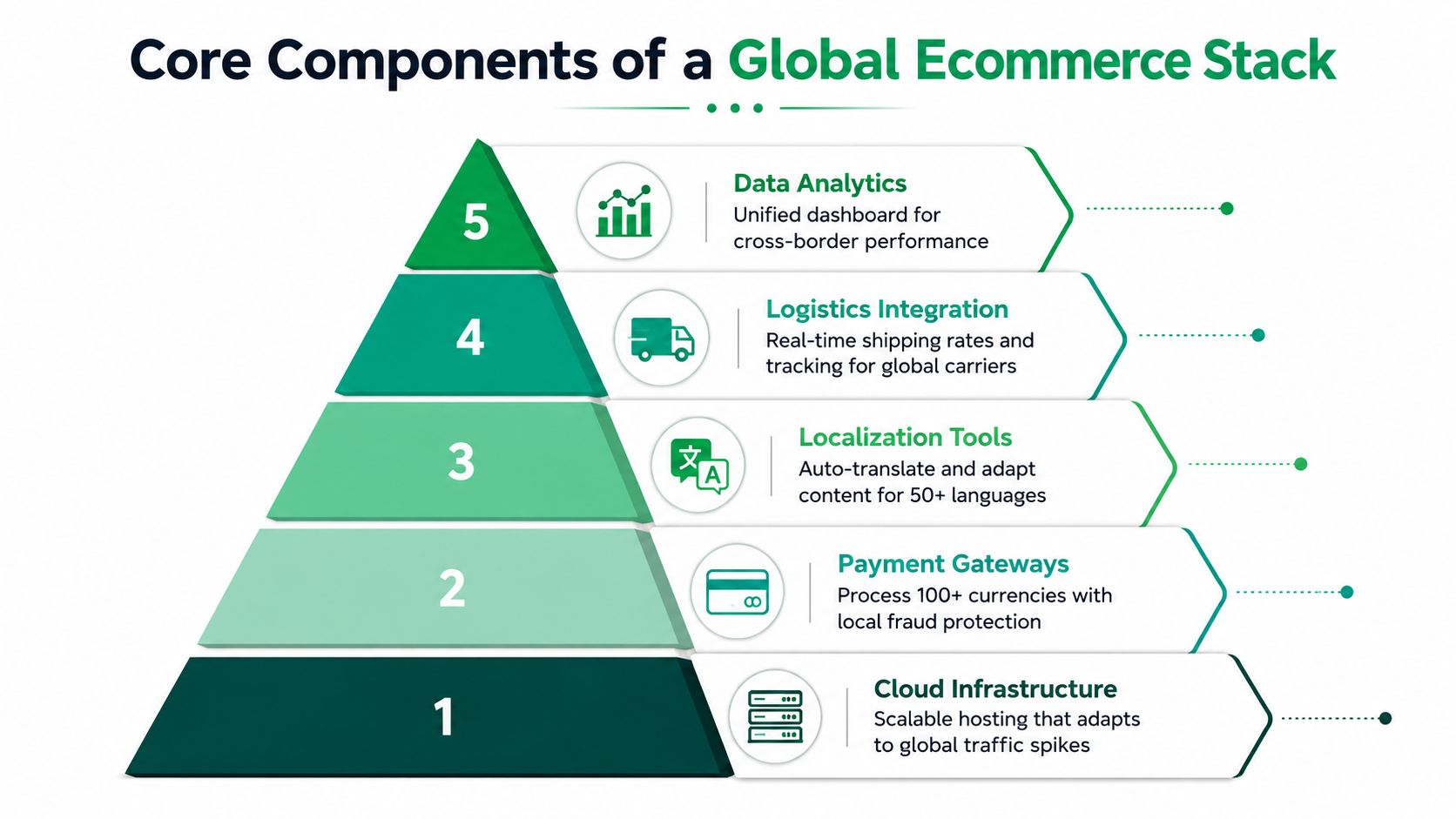
Localization, payments, logistics, and compliance have to work together
Localization is not just translation. It's currency display, market-specific merchandising, language-specific support, and content that doesn't read like a machine copied and pasted from another region. In parallel, payment orchestration needs to cover regional preferences and fraud controls without making legitimate cross-border orders look suspicious. If your checkout accepts international traffic but rejects valid payment behavior too aggressively, you're buying friction instead of conversion.
Logistics is the next failure point. Buyers need accurate rates, tracking, and shipping options that match what your fulfillment partners can deliver. If the promise on the site doesn't match the carrier reality, the support queue will catch the difference later. That's why the internal thinking behind ecommerce logistics services is useful even for brands that already have carriers in place, because the logistics layer has to be designed around customer-facing expectations, not just warehouse efficiency.
The platform layer decides how much you can change
The technical architecture underneath all of this matters more than most vendor demos admit. The clearest pattern for global ecommerce is a microservices-based architecture with well-defined domain boundaries, because it lets teams localize external services, separate payment orchestration from fulfillment, and scale volatile domains independently microservices architecture guidance. That reduces the blast radius when one region needs a change and another doesn't.
One underused layer is post-purchase automation. Tools in that category let customers edit addresses, modify orders, or add items without requiring a rep to step in. If you're evaluating newer commerce automation resources, Zinc's AI for commerce is a useful reference point for how the industry is thinking about more agentic buying and servicing flows.
What each layer should protect
- Cloud infrastructure: absorbs traffic spikes without forcing a replatform.
- Payment gateways: accept regional preferences while managing fraud risk.
- Localization tools: keep the experience native to each market.
- Logistics integration: aligns shipping promises with actual carrier performance.
- Data analytics: shows where the stack is leaking revenue or creating tickets.
The important point is that none of these layers can compensate for the others. A strong payment setup doesn't rescue weak localization. Fast logistics doesn't fix poor address data. Global ecommerce only feels integrated when the layers are designed to cooperate.
Choosing the Right Global Ecommerce Platform
Platform selection gets messy because every vendor claims to support international growth. The difference is whether the system can isolate complexity or hide it behind more admin screens. If a platform forces every market change through the same release path, you'll feel that bottleneck quickly.
| Criteria | What to Look For | Red Flags |
|---|---|---|
| Architecture | Clear domain separation, support for regional variation, and room for independent scaling | One monolithic release cycle for every market |
| Localization | Market-specific content, currency, and rules without heavy custom work | Translation only, with no operational localization |
| Payments | Strong regional payment coverage and fraud controls | A narrow gateway list that forces awkward workarounds |
| Integrations | Reliable APIs and connectors for ERP, CRM, shipping, and analytics | Manual exports or fragile middleware |
| Expansion fit | Ability to launch one region without disturbing others | Global changes that affect the entire store |
| Operational control | Support for edits, address correction, and post-purchase workflows | Support reps forced to do everything by hand |
A basic plugin stack can work for a small number of markets, but enterprise-grade global commerce usually needs a stronger backend posture. Headless or composable approaches are useful when the storefront, checkout, and service workflows need to move at different speeds, which is why headless commerce platform guidance can be valuable when teams are comparing vendor categories.
The best platforms don't just let you add more regions. They let you manage complexity without multiplying it. That's what separates a real operating platform from a front-end convenience layer.
What I look for during vendor review
I always ask whether the platform can scale a single domain independently, especially payments or fulfillment. If a vendor can't explain how one region gets a unique rule set without forcing a global rollout, that platform will create friction later.
I also look for integration depth, not just a logo wall of partners. A platform that “integrates” in name only still leaves operations buried in spreadsheets and manual exceptions. That's manageable until volumes rise, then it becomes the thing slowing every launch.
Implementation Best Practices for Multi-Market Launch
I've seen multi-market launches stall for the same reason again and again. Teams choose a target market for commercial reasons, then discover too late that support, payments, logistics, and content weren't ready for the local reality. The launch doesn't fail because demand was absent. It fails because the internal handoffs were.
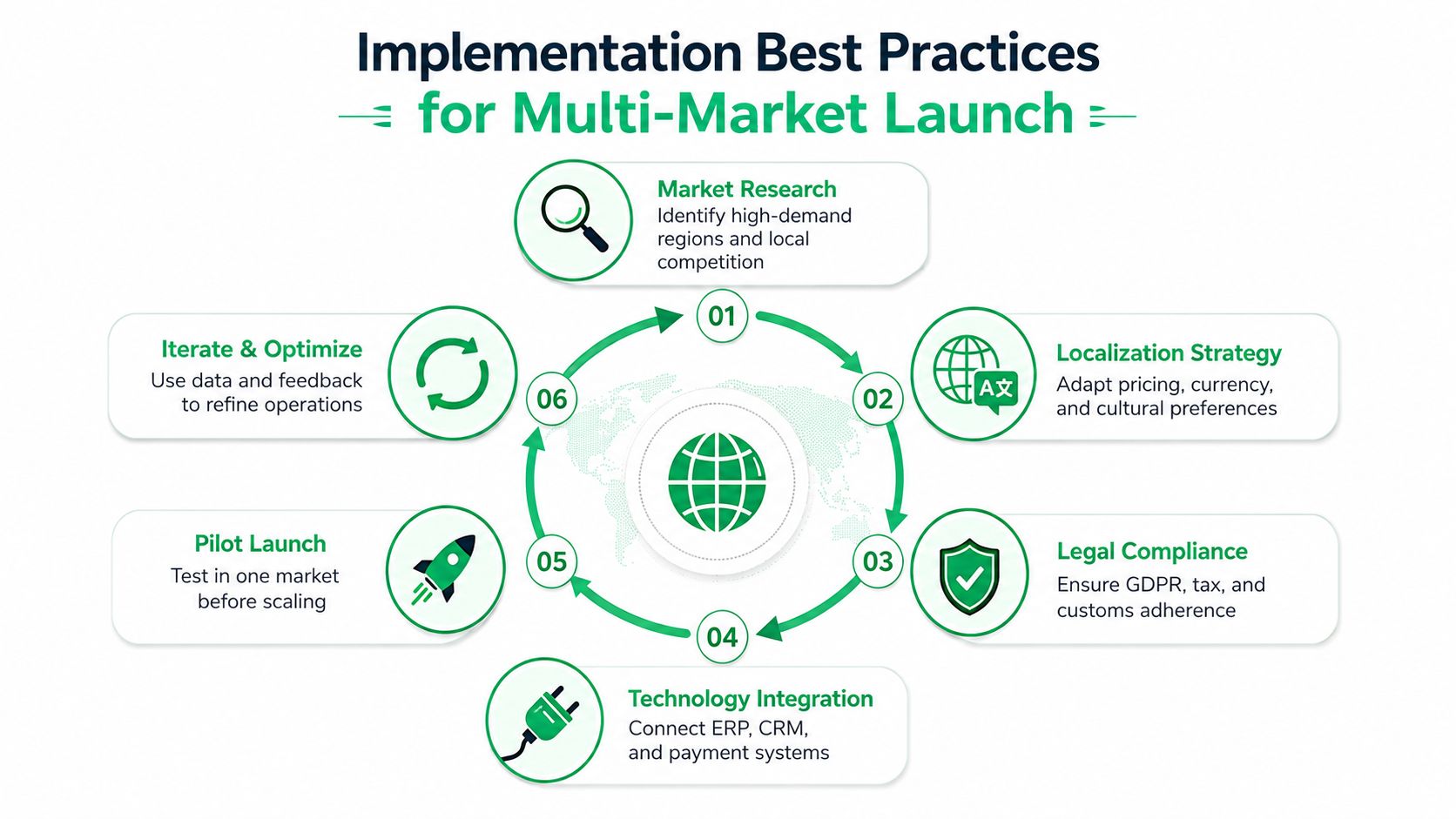
The safest rollouts start with one market that is large enough to matter and simple enough to learn from. Teams test pricing, shipping promises, payment methods, and support language before they go wider. That sounds slow, but it's cheaper than finding out after launch that your tax logic is fine while your delivery updates are unreadable.
What usually breaks first
- Market research: brands overestimate demand and underestimate support complexity.
- Localization strategy: copy gets translated, but the buying context doesn't.
- Legal compliance: teams assume one legal review covers every region.
- Technology integration: ERP, CRM, and shipping systems aren't synced cleanly.
- Pilot launch: the first market is treated like a full rollout instead of a test.
- Iteration: nobody owns the feedback loop after go-live.
The teams that do this well don't chase perfection before launch. They build a controllable pilot, observe where tickets cluster, and tighten the workflow before multiplying the problem. That's especially true where address formats, language diversity, and carrier handoffs create more ways for the order to go wrong.
A useful mental model is to treat each market as a separate operational test, not just a sales target. That mindset keeps marketing, operations, and support aligned around the same outcome, which is a functioning customer journey, not just a launch announcement.
The Post-Purchase Gap Most Global Strategies Miss
The biggest blind spot in global ecommerce is what happens after the order is placed. Most public guidance stops at localization, payments, and fulfillment, but that leaves out the most operationally expensive part of the journey, when a shopper realizes the address is wrong, the order needs a change, or the delivery details don't match local expectations. UNCTAD makes the broader point that ecommerce benefits depend on affordable ICT access, local support needs, and platforms oriented toward local businesses and consumers, but the merchant's actual pain often shows up after checkout UNCTAD ecommerce and development report.
Support teams feel the gap immediately
Cross-border orders create more exceptions than domestic ones. Customers type addresses in different formats, time zones slow down live support, and language differences make simple fixes take longer than they should. If the only way to correct an order is to open a ticket, wait for a rep, and manually edit the record, the support team becomes the correction layer for the entire store.
That's why post-purchase self-service should be treated as operational infrastructure. A multilingual order editing portal gives shoppers a controlled way to change shipping or contact details inside defined windows. Address validation with Google Maps integration catches obvious delivery mistakes before they turn into failed shipments. Permission-based edits keep merchants in control of what can be changed and when.
Tools should reduce friction, not add another workflow
SelfServe is one example of this kind of workflow on Shopify. It gives customers a self-service order editing portal, supports multilingual order management, and includes real-time address validation, which means the customer can fix a bad address without the support team manually rewriting the order. It also supports upsell flows on the Thank You and Order Status pages, so the post-purchase stage can do more than just reduce friction.
That same logic applies to tracking and delivery communication. If the delivery chain is opaque, more customers will ask for status updates, and more of those requests will reach support. For teams thinking about that handoff, the operational framing in how TMS improves last mile tracking helps connect transport visibility with customer service load.
Practical rule: if the customer can safely fix it themselves, don't force a ticket.
The post-purchase gap becomes a revenue issue as well as a service issue. The Thank You and Order Status pages are still part of the shopping experience, and they're one of the few places where the brand can expand an order without making the customer start over. Global brands that ignore that moment leave money on the table and make their support teams carry avoidable work.
Measuring ROI from Global Ecommerce Investments
ROI in global ecommerce is easy to misread if you only look at top-line sales. A market can be growing while support costs rise, order errors increase, and teams spend more time cleaning up after checkout. The right measurement set has to show whether the stack is making expansion more efficient or just making the mess larger.
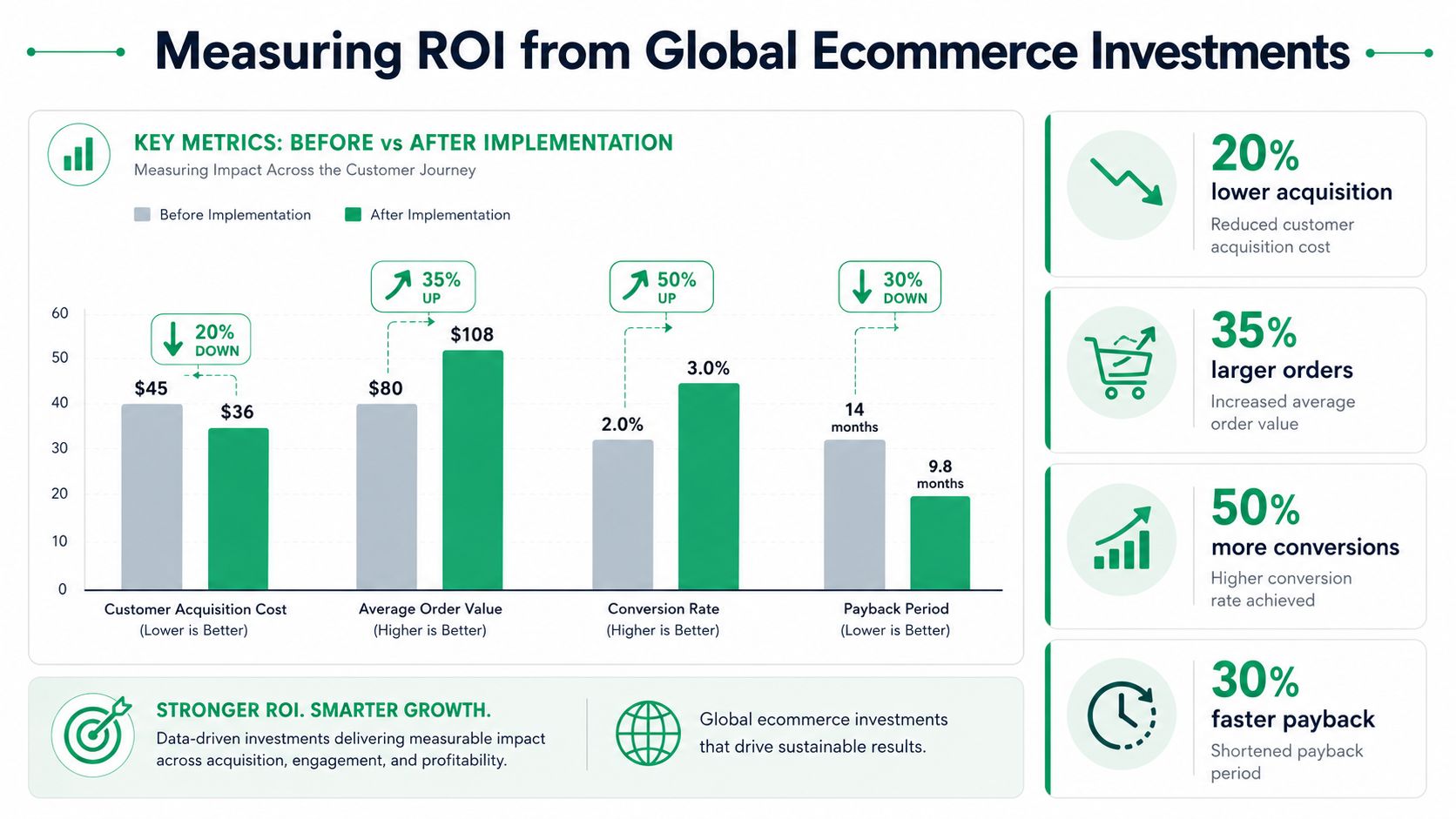
Track the metrics that expose hidden friction
Start with conversion by market, average order value by geography, support tickets per order, and the cost of post-purchase operations. Those are the numbers that show whether localization, payment expansion, and post-purchase tooling are helping. If a market converts well but generates a disproportionate amount of support work, the margin picture is weaker than the sales dashboard suggests.
A second layer is customer lifetime behavior by region. Repeat purchase patterns tell you whether the local experience feels trustworthy enough for shoppers to come back. That matters more in global commerce than in domestic rollouts because international buyers have more reasons to hesitate the first time and more reasons to abandon the brand after a bad correction experience.
Isolate the impact of each investment
Don't measure the whole stack as one lump. If you add address validation, for example, watch whether support edits decline and whether shipping exceptions shrink. If you add multilingual self-service order editing, track how many changes customers complete without intervention and whether order modifications happen without creating new tickets.
The same applies to upsells. Post-purchase offers are only useful if they lift order value without adding confusion. If the workflow feels native to the market, the order status page becomes a commercial surface, not just a receipt.
The best ROI story in global ecommerce is usually not one giant win. It's a series of small operational improvements that lower friction, reduce manual handling, and make each new market cheaper to serve. That's what makes the stack compound over time.
Your Action Plan for Global Ecommerce Success
Start by auditing the parts of your stack that touch the customer after checkout. If address correction, order edits, and support routing are still manual, fix those first. Then review localization quality, payment coverage, and logistics visibility, because those are the layers that keep the post-purchase experience from collapsing under its own complexity.
If you're launching new regions, pilot one market with real support coverage and a clear escalation path. If you're already global, measure support load by market and compare it with order volume, because that gap usually shows where the system is leaking effort. The best global ecommerce operators don't add tools randomly. They build a stack that lets customers self-serve, lets teams stay in control, and keeps international growth from turning into operational drag.
If you're building or cleaning up post-purchase workflows, SelfServe gives Shopify teams a way to let customers edit orders, validate addresses, and add upsells without handing the whole process to support. Visit SelfServe to see how multilingual self-service can fit into a global ecommerce stack that's built to scale.