
How Much Does It Cost to Ship Mattress: 2026 Guide

Shipping a mattress can cost $150.35 to $482.10 by USPS for a cross-country parcel shipment, and a queen-size freight move can start at about $900 and reach $2,240 for a faster option. In practice, the final bill is often higher than the first quote because packaging, insurance, handling charges, and oversize fees get added after the base rate.
That gap between the quote and the invoice is where most merchants lose margin. Mattress shipping looks simple until the carton is measured, the destination is tagged as residential, and the carrier starts layering on fees that weren't obvious in the first estimate.
I've seen the same mistake repeatedly in mattress logistics. Teams compare line-item base rates, pick the cheapest option, and only later realize they priced the shipment as if the mattress were a normal parcel. It isn't. A mattress is a bulky, damage-prone, surcharge-heavy product. If you want a clean shipping P&L, you need to model the all-in landed cost, not the teaser rate.
Your Guide to Mattress Shipping Costs in 2026
If you're asking how much does it cost to ship mattress products, the honest answer is that the range is wide because the shipping method changes the economics completely. A compact boxed mattress moving by parcel behaves one way. A full queen moving by freight behaves another way.
Most published guides stop too early. They show a base range, maybe mention size and distance, then move on. That's not enough for a merchant deciding whether to offer free shipping, charge a flat fee, or route a shipment through parcel, LTL, or a premium setup service.
Why base rates mislead
The first number a carrier gives you is rarely the number finance should use. The invoice expands because mattresses trigger cost layers that small packages often don't:
- Dimensional billing: Carriers charge for the space the mattress takes up, not just scale weight.
- Oversize exposure: A shipment can clear the weight threshold and still get penalized on dimensions.
- Packaging add-ons: Bags, wrap, cartons, corner protection, pallets, and labels all cost money.
- Service extras: Insurance, special handling, appointment delivery, and setup push the bill up fast.
The broad lesson is simple. You're not buying transportation alone. You're buying transportation plus handling risk.
Practical rule: If your margin model only includes the carrier's quoted transportation line, your mattress shipping cost is understated.
What operators should actually compare
The useful comparison isn't carrier versus carrier by headline rate. It's all-in delivered cost versus customer experience. Sometimes the cheapest method wins. Sometimes it creates enough delivery friction, damages, or support tickets that it becomes the expensive choice.
That's one reason I also look at how retailers present delivery expectations to shoppers. For example, NZ Bed Company's shipping information is a good reference for how bed and mattress merchants set practical delivery expectations around geography and service conditions. Even if you don't ship in that market, the operational thinking is worth noting.
The cost model that works
For mattress brands, the right model is usually:
| Cost layer | What to include |
|---|---|
| Transport | Parcel, LTL, or premium delivery |
| Packaging | Bag, wrap, carton, pallet, labels |
| Accessorials | Residential, appointment, liftgate, inside delivery |
| Risk cost | Insurance, damage claims, reships |
| Support cost | Address corrections, failed delivery coordination, customer service time |
Merchants who price shipping well don't chase the lowest quote. They build around the total delivered outcome.
The Anatomy of a Mattress Shipping Bill
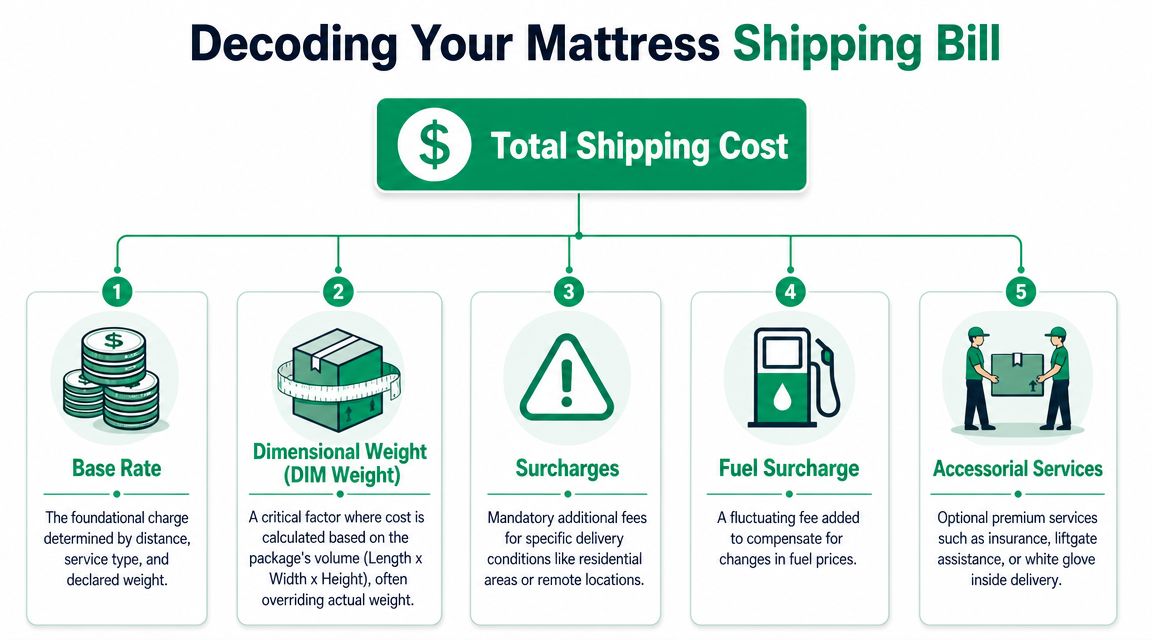
A mattress shipping invoice has more moving parts than most operators expect. The base rate is only one component. The bigger drivers are how the package is measured, how it's handled, and what the carrier classifies it as once it enters the network.
Base rate is only the starting point
The base rate usually reflects three fundamentals: distance, service level, and declared shipment details. That's the easy part. The hard part is that mattresses are large enough to trigger adjustments even when the base transportation price looks manageable.
Red Stag Fulfillment notes that the shipping cost can change materially after packaging, insurance, handling, and surcharges are added. In its example, a $130 to $280 U.S. ground base rate can rise by 10% to 15% once those fees are applied, and it also points to a $100 USPS charge for shipments over 70 lbs and 108 inches, plus a $920 UPS charge above maximum limits in some cases, as explained in Red Stag Fulfillment's mattress shipping cost breakdown.
Dimensional weight is what catches most brands
For mattresses, dimensional weight often matters more than actual weight. That's because carriers are pricing the cube they have to move through their network. A light but bulky mattress can cost more than a denser item that weighs more but occupies less trailer or sortation space.
This is why compression matters operationally. If you can legally and safely reduce the shipping footprint, you're not just saving a little space. You're changing the billable profile of the shipment.
A mattress that looks shippable on a scale can still become unprofitable after the carrier measures the carton.
The surcharge stack
A real mattress shipping bill usually includes several layers beyond transportation:
- Oversize fees: Triggered when the packed mattress exceeds carrier thresholds.
- Additional handling: Applied when the package is awkward, flexible, or hard to move through standard equipment.
- Fuel surcharge: Variable and outside your control, but still part of the landed cost.
- Residential delivery: Common for DTC brands and easy to overlook in quoting.
- Insurance: Sensible for higher-value shipments, especially if replacement cost is painful.
What operators should audit on every quote
I'd review every mattress quote against this checklist before approving it:
- Packed dimensions: Not product dimensions. Actual packed dimensions.
- Billable weight logic: Actual weight versus dimensional billing.
- Delivery type: Residential, commercial, apartment, or limited-access.
- Accessorial exposure: Liftgate, appointment, inside delivery, debris removal.
- Claims risk: Whether the packaging method supports a defendable claim if damage happens.
If you don't break the quote down this way, you're not auditing a shipment. You're guessing.
Comparing Your Shipping Options Parcel LTL and White Glove
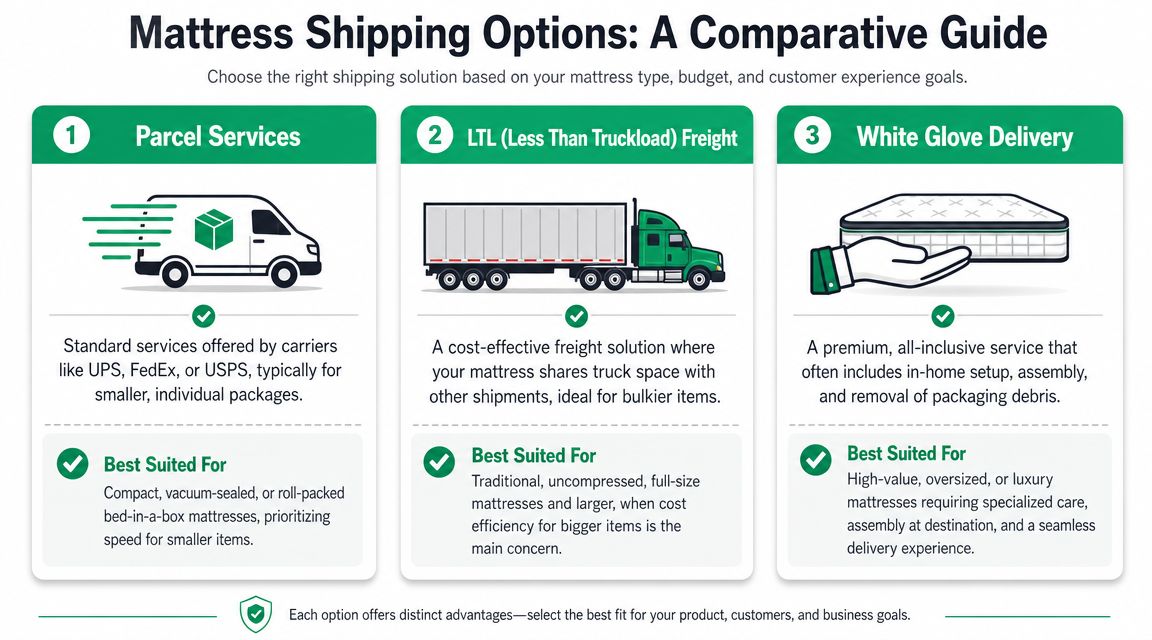
The shipping method is the biggest strategic choice in mattress logistics. Parcel, LTL, and white glove each solve a different problem. When brands pick the wrong one, they either overpay or create a delivery experience that drives complaints and exceptions.
Parcel works when the mattress behaves like a parcel
Parcel is best for compressed, boxed mattresses that stay inside carrier limits. Easyship's example for a 70-pound mattress moving from New York to Los Angeles shows USPS Retail Ground at $150.35, Priority Mail 2-Day at $181.15, and Priority Mail Express 1-Day at $482.10. It also notes that USPS adds a $100 oversize fee if the package exceeds 108 inches in combined length and girth, which can completely change the economics, as shown in Easyship's mattress shipping guide.
Parcel is usually the easiest operating model for a bed-in-a-box brand. Pickup is straightforward. Tracking is familiar to customers. Transit is usually simpler to explain.
But parcel has hard limits. Once the carton gets too bulky, the “cheap” option stops being cheap.
LTL is the right benchmark for full-size freightable mattresses
LTL becomes the practical choice when the mattress is too large, too rigid, or too awkward for parcel economics to work. It's also often the right answer for unboxed or palletized product.
Nolah reports that shipping a queen-size mattress by freight can start at about $900, and one cited three-day freight option was $2,240, which is why freight should be treated as its own cost model rather than an expensive version of parcel. That pricing context appears in Nolah's guide to shipping a mattress safely and easily.
LTL has real strengths:
- Better fit for large product: Especially traditional or non-compressible mattresses.
- More flexible handling: Pallets and freight terminals are built for big items.
- Better multi-unit economics: Consolidation usually improves cost per unit.
The trade-off is operational complexity. Freight requires better appointment management, better packaging discipline, and stronger exception handling.
White glove buys service quality, not just transportation
White glove isn't just shipping. It's a service layer. That can include inside placement, setup, and debris removal. For premium mattresses, that experience can be worth the extra operational spend because it reduces customer effort at delivery.
If you want a reference point for what that service model looks like in practice, this overview of white glove furniture delivery service is useful because it frames the customer-facing side of those premium handoffs.
For merchants deciding between methods, I'd use this simple lens:
| Method | Best fit | Main risk |
|---|---|---|
| Parcel | Compressed boxed mattresses | Oversize and DIM surprises |
| LTL | Full-size or palletized mattresses | More coordination and exceptions |
| White glove | Premium delivery experience | Highest service cost |
Brands that ship enough volume should also centralize rating and routing logic instead of letting teams make one-off decisions. A strong shipping and courier workflow helps operations teams route the right mattress into the right network before margin disappears.
Real-World Mattress Shipping Cost Scenarios
The easiest way to understand mattress shipping cost is to stop thinking in averages and start thinking in scenarios. A boxed foam mattress going parcel and a full queen moving by freight are not close substitutes. They belong in different financial models.
Scenario table for decision-making
The table below uses only verified market examples and translates them into practical planning scenarios.
| Scenario | Likely method | What drives cost | Cost signal |
|---|---|---|---|
| Cross-country shipment of a boxed 70-pound mattress | Parcel | Service speed and parcel handling | USPS example ranges from $150.35 for Retail Ground to $482.10 for Express 1-Day |
| Same shipment, but carton crosses oversize threshold | Parcel with surcharge | Combined dimensions and carrier penalty | A $100 oversize fee can materially change the final total |
| Full queen-size mattress moving long distance | Freight | Line-haul distance, bulky handling, service level | Freight can start at about $900 |
| Faster freight option for a queen-size mattress | Expedited freight | Priority handling and shorter transit window | One example reached $2,240 |
The merchant lesson is clear. Two mattresses can have similar product value and completely different shipping P&Ls.
What changes the invoice in practice
The first scenario is where newer operators often get overconfident. A parcel quote looks manageable, so they assume the whole category ships that way. That only holds when the mattress remains compressible, boxed correctly, and inside the carrier's dimensional thresholds.
The third and fourth scenarios show why freight has to be budgeted separately. As noted by Nolah, a queen-size freight shipment can start around $900, and a faster quoted freight option reached $2,240 in one example. That's not an edge case. It reflects the actual economics of moving a large mattress through freight networks rather than parcel systems.
If the product can't live comfortably inside parcel limits, compare freight against freight. Don't compare it against an unrealistic parcel quote.
How merchants should use these scenarios
Use scenario planning for three decisions:
- Checkout pricing: Decide whether shipping is embedded, partially subsidized, or passed through.
- Carrier routing rules: Define when a mattress must move from parcel to freight.
- Customer promise setting: Match the service sold to the service operations can execute.
That discipline matters because “how much does it cost to ship mattress” isn't one question. It's a different question for every packaging format and delivery model.
How to Pack a Mattress and Calculate Dimensional Weight
Packing decides two things at once. It protects the product, and it determines how expensive the shipment becomes once the carrier measures it.
Pack for both protection and billing
A bad pack job creates a double penalty. The mattress is more likely to get damaged, and the shipment is more likely to pick up avoidable dimensional cost because the carton is oversized, loose, or poorly contained.
For practical moving guidance on the physical handling side, this advice on relocating a mattress in Sydney is a useful reference. The geography is different, but the handling logic is familiar to any mattress operation.
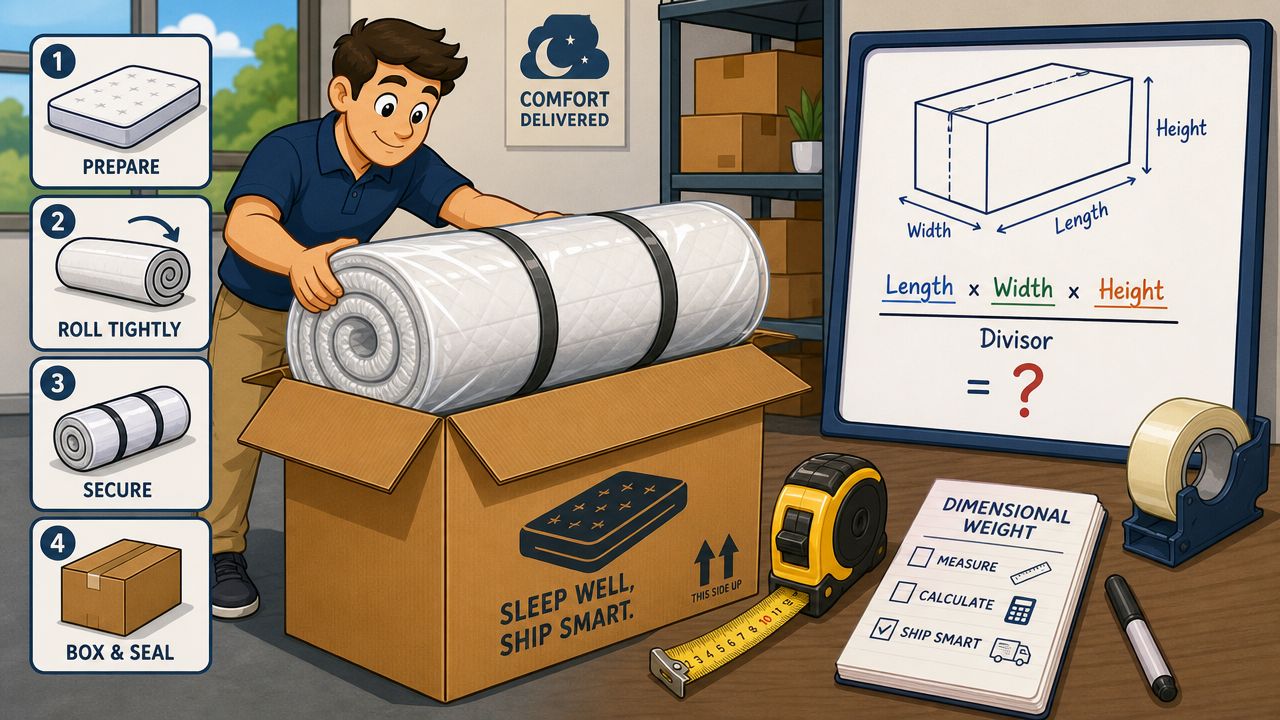
Here's the process I'd use for a merchant or small warehouse team:
- Bag the mattress first. Use a proper mattress bag so dust, moisture, and abrasion don't become claim problems.
- Compress only if the product allows it. Foam mattresses are the usual candidates. Don't force a compression method that compromises the product.
- Add exterior protection. Use wrap, reinforced cardboard, and edge protection where punctures happen most.
- Choose the smallest safe carton. Empty air is expensive once dimensional billing starts.
- Seal and label cleanly. Carriers notice awkward, loose, shifting cartons, and those are exactly the shipments that get extra handling attention.
How dimensional weight works
Dimensional weight is usually calculated by multiplying length x width x height and then dividing by the carrier's divisor. The exact divisor depends on the carrier and service. The important operational point is this: a small reduction in packed dimensions can lower the billable profile even when the mattress itself weighs the same.
If your team needs a refresher on how parcel carriers approach billable measurements and related fees, this guide to calculating UPS charges is useful for framing the logic.
A few measuring rules matter:
- Measure the packed shipment, not the bare mattress
- Use the longest points, including bulges or overhangs
- Recheck after taping, because dimensions often change once the carton is fully sealed
Packing rule: Don't optimize for a pretty carton. Optimize for the smallest defensible package that still protects the mattress in transit.
Train the team on repeatable pack standards
Mattress shipping becomes expensive when every shift packs differently. You want one documented method, one approved material set, and one measurement process.
This video is a good visual companion for teams that need to standardize their handling process:
When a warehouse measures consistently, your quotes get cleaner, your invoice audits get easier, and your claims files get stronger.
Actionable Strategies for Merchants to Lower Shipping Costs
Most mattress brands have more control over shipping cost than they think. The mistake is treating transportation spend as fixed when a big share of it is created by packaging choices, routing rules, service promises, and post-purchase execution.
Cut cost before the label is printed
The cheapest savings usually come from process, not negotiation.
- Reduce carton size where safe: The most reliable way to lower mattress shipping cost is to lower the package footprint before the carrier measures it.
- Route by product type: Don't let a non-compressible mattress default into parcel just because parcel is familiar.
- Set service tiers at checkout: Offer economy and premium delivery paths so the customer helps choose the cost structure.
- Control exception work: Failed deliveries, address changes, and reschedules create avoidable cost fast.
Stop paying for preventable accessorials
A lot of shipping waste shows up after checkout. Wrong apartment details, missing gate codes, undeliverable addresses, and customer-initiated changes all create fees and support work that don't appear in the original quote.
That's why merchants should tighten post-purchase operations around address accuracy and change windows. Better order controls won't eliminate freight complexity, but they do cut the expensive noise around it.
Build a routing playbook, not one-off decisions
The brands with the cleanest shipping P&L usually document rules such as:
| Decision point | Recommended rule |
|---|---|
| Compressible boxed mattress | Start in parcel workflow |
| Full-size uncompressed mattress | Quote freight first |
| Premium mattress purchase | Offer upgraded delivery option |
| Limited-access or difficult residence | Review accessorial exposure before rate approval |
This matters even more as volume grows. Teams that rely on manual judgment eventually create inconsistency, and inconsistency shows up as invoice leakage.
A centralized multi-carrier shipping solution helps merchants enforce routing logic, compare options, and avoid defaulting into whatever carrier a team member happens to prefer that day.
The margin on a mattress order doesn't disappear all at once. It leaks out through bad packaging, wrong routing, and preventable delivery exceptions.
Treat returns as part of the shipping model
Returns can wreck mattress economics. Even when the outbound leg was profitable, reverse logistics can erase that gain if the product can't re-enter inventory cleanly or the pickup model is too expensive.
Merchants should decide in advance which returns get inspected, donated, liquidated, or written off. If you wait until the return request arrives, the cost decision has already gone sideways.
If your team wants tighter control over post-purchase changes that often trigger shipping waste, SelfServe is worth a look. It helps Shopify brands manage address edits, order changes, validation, and customer self-service workflows before small issues turn into carrier fees, support tickets, or failed deliveries.