Shipping and Courier: A Guide for High-Volume DTC Stores
Your shipping setup usually looks fine until order volume exposes every weak spot.
A fast-growing Shopify Plus brand hits the same wall in some form. Support starts fielding address-change requests all day. Customers ask where their package is even though tracking exists. A few failed deliveries turn into refunds, replacements, and angry follow-ups. Then finance asks why shipping costs climbed while customer satisfaction slipped.
At that point, the question stops being “Which carrier is cheapest?” It becomes “What kind of delivery model can our team operate well?”
That’s where the shipping and courier decision matters. Not as a branding exercise. As an operating model.
The DTC Merchant's Dilemma Shipping vs Courier
A lot of DTC brands start with a simple setup. They use broad national carriers, standard service levels, and a rule of thumb that says faster shipping should be offered only when the customer pays for it. Early on, that works.
Then growth changes the math.
The product catalog expands. Order routing gets messier. A meaningful share of orders need edits after checkout. Some customers want low-cost delivery, others expect speed, and your team is stuck managing both inside one post-purchase workflow.
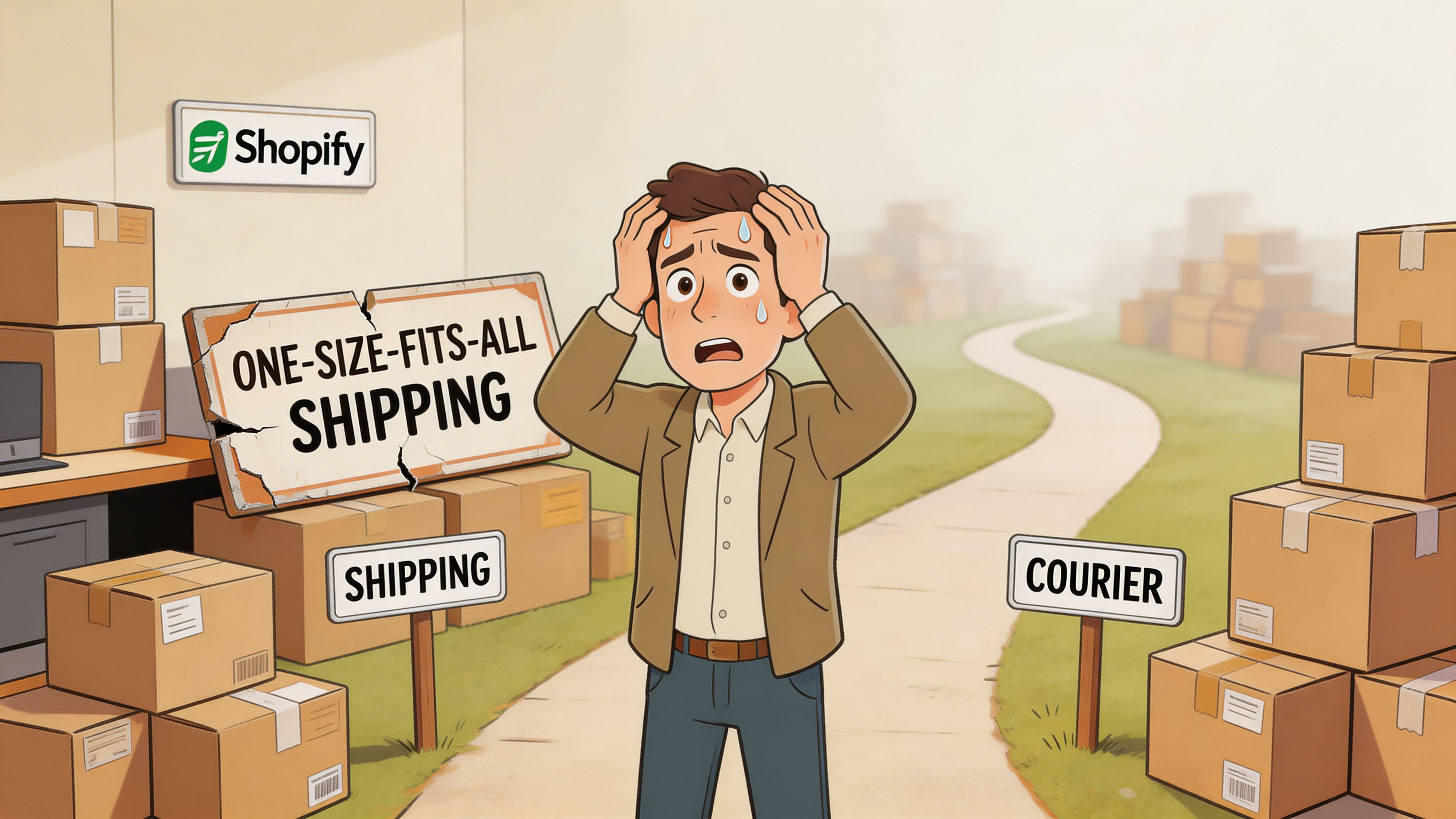
In practice, shipping usually means standardized parcel movement through large carrier networks such as USPS or UPS Ground. It’s built for coverage, consistency, and scale. Courier usually means a more specialized service with tighter delivery control, faster turnarounds, and more hands-on handling.
That distinction matters because the U.S. parcel market is massive. In 2022, the U.S. courier, express, and parcel market delivered over 19.5 billion parcels and generated $136.6 billion in revenue, and failed deliveries cost $17.2 per parcel in the U.S., according to Statista’s overview of the U.S. CEP market.
Where the problem starts
The pain rarely shows up in one dramatic failure. It shows up in operational drag:
- Support drag: address corrections, delivery-status questions, and exception handling pile up
- Margin drag: premium reships and customer appeasements erase what looked like savings at label purchase
- Experience drag: the checkout promise and the delivery experience stop matching
Operational reality: a low-cost label can become an expensive order if your team has to manually fix the customer experience afterward.
A quick comparison
| Criterion | Shipping (e.g., UPS Ground, USPS) | Courier (e.g., Local Pro, Specialist) | Best For |
|---|---|---|---|
| Network model | Large national system | Focused local or specialist network | Brands balancing reach vs control |
| Speed | Standard transit windows | Faster, tighter windows | Urgent or premium delivery promises |
| Cost profile | Lower base cost in many cases | Higher service premium | Margin-sensitive vs experience-sensitive orders |
| Handling style | Standardized parcel flow | More specialized handling | Fragile, high-value, or urgent items |
| Operational fit | Works well for broad-volume fulfillment | Works well for exception-heavy or premium flows | Hybrid DTC operations |
Brands that scale cleanly usually stop treating shipping and courier as opposites. They treat them as tools for different order types, customer expectations, and support realities.
Understanding the Fundamental Differences
The simplest way to understand shipping and courier is this. Shipping is a network utility. Courier is a managed service.
That sounds abstract until you run a busy ecommerce operation.
Shipping is built for throughput
Shipping services are designed to move a high volume of parcels through broad networks with repeatable rules. They’re optimized for coverage, lane density, and predictable processes. For a DTC brand, that usually means standard labels, scheduled pickups, zone-based pricing, and service levels that work well for the bulk of everyday orders.
Consider public transport. It’s effective because the system is built to move a lot of people through established routes. You give up some flexibility, but you gain reach and efficiency.
For most brands, this is the operational backbone. It’s how you move standard orders without manually thinking about each one.
Courier is built for control
Courier services prioritize control over the delivery experience. That can mean tighter timing, direct handling, more precise tracking, special instructions, or a local delivery footprint where speed matters more than broad national coverage.
It’s closer to a private car service. You’re paying for more direct execution, not just movement from point A to point B.
That distinction matters because delivery performance shapes retention. U.S. first-attempt delivery rates are 97.2%, but 70% of shoppers are unlikely to return after a single delivery failure, and 22% abandon carts due to slow shipping, according to Smartroutes’ delivery success data.
The Operational Difference
The mistake I see most often is defining shipping and courier only by speed. That’s too narrow.
The key difference shows up in how your team manages the order after checkout:
- Shipping workflows favor standardization. Bulk label generation, automated routing, and broad service coverage matter most.
- Courier workflows favor exceptions. Delivery notes, timing windows, local dispatch coordination, and tighter customer communication matter more.
- Support impact changes too. A standardized network can lower complexity on ordinary orders. A courier model can reduce friction on premium or urgent orders that would otherwise create escalations.
If your team handles every order like a special case, standard shipping starts to feel rigid. If your team tries to run commodity orders through premium courier logic, margins disappear fast.
Why merchants confuse the two
A lot of platforms and 3PLs blur the language. They’ll call every movement “shipping” even when the delivery experience is effectively courier-led at the final mile. That’s why operations teams need to define terms internally.
Use simple internal rules:
- Classify by promise: Is the customer buying speed, certainty, or just delivery?
- Classify by product risk: Is the order fragile, expensive, perishable, or routine?
- Classify by support exposure: If this order fails, does it create a simple refund or a high-touch escalation?
When those rules are clear, carrier decisions stop being emotional. They become operational.
Comparing Shipping and Courier Services by Key Criteria
Many teams don't need a philosophical answer. They need a working comparison they can use when deciding service levels, routing rules, and support staffing.
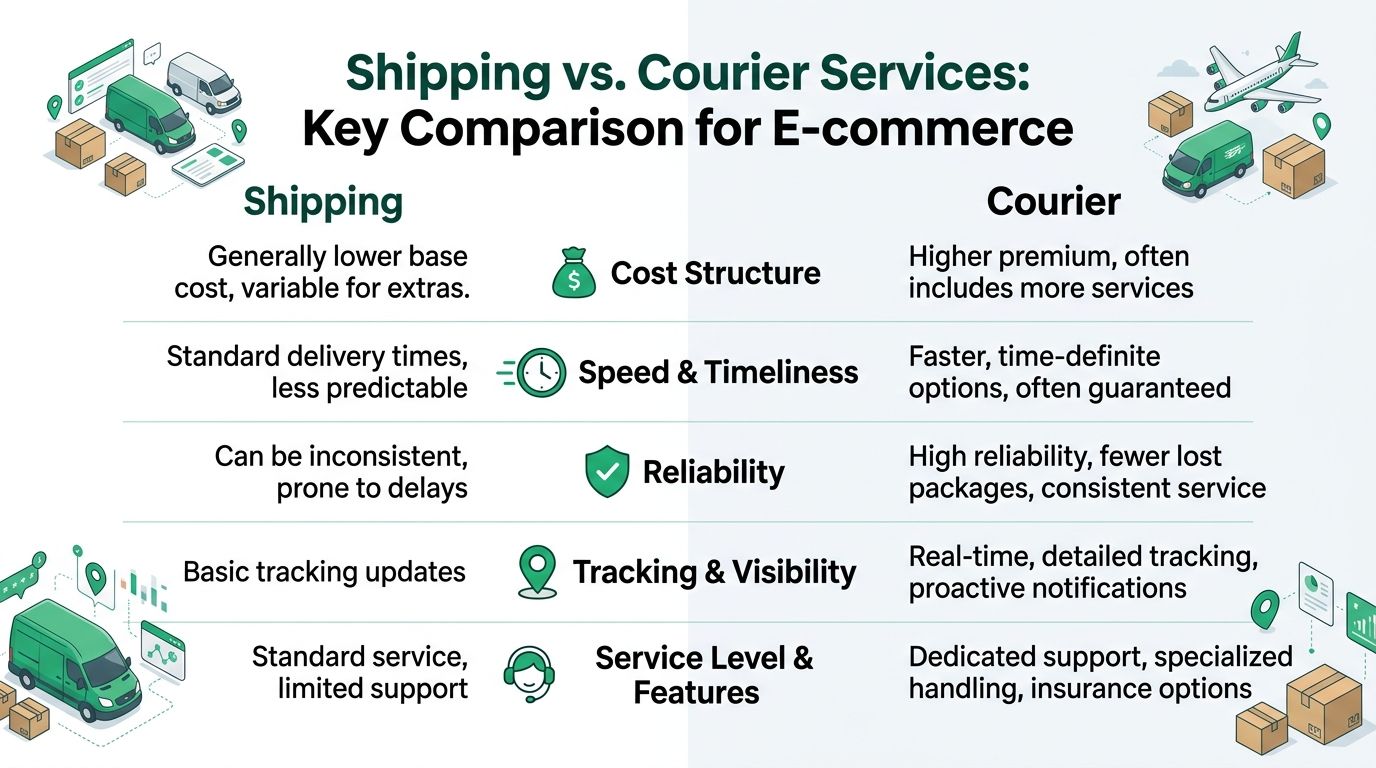
Shipping vs Courier At a Glance
| Criterion | Shipping (e.g., UPS Ground, USPS) | Courier (e.g., Local Pro, Specialist) | Best For |
|---|---|---|---|
| Cost Structure | Lower base rate, more standardized pricing | Premium pricing, often bundled with service control | Commodity products vs premium experiences |
| Speed and Timeliness | Broader windows, less precision | Faster and more time-definite | Urgent local delivery and premium promises |
| Reliability and Handling | Strong for standard parcels | Better when handling needs are special | Fragile, high-value, or high-consequence shipments |
| Tracking and Visibility | Basic milestone updates | More detailed, customer-friendly visibility | Brands reducing “where is my order” contacts |
| International Complexity | Strong network reach, but can feel rigid | Useful for specialty flows, less scalable broadly | Brands segmenting by market and service need |
For merchants comparing major carrier behavior, this breakdown of DHL vs FedEx for ecommerce shipping is useful because it forces the same kind of operational comparison you should apply across any shipping and courier mix.
Cost structure
Standard shipping wins when your main goal is moving a lot of orders at acceptable service levels. You get more predictability, easier budgeting, and simpler rule-setting across fulfillment operations.
Courier pricing usually looks expensive at first glance. Sometimes it is. But the invoice doesn’t tell the whole story.
If a courier prevents failed handoffs, supports a narrow time window, or gives your team enough control to avoid a refund spiral, the higher transport cost can still be the cheaper operating choice.
What doesn’t work is using courier service as a blanket policy across a national order base. That usually creates unnecessary premium cost on orders that would have arrived fine through standard networks.
A courier should solve a specific operational problem. If you can’t name that problem, you probably shouldn’t pay the premium.
Speed and timeliness
Merchants often overvalue stated transit time and undervalue delivery reliability inside the promised window.
That’s where carrier on-time performance becomes useful. Holiday season 2022 benchmarks showed UPS at 97.5% on-time performance, FedEx at 95.2%, and USPS at 94.3%, and 95% OTP is a reasonable standard to enforce in carrier and 3PL SLAs, according to Tusk Logistics’ guide to carrier performance metrics.
For DTC brands, the takeaway is practical:
- Shipping services are often good enough for standard delivery promises
- Courier services make more sense when the order promise is narrow and visible to the customer
- SLA discipline matters more than marketing language on the checkout page
A two-day promise with weak exception handling creates more damage than a four-day promise you reliably hit.
Reliability and special handling
Shipping networks are excellent at standardized movement. They are less elegant when an order needs unusual care, building access instructions, coordinated timing, or direct handoff requirements.
Courier models tend to perform better when the order itself carries more risk:
- Fragile items
- High-ticket products
- Temperature-sensitive goods
- Local premium deliveries
- Orders where a failed attempt creates a costly remake or replacement
The operational question isn’t “Which option is more reliable in theory?” It’s “Which option is more reliable for this order profile?”
Tracking and visibility
Tracking isn’t just a customer feature. It’s a support control system.
Basic shipping updates are often enough for low-friction orders. But as soon as a customer has a premium expectation, milestone-only tracking starts creating uncertainty. That uncertainty lands in your inbox.
Courier services often provide tighter visibility and better ETA confidence. That matters most when the customer is planning around the delivery, not merely waiting for it.
What doesn’t work is paying for premium tracking and then leaving customers inside a generic order-status experience that doesn’t help them act on the information.
International rules and complexity
Standard shipping networks are usually easier to scale internationally because they come with established infrastructure. The trade-off is less flexibility when destination-specific issues arise.
Courier services can be effective for specific markets, dense metro areas, or high-touch international segments. They become difficult when teams try to stitch together too many local exceptions without clear rules.
A strong international setup usually depends on discipline more than carrier count:
- Define which markets need premium delivery control
- Separate standard export flows from high-risk orders
- Make sure customer communication matches local expectations
- Keep address quality high before fulfillment starts
The best shipping and courier strategy usually isn’t one or the other. It’s a controlled split between standard volume and exception-sensitive orders.
How Your Choice Impacts Shopify Operations
A delivery decision turns into a Shopify operations problem almost immediately.
The carrier type affects how often customers contact support, how often orders need intervention, how returns are explained, and how much manual work your team takes on after the order is already paid.
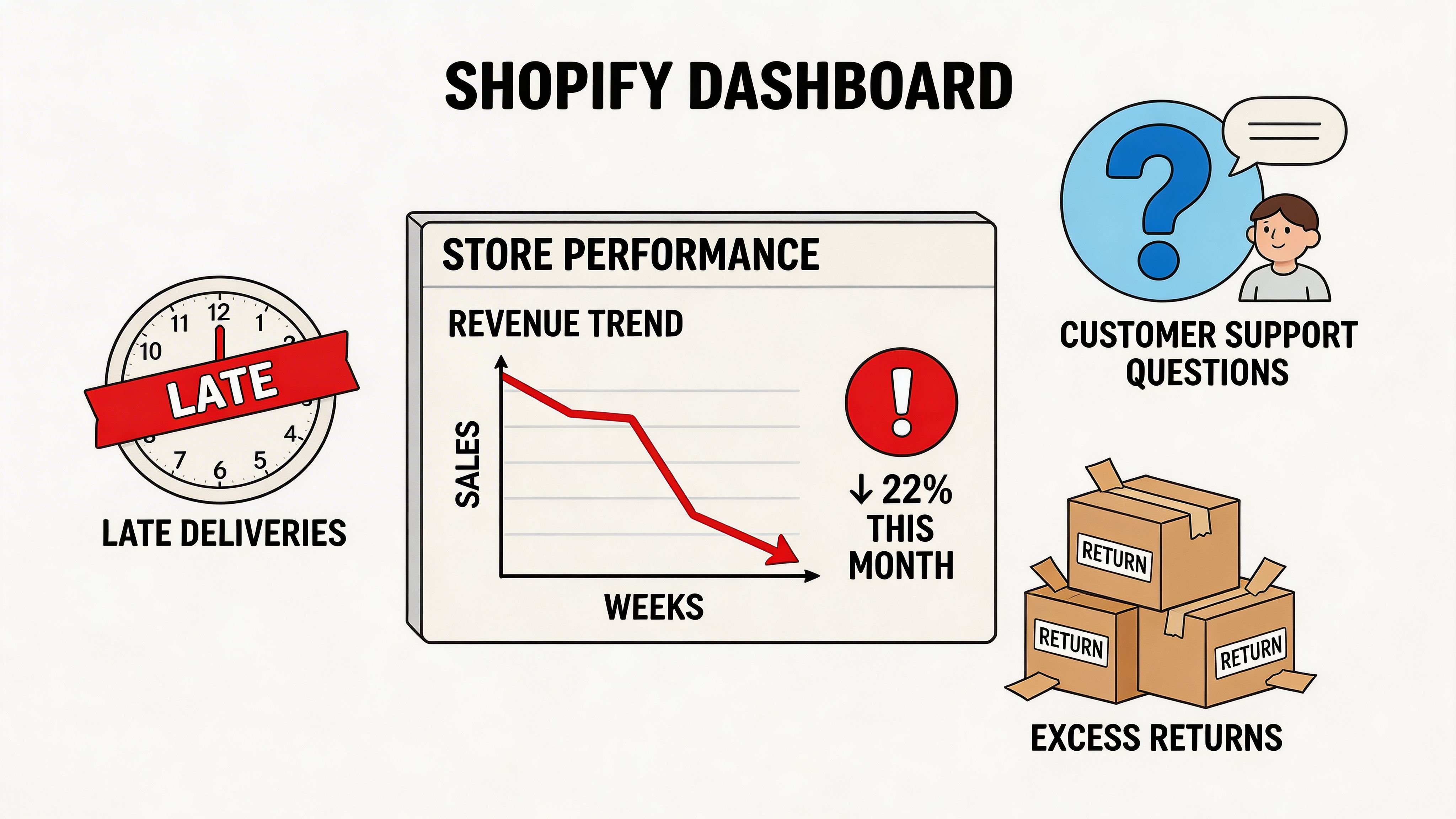
Support volume starts with preventable friction
Most brands think of support load as a staffing issue. It’s usually a workflow issue first.
If your shipping model gives customers no clean way to correct an address, update contact details, or understand the delivery state, they contact support because they have no alternative. The team then becomes a manual routing layer between checkout and fulfillment.
That problem is still under-addressed in ecommerce guidance. A key gap is helping merchants handle post-purchase address corrections on the merchant side, instead of relying on courier best practices alone, as noted by Speedster’s discussion of common courier delivery problems.
Standard shipping usually creates one type of workload
With broad-network shipping, the workload is typically repetitive:
- Address edits before fulfillment
- Delivery-status questions during long transit windows
- Missed-delivery follow-up
- Reship or refund decisions after exceptions
This model works if your operations stack is built to absorb volume efficiently. It breaks when support agents must touch too many orders individually.
That’s also where finance gets pulled in. If order changes, refunds, and shipping adjustments aren’t flowing cleanly into accounting, the fulfillment mess becomes a reconciliation mess. For teams trying to tighten that handoff, a practical reference on Xero integration Shopify can help frame how shipping outcomes and order edits should connect back to accounting workflows.
The hidden cost in shipping and courier decisions isn’t just the label. It’s the number of humans you need to keep the order experience from falling apart.
Courier models create a different workload
Courier service reduces some support contacts and creates others.
You may get fewer “where is my order” tickets if visibility is better and delivery windows are tighter. But you can create dispatch complexity, market-specific rules, and exception handling that requires more operational oversight behind the scenes.
That’s acceptable when the order value or brand promise justifies the effort. It’s a bad fit when the business applies courier logic to routine orders that don’t need it.
Returns and replacement decisions get shaped upstream
Returns are often discussed as a separate function. They’re not. The delivery model influences them.
When a shipment arrives late, goes to the wrong address, or misses a handoff, customers don’t care whether the problem started with checkout data, warehouse timing, or last-mile execution. They just experience a failed promise.
Operationally, that means your shipping and courier choice affects:
| Area | Standard shipping impact | Courier impact |
|---|---|---|
| Address changes | Often harder once labels are created | Sometimes easier when handoff is tighter |
| Delivery inquiries | More likely when updates are sparse | Lower when ETAs are clearer |
| Exception management | Scales, but can feel impersonal | More controlled, less scalable |
| Returns perception | Can rise when delays are unclear | Can improve when delivery is coordinated |
The stores that manage this well don’t ask support to compensate for weak delivery design. They redesign the post-purchase flow so customers can solve routine issues before they become tickets.
Optimizing the Post-Purchase Experience
Most carrier debates stop too early. They focus on label cost, transit speed, and broad service levels. The bigger win sits after checkout.
If the customer can correct mistakes, see meaningful tracking, and interact with the order without contacting support, both shipping and courier models perform better. The post-purchase layer is what turns a decent delivery operation into a manageable one.
Fix the order before the carrier has to
The cheapest delivery exception is the one that never leaves the warehouse.
That sounds obvious, but many Shopify stores still force customers into support queues for simple changes. That’s a process failure, not a customer problem. A stronger setup gives customers a controlled window to update shipping details, correct contact information, and resolve preventable errors before fulfillment locks the order.
Use tracking as a service layer
There’s still a major content gap around how merchants can use GPS-based real-time tracking and analytics in customer-facing post-purchase flows, even though couriers are using those tools operationally, as discussed in Reliable Couriers’ review of current courier industry challenges and technology shifts.
For merchants, the practical use case is simple. Tracking should do more than display status. It should reduce confusion and trigger the right next action.
That can mean:
- Showing a clearer delivery state so customers don’t open a ticket too early
- Using ETA confidence to time add-on offers instead of interrupting at random
- Routing exceptions internally so operations sees risky orders before the customer escalates them
If you’re looking at how this works at the carrier layer, this overview of last-mile carrier tracking is a good reference point.
Better tracking doesn’t matter because it looks modern. It matters because it cuts uncertainty, and uncertainty is what fills support queues.
Make the order status page earn its keep
Most brands waste the order status page. It’s treated like a receipt page with a tracking link.
That page should do more. It’s one of the few moments after purchase when customer attention is still high. If the delivery state is trustworthy and the order details are editable within clear rules, you reduce support demand and create a better customer experience at the same time.
You can also turn that surface into a revenue channel. Relevant add-ons and replenishment products fit naturally there because the customer is already focused on the order they just placed. The key is relevance and timing. Don’t use the page to spray unrelated offers.
Close the loop with feedback
Post-purchase optimization isn’t finished when the package arrives. You need a feedback loop that shows whether the shipping promise, tracking experience, and support model worked.
A useful operational companion to this is FeedbackRobot’s guide to mastering your automated post-purchase feedback strategy, especially if your team wants to connect delivery experience with customer sentiment without relying on manual follow-up.
The brands that improve fastest do three things well:
- They prevent editable mistakes early
- They make tracking useful instead of decorative
- They collect structured feedback after delivery and feed it back into operations
That’s how you stop treating post-purchase as a support cost center and start treating it as an operating advantage.
A Decision Framework for High-Volume Merchants
The right answer for shipping and courier usually isn’t ideological. It comes from your order mix, customer promise, and support tolerance.
If you’re deciding how to structure delivery for a high-volume store, work through the questions below. Answer them. The weak point in your model will show up fast.
Start with the product
Ask what happens if the order is late, mishandled, or delivered on the second attempt instead of the first.
If you sell consumables, commodity products, or low-complexity items, standard shipping usually makes more sense for the majority of volume. If you sell fragile goods, high-ticket items, limited releases, or products that trigger immediate support escalation when delayed, courier capacity becomes much more attractive.
Then look at your promise
A lot of brands accidentally create courier-level expectations with shipping-level infrastructure.
Use this quick lens:
- Standard promise: broad national delivery windows, cost-sensitive checkout, routine parcels
- Premium promise: narrow windows, gift delivery, urgent orders, same-day or local expectations
- Brand-sensitive promise: categories where delivery experience shapes trust as much as the product itself
If your brand promise is premium but your backend runs on the cheapest broad network available, support will absorb the mismatch.
Check your geographic density
Courier models get stronger when deliveries are concentrated. Standard shipping gets stronger when your customer base is broad and dispersed.
A dense metro customer base supports local delivery logic well. A national or international customer mix usually needs a shipping-first model with selective courier overlays.
That’s why many scaled brands eventually move toward a hybrid setup. They keep standard carriers for general volume and route certain lanes, markets, or product classes to more specialized providers. If you’re building that model, this guide to a multi-carrier shipping solution is worth reviewing.
Evaluate your support capacity
This is the question operators skip most often. Can your team handle the post-purchase consequences of your carrier choice?
Choose standard shipping when you can standardize workflows, automate exceptions, and tolerate broader delivery windows. Choose courier service when tighter control lowers business risk enough to justify the operational overhead.
The practical recommendation
For most high-volume DTC brands, the best setup is a hybrid model:
- Use standard shipping for routine national volume
- Use courier services for local premium lanes, high-risk items, urgent orders, or high-consequence deliveries
- Set clear routing logic so operations doesn’t make ad hoc decisions order by order
That approach keeps cost discipline where it belongs and adds control where it pays off.
Shipping and Courier FAQs
Is a 3PL part of the shipping or courier decision?
Yes. A 3PL shapes both. It affects which carriers you can access, how quickly orders are handed off, and whether your routing logic is consistent. A strong 3PL can support a hybrid model well. A weak one turns every carrier mix into more manual work.
When should a brand switch from standard shipping to courier service?
Don’t switch based on volume alone. Switch when a meaningful share of orders has one or more of these traits: urgent timing, local density, high order value, fragile handling needs, or support-heavy delivery consequences. If those traits apply only to part of the business, use courier service only for that segment.
Is a hybrid model too complex for a lean team?
It can be if the rules are vague. It usually works if the routing logic is tight. Define which SKUs, destinations, and customer promises trigger courier service, then automate as much as possible. Complexity comes from exceptions without rules, not from having more than one carrier type.
How should international shipping affect the choice?
International expansion pushes most brands toward standardized shipping first because the infrastructure is easier to scale. Add courier-style service only where local conditions, product risk, or customer promise justify the extra control.
What’s the biggest mistake merchants make with shipping and courier?
They optimize for label cost and ignore post-purchase workload. The cheaper option at checkout often becomes the more expensive option once support time, delivery exceptions, and customer recovery are included.
If your team is spending too much time on address changes, order edits, and post-purchase support, SelfServe is worth a look. It gives Shopify merchants controlled order editing, real-time address validation, multilingual customer experiences, and post-purchase upsell tools without turning support into a manual repair team.