UPS Shipping vs USPS: The Ultimate Merchant Guide
Rising carrier costs usually show up in the same week as a spike in support tickets. A customer changes an apartment number after checkout. Another wants to add one more item before the order ships. A third keeps asking why tracking hasn't updated. Finance sees freight spend climbing. Support sees queue times climbing. Ops gets both problems.
That’s why ups shipping vs usps isn’t just a rate-card decision. It shapes how often your team deals with address failures, how visible shipments are after handoff, how confidently you can offer post-purchase edits, and how painful it is when something goes wrong. The cheapest label at checkout can become the most expensive shipment in your system once re-shipments, manual interventions, and customer frustration are added in.
For high-growth Shopify brands, the right answer usually isn’t ideological. It’s operational. You need a carrier setup that fits your SKU mix, destination profile, service promise, and support model.
Choosing Your Shipping Partner UPS vs USPS
A customer places a $42 order at 2:10 p.m., then emails support at 2:18 to fix a bad apartment number and add one item before the label prints. Your carrier choice decides whether that request stays cheap and recoverable or turns into an intercept, a delayed delivery, or a second shipment.
That is the core frame for ups shipping vs usps. Ops teams are not only buying transportation. They are choosing how much tracking clarity customers get, how often support has to explain delays, and how flexible the post-purchase experience can be when orders need edits.
USPS usually fits brands shipping lightweight residential orders with broad U.S. coverage requirements. It serves every U.S. address, including PO boxes, APO and FPO destinations, and remote ZIP codes that private carriers handle less cleanly. If your average shipment goes out in a small box or padded mailer, USPS often keeps the economics simpler. Flat Rate and Priority Mail can also make planning easier for teams standardizing packaging. This breakdown of USPS Priority Mail boxes and rates is useful when you are deciding whether to build around carrier packaging or your own cartons.
UPS fits a different operating model. It tends to make more sense when orders are heavier, replacement cost is higher, and your support team needs more consistent scan events to answer WISMO tickets quickly. For a brand shipping footwear, bundles, glass products, or subscription orders that regularly move past a few pounds, better tracking visibility can matter as much as the label price. That visibility also supports post-purchase workflows such as address correction, delivery planning, and premium shipping upgrades with less manual intervention.
Here is the fast comparison operations teams usually need:
| Decision area | USPS | UPS |
|---|---|---|
| Best use case | Lightweight domestic parcels, PO boxes, rural reach | Heavier parcels, higher-value orders, stronger tracking visibility |
| Delivery network | Universal U.S. coverage | Broad commercial and residential coverage, but no PO boxes |
| Customer support impact | Lower label cost, but scan gaps can create more tracking questions on some lanes | More consistent tracking detail can reduce WISMO volume |
| Packaging fit | Mailers, small cartons, flat-rate options | Larger boxes, multi-item orders, heavier shipments |
| Post-purchase flexibility | Good for standard low-risk orders | Better fit when edits, intercepts, and service upgrades matter more |
The practical decision is rarely exclusive. Many growing Shopify brands use USPS for low-weight residential orders and UPS for heavier, urgent, or higher-risk shipments. That split protects margin without forcing support to absorb the downside on every order.
If you ship outside the U.S., do not assume the same logic carries over market by market. Local postal networks, private couriers, customs handling, and delivery expectations can change the right setup. Teams comparing those models may find this guide to Australia Post courier services helpful as a reference point.
Practical rule: Pick the carrier that lowers total operational cost after support load, delivery exceptions, and re-ships are included.
Decoding Shipping Costs UPS vs USPS Pricing and Surcharges
A $1 difference in label cost looks small until it shows up across 20,000 orders, then shows up again in support tickets, replacements, and address correction fees. Carrier cost decisions belong with operations because the cheapest label is not always the cheapest shipment.
Where USPS usually wins on cost
USPS usually has the edge on lightweight residential parcels, especially when the order fits in a mailer or small carton and the customer does not need premium tracking visibility. For many DTC brands, that means apparel, skincare, vitamins, accessories, and other low-cube products under a few pounds.
The pricing advantage is only part of the story. USPS keeps cost planning simpler for brands that ship to PO boxes, Alaska, Hawaii, U.S. territories, and military addresses. That reach reduces the number of orders your team has to hold, reroute, or manually review because the carrier cannot serve the address.
Packaging also matters. Flat-rate and Priority Mail packaging can work well for specific order profiles, but only if your team matches box choice to order density instead of defaulting to whatever is closest at the pack station. Merchants comparing those packaging options can use this guide to USPS Priority Mail boxes and rates as a quick reference.
Where UPS can come out ahead
UPS gets more competitive as weight, dimensions, and order value increase. Once a shipment is heavy, awkward, or expensive enough that a failed delivery creates real margin loss, rate sheets need to be read alongside surcharge exposure and exception handling.
Red Stag Fulfillment’s comparison of UPS vs USPS rates explains that UPS often becomes the better buy on heavier ground shipments, while USPS tends to hold the advantage on lighter parcels. That is the operating rule many ecommerce teams end up using in practice. Keep USPS for light, low-risk orders. Route heavier cartons and higher-consequence shipments to UPS.
If your team is pricing out bulky products, this outside resource on the cheapest way to ship heavy items is useful because it frames the problem correctly. Weight alone is not enough. Dimensional size, zone mix, residential delivery, and replacement risk all affect the actual cost.
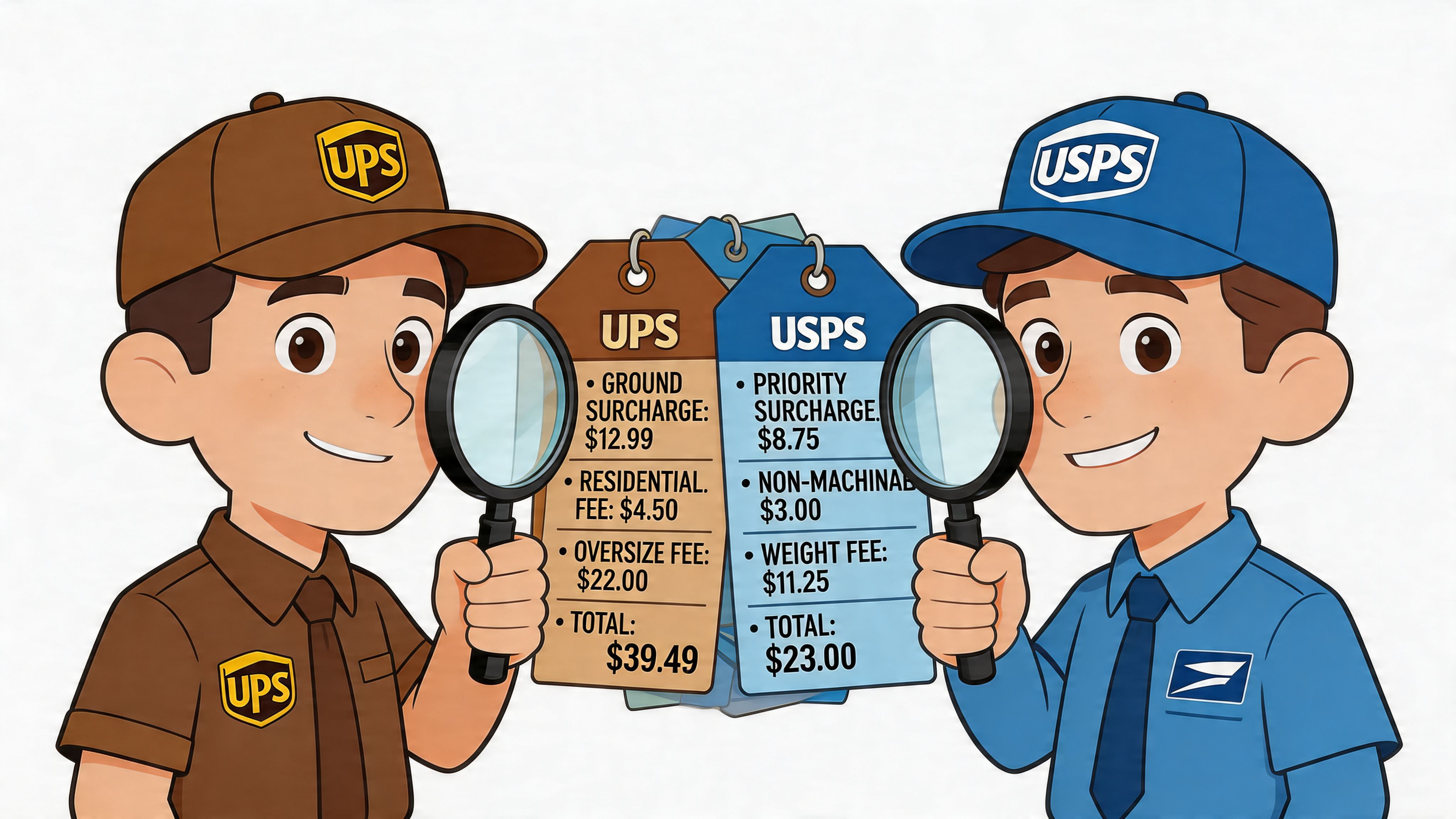
Surcharges are where bad rules get expensive
Base transportation is the number finance sees first. Surcharges are the numbers ops has to clean up later.
UPS pricing often becomes less favorable when shipments trigger residential fees, large-package thresholds, additional handling, address corrections, or delivery intercept requests. USPS has fewer moving parts on many lightweight shipments, which is one reason it can be easier to control for simple DTC orders. But USPS can create a different kind of cost if lower scan quality on certain lanes leads to more “where is my order?” contacts and more manual support work.
That trade-off matters. A lower label cost can still produce a higher total fulfillment cost if your support team spends extra time answering tracking questions or replacing orders that customers assume are lost.
2025 rate increases raised the cost of mistakes
Carrier increases hit more than outbound postage. They raise the cost of every fix after checkout.
According to Red Stag Fulfillment’s review of 2025 UPS and USPS rate changes, USPS ground shipping increased 3.9% and UPS Ground increased 5.9% in 2025. If a customer enters the wrong apartment number, requests a reroute after the label is created, or needs a replacement because the first shipment failed, those higher rates apply to the second move too.
That changes how operations teams should think about carrier selection. The question is not only which service is cheaper at label creation. The question is which setup creates fewer expensive exceptions across the full post-purchase flow.
A preventable address error is not just a CX issue. It can turn one profitable order into two labels, one support ticket, and a refund risk.
Brands that allow post-purchase edits need rules tied to carrier behavior. If UPS intercepts are costly on a certain order type, limit that workflow. If USPS is the low-cost option for a class of shipments, pair it with stronger address validation before the label is purchased.
Cost discipline comes from routing logic
Scalable teams do not choose a carrier by habit. They write routing rules and review them every month against actual outcomes.
- Use USPS for low-weight domestic shipments: It usually protects margin best on small parcels, especially where PO box coverage matters.
- Use UPS for heavier or higher-risk orders: The economics often improve as cartons get heavier, and the cost of a missed or damaged delivery gets higher.
- Track surcharge categories by SKU and package profile: Weight, dimensions, and destination mix matter more than carrier preference.
- Measure support cost with shipping cost: A carrier that saves $0.80 on postage but creates more WISMO contacts can still lose money.
- Audit re-ship and correction rates: If post-purchase changes are common, carrier choice should be tied to how expensive those changes are to fix.
Here’s a short explainer worth watching if your team needs a reset on carrier selection basics before refining rules by product and zone.
Service by Service A Detailed UPS and USPS Comparison
A customer places a Friday order for a birthday gift, updates the address an hour later, then checks tracking three times before Monday. The carrier you chose now affects margin, support load, and whether that customer buys again.
Delivery speed and reliability
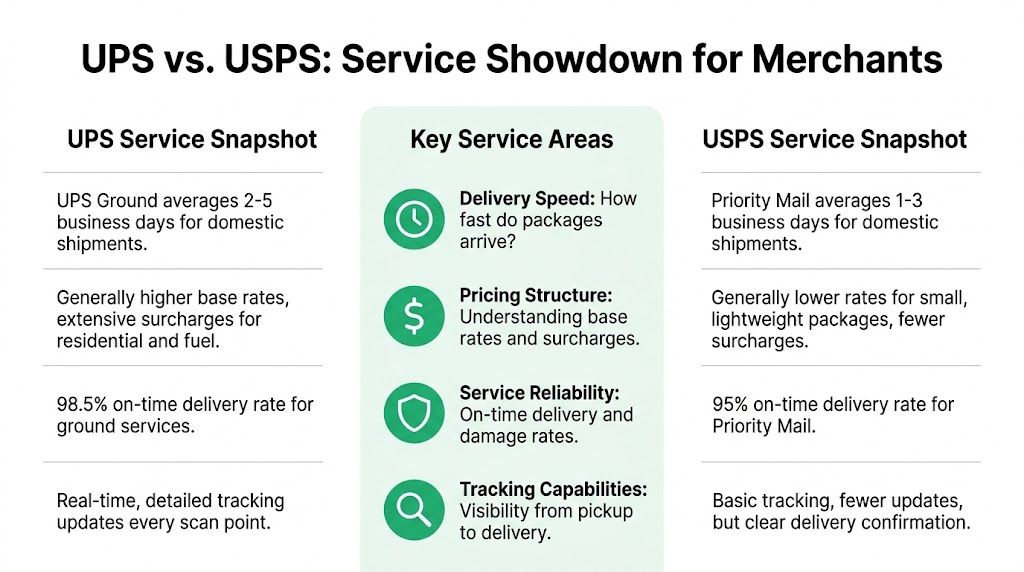
UPS and USPS both cover domestic ecommerce well, but they solve different operational problems. UPS is usually the safer choice for orders where scan consistency, tighter delivery windows, and exception handling matter more than the lowest label cost. USPS is often the better fit for lightweight residential shipments, especially where PO boxes are part of the address mix.
A key trade-off shows up after the label is created. If a package stalls, your support team has to explain the delay, decide whether to reship, and judge how much patience the customer has left. Carriers with clearer scans and more predictable service reduce "where is my order" volume and make those decisions easier.
That matters most for time-sensitive orders. Subscription replenishments, gifts, launch-day drops, and replacement shipments all carry a higher support risk when delivery timing slips.
Weight limits and package fit
Package profile should drive service selection. USPS works well for lighter parcels. UPS becomes more practical as cartons get heavier, larger, or more expensive to replace.
USPS services generally top out at 70 pounds. UPS handles packages up to 150 pounds, which gives growth brands more room to ship bundles, oversized items, and wholesale-style cartons without splitting the order. If your team needs a closer look at heavier-carrier economics, review these UPS international shipping cost considerations for larger parcels.
That difference affects fulfillment design more than many teams expect.
| Shipment profile | Better fit | Why |
|---|---|---|
| Small poly mailers and light cartons | USPS | Lower-cost structure for lighter parcels |
| Midweight parcels with customer delivery sensitivity | Depends | Weight, zone, and support burden decide it |
| Heavy or bulky parcels | UPS | Higher weight ceiling and better fit for large cartons |
| High-value large shipments | UPS | Better visibility and stronger claim support |
If you sell fitness equipment, furniture, or multi-unit bundles, split shipments get expensive fast. You pay for extra cartons and extra pick time. Customers see multiple tracking numbers, partial deliveries, and missing-item confusion. Support then absorbs the fallout.
Tracking from the customer’s perspective
Tracking quality is not a nice-to-have. It is part of the post-purchase experience.
UPS usually gives customers and agents more detailed scan history, which helps in two ways. Customers are less likely to panic when they see clear movement, and support reps can tell the difference between a normal delay and a true exception without escalating every case.
That changes the workload inside your team:
- Fewer status-check tickets: Customers can answer basic delivery questions on their own.
- Better agent judgment: Reps can wait, reassure, or reship based on clearer shipment events.
- More accurate proactive messaging: Your team can message around delay patterns without guessing.
- Lower refund pressure: Customers are less likely to assume a package is lost when tracking looks active.
USPS tracking is often good enough for straightforward domestic orders. It gets harder to manage when your brand promise depends on tighter delivery communication or when customers frequently request post-purchase edits and expect precise shipment updates afterward.
Better tracking helps customers self-serve and helps agents choose the right recovery path faster.
Insurance and claims realities
Claims handling matters most when order values rise above the point where a replacement wipes out the contribution margin. At that point, carrier choice is partly a finance decision and partly a support decision.
UPS is often the better operational fit for higher-value orders because the tracking trail is usually stronger, which gives your team cleaner documentation if a package is damaged or goes missing. USPS can still make sense on lower-risk shipments where the postage savings outweigh the downside of a slower or less detailed claims process.
Set a clear rule here. Low-AOV lightweight orders can route for postage efficiency. High-AOV orders, limited releases, and bundles with expensive replacement cost should route for recoverability.
Speed options for urgent orders
Urgent shipping is where the service gap becomes easier to see. UPS gives merchants more express-service depth, which is useful when fast delivery is part of the offer and a late package creates an immediate retention problem. USPS expedited services can still work for many orders, but they are usually a better fit when the customer wants a faster option without paying private-carrier pricing.
For operations teams, the practical question is simple. What happens if the promised delivery date slips by one day?
If the answer is a refund request, a lost repeat customer, or a high-touch support thread, UPS is usually worth the extra spend. If the answer is mild disappointment on a low-margin order, USPS may still be the right call.
International Shipping Demystified for Shopify Brands
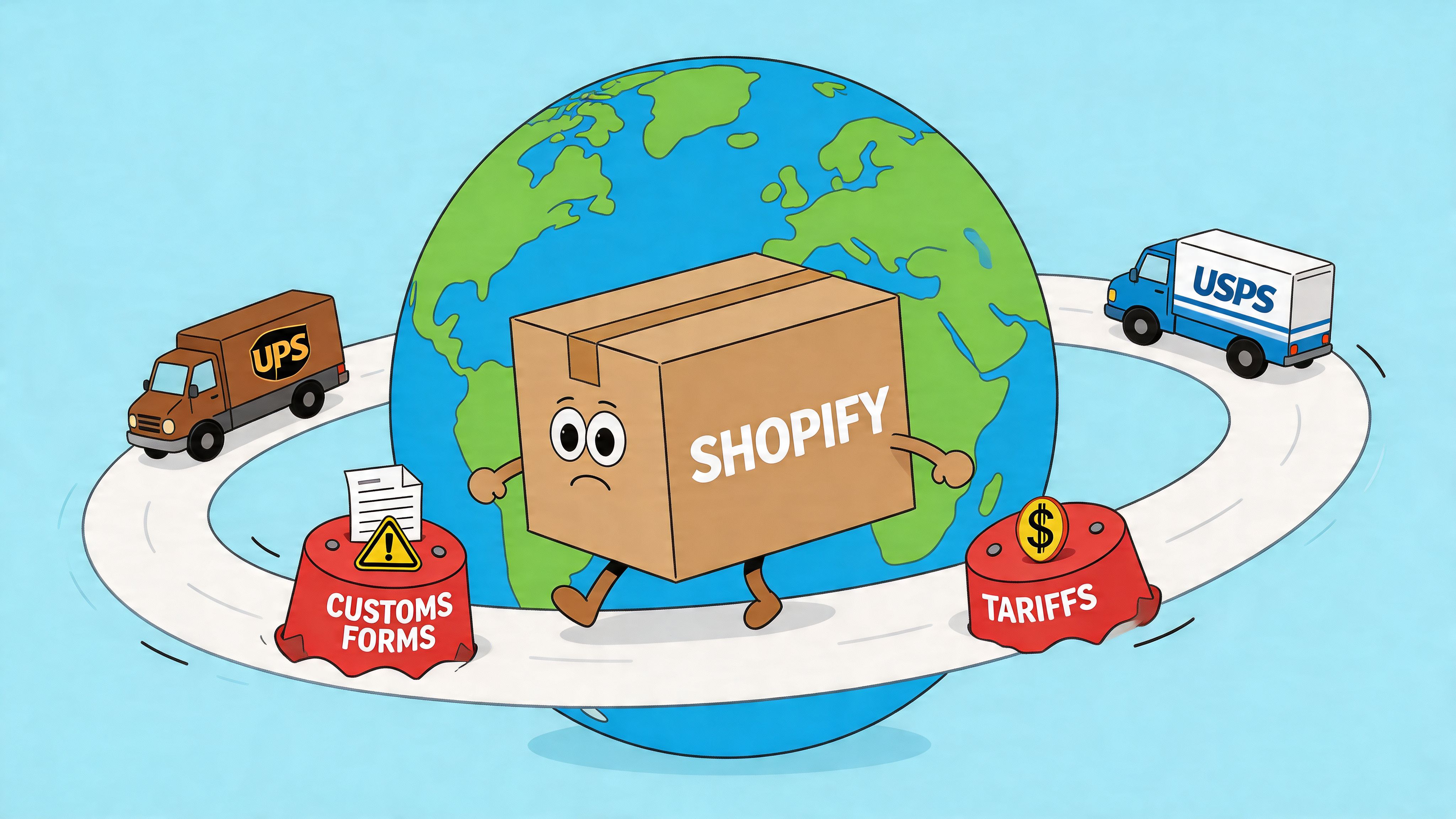
An international order is where weak shipping logic turns into real cost. A domestic misroute might create one annoyed email. A cross-border delay can create a refund request, a reshipment, a customs complaint, and three support touches before the package even clears the destination country.
Why UPS is often the better fit for high-stakes international orders
For Shopify brands, the international carrier decision is rarely about postage alone. It is about how much control your team keeps after the parcel leaves the warehouse.
UPS is usually the safer choice for orders where delay, loss, or poor tracking would create a high support burden. Its international services give brands more consistent tracking, tighter operational control, and fewer blind spots once the shipment leaves the U.S. That matters on gift orders, subscription shipments with a strict delivery window, launches, and any order where a missed promise turns into churn risk.
UPS also tends to fit carts that are heavier, higher value, or built through upsells and bundles. If a customer adds multiple items post-purchase or updates the order before fulfillment, the shipment often becomes less forgiving on cost and replacement risk. In those cases, better visibility usually saves more than the rate difference.
Where USPS still works well
USPS remains a practical option for lightweight international parcels where the customer chose an economy experience and the order can absorb a slower, less transparent journey. That usually means lower-AOV items, simple SKUs, and destinations where the buyer is less sensitive to delivery speed.
The trade-off is operational, not theoretical. USPS often relies on postal handoffs outside the U.S., which can reduce scan detail and make exception handling harder for your team. Support feels that immediately. Customers do not ask which carrier partner has the parcel. They ask why tracking stopped updating.
Build international rules around support load, not just shipping spend
International shipping decisions should sit with ops, support, and finance together. If finance picks the cheapest label without factoring in ticket volume, claims effort, and replacement cost, the savings disappear in labor and customer frustration.
A workable rule set looks like this:
- Route low-value, lightweight international orders to USPS when the customer has accepted an economy delivery window.
- Route high-value orders, time-sensitive gifts, bundles, and fragile items to UPS.
- Default to the carrier with better visibility when a missed delivery is likely to create a refund or a chargeback risk.
Teams that do this well treat carrier selection as part of the post-purchase experience. Better visibility means fewer “where is my order?” tickets, faster responses when customs delays happen, and more confidence when customers request address fixes or add items before the order ships.
If you are setting those rules inside Shopify, this breakdown of UPS international shipping cost is useful because it frames international shipping around margin protection and service control, not just carrier rates.
Optimizing Your Operations with UPS and USPS
At 4:30 p.m., the warehouse is closing out the last pick wave, support has three address-change requests waiting, and two VIP orders are still sitting in a packed state. Carrier choice decides whether your team can fix those orders without manual work, whether tracking will answer the customer’s next question, and whether tomorrow starts with a stack of WISMO tickets.
Build around operational rules, not carrier preference
The cleanest shipping operations run on rules that the system applies automatically. If pickers, packers, and support agents are deciding UPS versus USPS order by order, throughput slows down and exception handling gets expensive.
A practical setup usually includes:
- Label rules tied to order data such as weight, zone, order value, package dimensions, and promised delivery window.
- Exception handling for edge cases such as PO boxes, military addresses, fraud review, and high-value orders.
- A single support view with tracking events, edit status, and shipment history so agents are not jumping between carrier portals and Shopify.
UPS often gives operations teams more control, especially when the order needs tighter handling after checkout.
Better visibility lowers support workload
The biggest operational difference is not the line-haul itself. It is what your team can see after the parcel leaves the building.
UPS usually gives brands more detailed tracking events and more predictable scan progression. That matters because support does not work from carrier rate tables. Support works from customer questions. If a package shows vague or delayed scan activity, agents spend more time explaining uncertainty, opening investigations, and deciding whether to reship.
For a fast-growing Shopify brand, that changes daily execution in a few concrete ways:
- Agents resolve tickets faster because shipment status is clearer.
- Ops can catch lane issues sooner when delays cluster by region or service level.
- Automations work better when order tags, delay alerts, and post-purchase messages are based on cleaner shipment data.
USPS still fits many standard domestic flows. But if your team promises proactive updates, manages a meaningful VIP segment, or gets frequent "where is my order?" contacts, the extra visibility from UPS often reduces avoidable support labor.
Returns and post-purchase edits need carrier-specific rules
Returns logic should not mirror outbound logic. A low-cost outbound label can create expensive downstream work if return scans are inconsistent or if support cannot confirm where the package is in transit.
The same applies to order edits. Address corrections, hold requests, and last-minute add-ons are operational events, not just CX gestures. If your cut-off times, label creation process, and carrier handoff windows are not aligned, every edit request turns into a Slack message, a warehouse interruption, or a replacement order.
A few practices hold up well at volume:
- Delay label creation until the order is release-ready for batches with frequent edits.
- Route high-value returns through the carrier with better tracking detail, even if the label costs more.
- Validate address changes before final manifesting so support is not trying to fix a package after carrier acceptance.
Brands formalizing these workflows usually benefit from a multi-carrier shipping solution for Shopify operations, because the primary benefit is automatic rule enforcement across outbound, returns, and post-purchase changes.
Match pickup timing to how your warehouse actually runs
Pickup timing sounds minor until it starts breaking your day. If your team prints labels early, closes orders in waves, or regularly captures upsells and edits between purchase and handoff, the carrier schedule affects labor efficiency and customer experience.
USPS works well for routine lightweight volume where the process is simple and the service promise is broad. UPS is often the better fit for heavier parcels, higher-value shipments, and orders where a missed scan or missed delivery creates more support cost than the rate difference saved.
The strongest setup is not single-carrier loyalty. It is a rule-based operation that protects margin, keeps support volume under control, and gives customers a smoother post-purchase experience.
When to Use UPS When to Use USPS and When to Use Both
The best carrier strategy looks boring in a spreadsheet and excellent in production. It uses clear rules, applies them consistently, and leaves room for exceptions that matter.
Use USPS for lightweight domestic volume
If your average order is small, affordable, and shipped within the U.S., USPS is usually the cleanest answer. That’s especially true when your customer base includes PO boxes, military addresses, or rural destinations.
USPS fits brands like:
- Apparel stores shipping tees, socks, caps, and lightweight accessories
- Beauty brands shipping low-weight replenishment orders
- Book and stationery sellers with dense but manageable parcel sizes
- Supplement brands moving recurring domestic orders
The strength here isn’t only lower shipping cost. It’s broad domestic compatibility with fewer address-type constraints.
Use UPS for heavy, valuable, or support-sensitive orders
UPS becomes the stronger tool when the package itself creates risk. Heavy parcels, premium items, and orders where customers expect precise visibility all lean in UPS’s favor.
Typical UPS use cases include:
| Scenario | Better carrier | Reason |
|---|---|---|
| Heavy home goods | UPS | Better economics and higher weight ceiling |
| Electronics and premium products | UPS | Better tracking and stronger claims posture |
| Time-sensitive replacement orders | UPS | More dependable visibility and service options |
| High-volume stores with complex CX workflows | UPS | Better API and event-level tracking detail |
If one failed shipment can trigger a costly replacement or an angry customer thread, paying more for stronger visibility is often the right call.
Use both when you want real operational control
Most mature brands shouldn’t force an either-or decision. They should build a hybrid model. That means USPS handles the shipments it’s structurally good at, while UPS takes the orders where visibility, speed options, or heavy-parcel economics matter more.
The smartest shipping strategy usually isn’t a carrier choice. It’s a routing policy.
A practical hybrid setup often looks like this:
- USPS for lightweight domestic orders
- UPS for parcels above your internal weight threshold
- USPS for PO boxes and military destinations
- UPS for high-value or support-sensitive shipments
- Manual review for unusual post-purchase edits
This is also the best answer for brands that offer customer-driven changes after checkout. If an order changes enough to alter risk, the carrier should be eligible to change too.
The decision criteria that matter most
When teams debate ups shipping vs usps, I usually narrow it to four variables:
Weight
Light orders tend to favor USPS. Heavy orders tend to favor UPS.Value
The more painful a loss or delay is, the more useful strong tracking becomes.Destination
PO boxes and universal reach point toward USPS. Complex international or service-sensitive destinations point toward UPS.Support impact
If your support team spends too much time answering tracking questions, better visibility may be worth a higher transportation cost.
The mistake is optimizing for only one of those variables. The better move is balancing all four.
Frequently Asked Questions About UPS and USPS
Is UPS or USPS better for Shopify merchants
Neither is universally better. USPS is often the stronger fit for lightweight domestic orders and address types that require universal postal reach. UPS is usually better for heavy parcels, high-value shipments, and workflows where detailed tracking reduces support load.
Can I negotiate rates with UPS or USPS
Large merchants often get more flexibility with UPS, especially when volume is meaningful and service mix is predictable. USPS can still be cost-effective, but operational negotiation and custom enterprise terms tend to be more central to UPS relationships.
Which carrier is better during peak season
The better choice depends on your order profile and how much visibility you need. During peak, support teams benefit from clearer tracking and fewer unknowns. If your brand can’t absorb tracking ambiguity, stronger visibility is often worth the premium.
What about hybrid services like last-mile handoff options
Hybrid models can work well when you want one carrier’s network benefits and another’s final-mile coverage. But they also add complexity. Before using them widely, make sure your support team understands how tracking events will appear and who controls the final delivery.
Should I standardize on one carrier to simplify operations
Usually no. Standardization sounds efficient, but it often creates waste. A better approach is standardizing your decision rules while keeping more than one carrier available. That gives your team consistency without forcing every shipment into the same cost and service profile.
If your team wants to reduce support workload while giving customers controlled post-purchase flexibility, SelfServe is built for that job. It lets Shopify brands manage customer edits, multilingual experiences, address validation, and post-purchase upsells without turning every order change into a manual support task.