
USPS Address Validation: A 2026 Ecommerce Guide
17% of Americans change addresses every year, so USPS address validation can't be treated like a one-time checkout checkbox. It's a recurring operations control, because the address that looked fine at order capture can stop being deliverable by the time a label gets printed.
If you've ever watched a clean order turn into a return-to-sender, a reshipment, and a support ticket pile-up, you already know the problem. The merchant didn't just have a formatting issue, they had an address-quality problem that slipped past fulfillment.
Why USPS Address Validation Matters More Than Your Checkout Flow
A bad address usually does not fail loudly. It slips through one order at a time, then shows up later as margin loss, support volume, and avoidable returns.
USPS ties address quality to mailing rules, not just cleaner formatting. Its guidance connects validation to the Address Management System, renumbering data through the Locatable Address Conversion System when an exact match is not found, and freshness windows that affect mailing eligibility, including 95 days for Automation mail, 90 days for Carrier Route mail, and 12 months for Presorted mail ZIP Code data (USPS address-quality guidance). A checkout address can look valid and still be stale by the time fulfillment starts.
What the bad workflow looks like
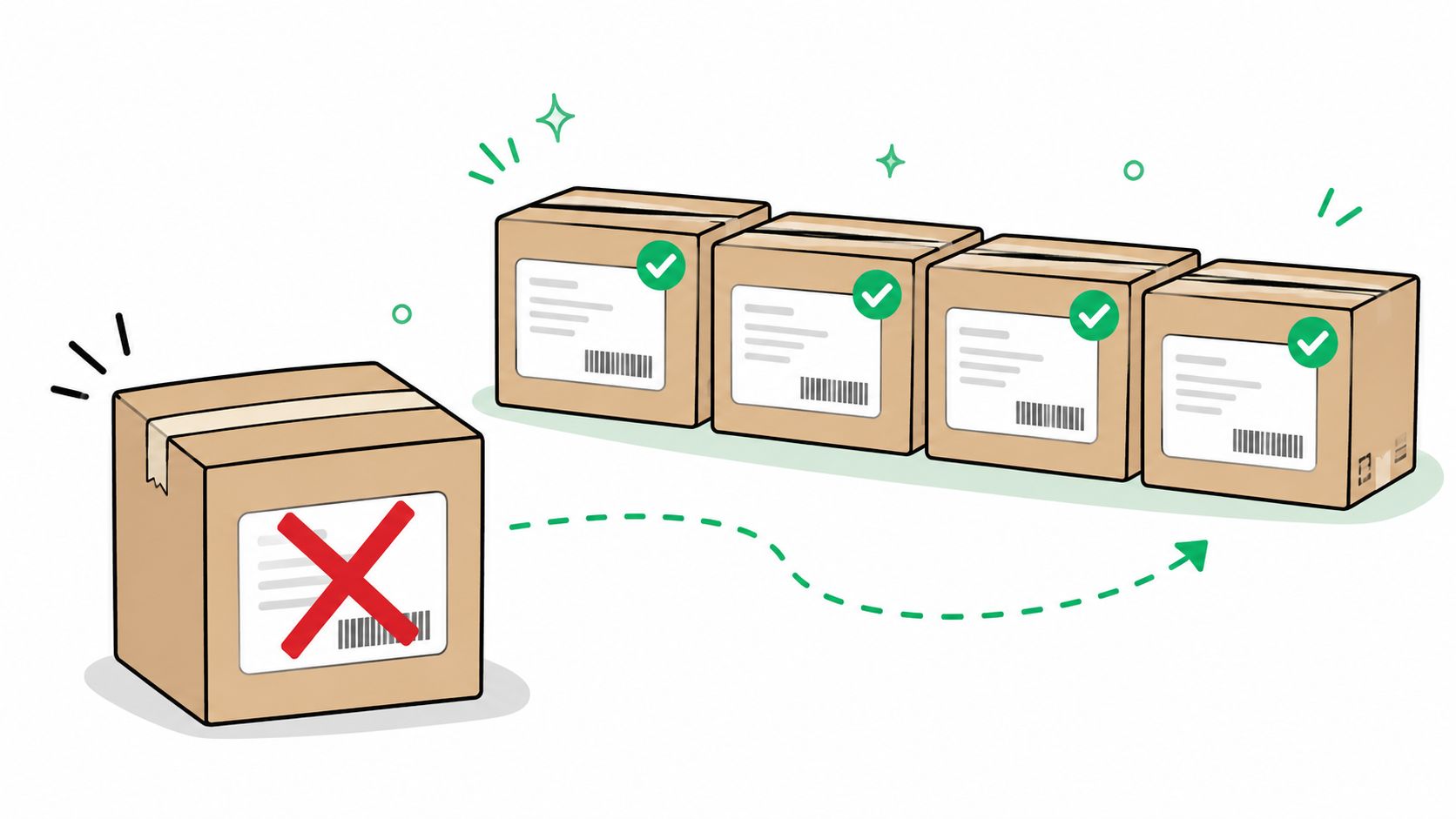
A customer leaves off an apartment number. The order clears, the label prints, and the carrier cannot complete delivery. Your team then pays to fix a problem that should have been caught before fulfillment.
That is why address validation belongs upstream of shipping, support, and refunds. USPS also reports that 17% of Americans change addresses annually, which explains how fast a clean database can decay if nobody rechecks it (USPS address-quality guidance).
Practical rule: if your team only validates at checkout, you are still shipping on yesterday's data.
The better model is simple. Validation is a workflow, not a form field. It should shape checkout, order edits, fulfillment logic, and periodic refreshes, because each step can surface a bad premise, a missing secondary unit, or an address that is no longer current.
For Shopify merchants, the trade-off is operational, not just technical. Failed delivery can trigger a second shipment, a customer service exchange, and a lost chance to keep the buyer happy without extra manual work. Address quality is one of those boring disciplines that protects the whole post-purchase experience.
What USPS Address Validation Actually Checks
USPS address validation works in two layers. One layer standardizes the address, the other checks whether mail can get there.
Standardization versus deliverability
The first layer is CASS, the USPS certification program for address-matching software. USPS says CASS tests how software parses and normalizes addresses against Publication 28 standards, with certification thresholds of 98.5% minimum for ZIP+4, carrier route, Five-Digit ZIP, and LACSLink, and 100% for delivery point coding, eLOT, DPV or DSF2, RDI, and Perfect Address (USPS CASS certification). A system can format an address correctly and still miss the delivery point.
The second layer is DPV, or Delivery Point Validation. That is the signal that tells you whether the address can receive mail. Google's USPS-derived guidance is straightforward, Y means fully deliverable, S means the primary number is valid but the secondary unit is present and not confirmed, and N or empty means USPS does not recognize the premise as deliverable, with a direct instruction to fix the address when DPV is not confirmed (Google address validation guidance).
A clean format is not enough. If the unit number is wrong or missing, you can still end up with a label that looks right and lands wrong.
That distinction matters most in multi-unit housing. An apartment omission may pass the formatting check but still fail full deliverability. Shipping labels are only as good as the delivery-point data behind them.
USPS also makes a separate point that merchants miss. Its Address Validation APIs are for validating, completing, and correcting addresses you already captured, not for sourcing new addresses for a database (USPS Address Information API). In practice, a validated record should be treated as a corrected customer entry, not a promise that the address will stay good forever.
DPV response codes and shipping decisions
| DPV Code | Meaning | Recommended Action |
|---|---|---|
| Y | Fully deliverable | Proceed with fulfillment |
| S | Primary number valid, secondary unit unconfirmed | Prompt for apartment or suite confirmation |
| N | Not recognized as deliverable | Block shipment and correct the address |
| Empty | No deliverability confirmation | Treat as unresolved and review before label printing |
If your shipping stack does not separate standardization from deliverability, it leaves too much to chance. The merchants that avoid costly re-shipments use both checks, and they do not confuse a normalized address with a shippable one.
The Business Impact of Better Address Data
Better address data pays off in places finance teams notice and support teams feel right away. The savings rarely come from one dramatic event. They come from fewer small disasters.
USPS has shown how large the correction and feedback workflow is inside its own operations. In a strategic-planning summary, USPS reported a 2.5% improvement in mailer address quality, 9.7 billion addresses processed through NCOALink, 387 million pieces processed through FASTforward, and a 13% increase in records delivered to customers through electronic feedback methods (USPS strategic-planning summary). Address quality is not a side task, it sits inside core mail operations at massive volume.
Where the money leaks out
A failed delivery usually starts a chain reaction. First comes the return or exception, then the reshipment, then the customer service touch, then the refund or concession if the buyer is frustrated enough. None of those steps feels expensive by itself, but they add up fast when the same data problem keeps showing up.
Freshness affects the mailing tier too. USPS ties presort and automation rules to address age, including the 95-day requirement for automation mail and the 12-month window for presorted ZIP Code verification. If your data drifts out of date, you are not only risking delivery errors, you are also risking the mailing tier you expected to qualify for.
Why support teams care as much as ops teams
A customer who never gets the package contacts support. A customer who gets the right parcel the first time stays quieter, costs less to serve, and is more likely to reorder. That is the operational reality most validation tools skip because it is less flashy than a checkout widget.
For stores that use post-purchase editing, address validation matters there too. A validated edit lowers the chance that a late change creates a new support thread or a failed handoff to the warehouse. The same applies whether the customer is fixing a street typo or adding a missing unit number.
Better address data is less about cleaning a database and more about protecting every downstream process that assumes the database is right.
The payoff is consistency. Fewer surprises at label time mean fewer manual exceptions, cleaner shipping economics, and less time spent undoing mistakes that should have been caught at the point of entry.
Choosing Between USPS APIs and Third-Party Address Services
The right implementation depends on what part of the workflow you're trying to protect. A merchant who only wants a basic USPS-compliant correction layer has different needs from one who needs smoother checkout suggestions and global formatting support.
USPS's own Address Information APIs are built for validating, completing, and correcting addresses captured through your processes (USPS Address Information API). That makes them a natural fit for compliance-sensitive workflows where the USPS source of truth matters, especially when you care about standardization and postal rules more than interface polish.
USPS-native or third-party
Third-party tools often win on user experience. Google's address validation guidance and autocomplete-style flows can help shoppers fix errors before they become orders, and a service like SelfServe can use Google Maps-powered validation inside a post-purchase editing flow, which is useful when the customer needs to correct a shipping address after checkout (SelfServe Google Maps address validation). If you're comparing delivery quality to broader logistics strategy, it also helps to read a practical last-mile perspective like Fleetalyse's last mile delivery guide, because address quality only matters when it survives the final handoff.
The trade-off is that third-party services don't automatically equal USPS certification. If you need CASS-aligned behavior for postal workflows, you need to confirm that the provider supports that requirement. If you need checkout friction to stay low, a richer suggestion layer can be the better front-end choice.
Here's the decision pattern that usually holds up in real stores:
- Use USPS-native APIs when label correctness, postal compliance, and standardization are the priority.
- Use third-party validation when customer experience, autocomplete, and broader format handling matter most.
- Use both when checkout needs to be fast, but fulfillment still needs a USPS-grounded deliverability check.
The maintenance question nobody budgets for
USPS systems bring postal specificity, but they also bring USPS documentation, certification boundaries, and operational discipline. Third-party services usually reduce implementation pain, but they add vendor management and another layer of data dependency. The wrong choice isn't “USPS” or “third party”, it's choosing one without mapping it to the actual job the address has to do.
For Shopify merchants, that job is usually split in two. The storefront needs to catch bad input fast, and the warehouse needs confidence before a label prints. If one tool can't do both cleanly, a two-layer stack often makes more sense than forcing a single service to cover every use case.
Best Practices for Implementing Address Validation in Shopify
Validation works best when it's placed where the damage starts, not where the damage is noticed. For Shopify merchants, that usually means checkout, order-edit flows, and any post-purchase self-service portal.
Put the check where the customer can still fix it
At checkout, the goal is to catch obvious errors before the order lands in fulfillment. But don't turn every ambiguity into a hard block. A response like S, where the primary number is valid but the secondary unit isn't confirmed, usually deserves a prompt, not a dead end.
If the building exists but the suite is missing, the right move is to ask for the suite, not to pretend the address is unusable.
That's where good UX and operational control have to coexist. A strong middle path is to show a correction suggestion, explain why the system is asking, and let the shopper confirm the entry before you print a label. For edge cases like newly developed subdivisions or addresses that recently changed, a manual override with review notes is safer than forcing the shopper to start over.
Build the rules around the workflow
A clean implementation usually has four moves:
- Enable validation at entry points, including checkout and any order-edit portal.
- Differentiate error types, so a missing unit doesn't get treated the same as a non-deliverable premise.
- Log validation results, so support and ops can see which failure modes repeat.
- Refresh stale records, because validation at capture time doesn't solve future drift.
Shopify teams that want to make post-purchase edits less painful can use a tool like SelfServe's address lookup tool inside the customer flow, which keeps the correction in the same place the problem starts. Merchants managing more complex automation stacks, including cross-border operations, may also want to review online store automation for Canadian businesses to see how address quality fits into broader workflow automation.
The main mistake is overblocking. If you reject too many legitimate edge cases, support will start bypassing the system. If you ignore bad data, fulfillment pays for it later. Good validation policy sits in the narrow lane between those two failures.
The Hidden Cost of Treating Validation as a One-Time Fix
Most address problems do not come from one bad capture. They come from data that looked fine once and then drifted out of date.
USPS treats refresh as part of address quality, not a one-time cleanup. Its guidance says presorted mail ZIP Code data must be verified within 12 months, and automation mail addresses must be verified within 95 days. That is a practical reminder that address quality has a shelf life.
Why stale data keeps breaking fulfillment
USPS also processes address changes at a scale that makes drift hard to avoid. Its strategic planning summary shows heavy use of NCOALink and FASTforward, which is a good signal that customer records keep changing in the real world (USPS strategic-planning summary). Even if your store only sees a fraction of that movement, customers still move, renumber, and change unit details.
That is why validation at checkout is only the first pass. A store that never rechecks saved addresses starts to accumulate undeliverable-as-addressed mail, support tickets, and wasted labels. The capture step matters, but it does not replace a review cycle for records that sit in the system.
Operational truth: an address can be correct when the order is placed and wrong when the package is packed.
The fix is dull, and that is a good thing. Set a schedule to revalidate stored customer profiles, especially if you ship repeat orders, preorders, or delayed fulfillment. Treat exceptions as a data-quality queue, not as proof that the old record should stand.
For high-volume merchants, address validation stops being a checkout control and becomes ongoing maintenance. The stores that keep their data clean do not just catch mistakes once, they keep checking the records most likely to go stale.
International and Multilingual Stores Need Extra Validation Care
Cross-border commerce exposes weak address logic fast. A form that works fine for a suburban US customer can break down the moment the shopper writes an address in another format or language.
USPS validation is grounded in American delivery conventions, which means street numbers, suffixes, and secondary-unit patterns need to be handled with care when international orders flow into a US fulfillment lane. A foreign-origin address that eventually enters USPS last-mile delivery still needs the same deliverability scrutiny before a domestic label is printed, because a missing apartment or ambiguous premise creates the same return risk as a domestic mistake.
Don't let language become a data-quality problem
Multilingual storefronts need validation that respects the shopper's language and the address format they're using. If the interface only behaves correctly in English, support ends up translating errors after the fact, which is the most expensive place to do it.
SelfServe's multilingual behavior helps here because it adapts the shopper experience to the language they're already using, which reduces the odds that a language mismatch turns into an unvalidated address in the fulfillment queue (SelfServe international address validation). For merchants shipping into the US from abroad, that kind of front-end help is useful, but it doesn't replace deliverability checks before label creation.
Global checkout needs a stricter handoff
Third-party validation tools can help with broader address formats, and Google's address validation guidance is useful when you're trying to correct input at the customer-facing edge (Google address validation guidance). The point is not to choose a global tool instead of USPS logic, it's to make sure the handoff between them is intentional.
If your store serves multiple languages or multiple countries, validation can't be an English-only bolt-on. It needs to live inside checkout, post-purchase edits, and fulfillment rules so the address stays usable as it moves through the system.
If you want to reduce shipping errors without adding more manual review, SelfServe gives Shopify merchants a post-purchase editing flow with real-time address validation, multilingual support, and controlled customer changes. Visit SelfServe to see how it can help keep deliverable addresses moving into fulfillment instead of into support.