USPS Post Office Holidays 2026: A Merchant's Guide
You're probably here because a holiday is coming up, orders are still landing, and someone on your team just asked, “Is USPS open that day?” That question sounds simple until it touches pickup schedules, delivery promises, support macros, and customers who want to edit an address after they've already checked out.
For ecommerce teams, USPS post office holidays aren't just calendar trivia. They create fulfillment pauses, tracking confusion, and a backlog that shows up as support volume a day or two later. The stores that handle holiday shipping well usually don't do anything flashy. They plan the closure, the day before, and the day after.
The Official 2026 USPS Post Office Holidays
A holiday calendar becomes an operations calendar fast. One closed postal day changes label timing, pickup plans, delivery estimates, and the support messages your team needs ready.
USPS typically follows the federal holiday schedule. Based on that schedule, the expected 2026 USPS holidays are below. USPS retail access, pickup behavior, and service availability can still vary by location, so use this list as the planning baseline and confirm details as the year approaches. USPS generally closes Post Office locations and pauses regular mail and package delivery on those holidays, as summarized in AARP's USPS holiday overview.
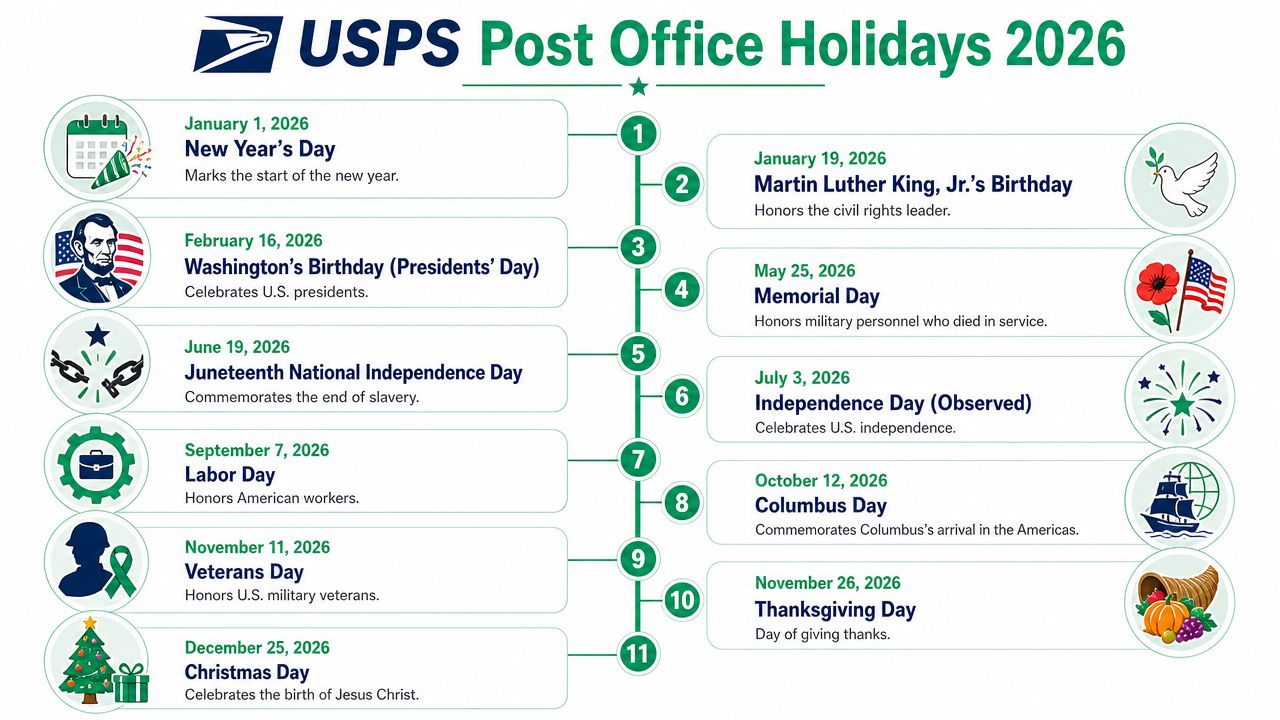
2026 USPS postal holidays
| Expected Date | Holiday | Day of the Week |
|---|---|---|
| January 1, 2026 | New Year's Day | Thursday |
| January 19, 2026 | Martin Luther King Jr. Day | Monday |
| February 16, 2026 | Presidents' Day | Monday |
| May 25, 2026 | Memorial Day | Monday |
| June 19, 2026 | Juneteenth National Independence Day | Friday |
| July 4, 2026 | Independence Day | Saturday |
| September 7, 2026 | Labor Day | Monday |
| October 12, 2026 | Columbus Day | Monday |
| November 11, 2026 | Veterans Day | Wednesday |
| November 26, 2026 | Thanksgiving Day | Thursday |
| December 25, 2026 | Christmas Day | Friday |
For merchants, this list is less about memorizing dates and more about setting triggers. These are the days to review checkout promises, pause any risky “arrives by” language, and decide whether customer edits should stay open longer because packages are less likely to move.
Carrier mix also matters here. Stores that split volume across services should compare USPS holiday exposure against private-carrier options before peak weeks. Our breakdown of USPS vs FedEx shipping tradeoffs for ecommerce teams is useful when you need a backup service plan.
The weekend observance rule
Observed holidays create confusion because payroll calendars and postal operations do not always translate cleanly into the same action for merchants. The practical rule is simple. Start with the actual holiday date on the USPS calendar, then verify local counter hours, carrier acceptance, and scheduled pickups for the surrounding weekday.
This distinction is important because fulfillment teams often see “observed Friday” or “observed Monday” on an internal calendar and assume USPS will behave the same way everywhere. That assumption leads to missed handoffs and customer promises your support team has to clean up later.
For the expected 2026 schedule, July 4 stands out. Independence Day falls on a Saturday, which is exactly the kind of date that causes internal confusion. If your warehouse ships on Fridays and your team uses batch label printing, confirm whether Friday handoff and retail acceptance will match your normal pattern before you promise weekend movement.
What merchants should put on the calendar
Use each holiday as an action date, not just a closure date.
- Checkout and PDP messaging: Adjust delivery promise language before the holiday window starts.
- Fulfillment rules: Set the last practical USPS handoff day for each warehouse.
- Support macros: Prepare replies for tracking delays, address changes, and “why hasn't it moved?” tickets.
- Post-purchase workflows: Keep order edits open long enough to reduce bad-address shipments when carrier movement slows.
- Marketing sends: Coordinate promotions with actual ship capacity, not the ideal calendar.
Teams that handle postal holidays well usually do one thing consistently. They plan the day before, the holiday itself, and the first operating day after.
How Postal Holidays Disrupt Ecommerce Shipping
A USPS holiday closure rarely creates just a one-day problem. It creates a short chain reaction. Orders still come in. Labels may still get created. Customers still expect movement. But the postal network changes pace, and your support queue feels it almost immediately.
The disruption starts before the holiday
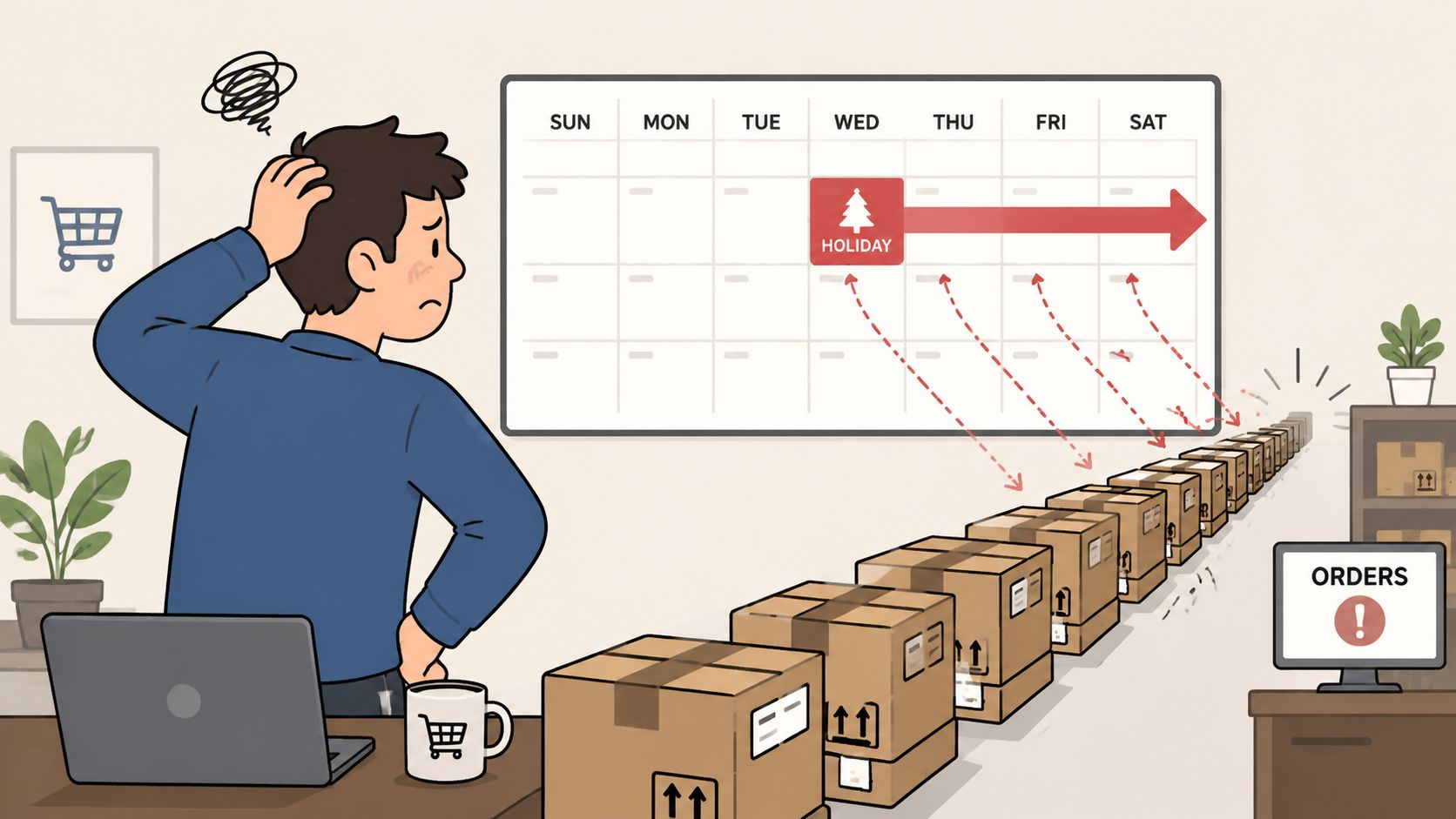
The most common operational mistake is treating a postal holiday as a single closed date. In practice, your team usually deals with three pressure points:
- The day before when order volume rises and customers try to “get it out before the holiday.”
- The holiday itself when regular delivery pauses.
- The first operating day after when warehouses, carriers, and customers all re-enter the system at once.
That's why delivery estimate tools often need a manual sanity check around holiday windows. A promise that looked acceptable on a normal week can become unrealistic once a closed day sits in the middle.
Why tracking appears to freeze
These scenarios often consume support teams' time. A customer gets a shipping confirmation, sees no movement, and assumes the package is stuck or lost. The true situation is usually less dramatic. The parcel may be waiting for acceptance, waiting for pickup, or moving through a slower scan sequence because the network just paused.
Most “where is my order?” tickets after a holiday aren't true exceptions. They're expectation failures.
If you use a 3PL or scheduled USPS pickups, the pause can show up one step earlier. The warehouse may have packed the order, but the pickup timing changes. That creates a gap between “fulfilled” in your system and “moving” in the customer's mind. If your notifications don't explain that gap, customers will fill in the story themselves.
Standard services versus urgent shipments
Not every USPS service behaves the same way during holidays. USPS distinguishes between regular postal holiday closures and Priority Mail Express, which continues year-round. The USPS Holiday Service Schedule notes that “Priority Mail Express items will still be delivered as that service functions year round,” as summarized in this postal holiday reference.
That distinction matters if you sell products tied to deadlines, replacements, perishables, or last-minute gifting. Standard services pause. Express gives you a continuity option, but only if your team intentionally routes the right orders into it.
If you're reviewing whether USPS is the right fit around these windows, this comparison of USPS vs FedEx for ecommerce shipping is useful for thinking through service-level trade-offs.
A quick explainer helps when training ops and support teams:
| Shipping situation | What usually happens |
|---|---|
| Standard USPS services | Regular mail and package delivery pause on postal holidays |
| Post Office retail access | Locations close on the holiday |
| Priority Mail Express | Continues to operate year-round |
The operational lesson is simple. Don't promise continuity unless the specific service supports it.
Here's a useful walkthrough if your team needs a visual refresher on holiday-related USPS service interruptions and customer expectations:
What works and what doesn't
What works is adjusting promises before customers ask. What doesn't work is waiting for tracking complaints, then explaining the holiday after the fact.
Use holiday planning to decide:
- Which orders can wait: Low-urgency shipments can move on the next operating day.
- Which orders need upgrade logic: Certain SKUs or customer segments may justify Express.
- Which notifications need editing: Shipping confirmations and order status pages should mention holiday pauses clearly.
The merchants who stay calm during USPS post office holidays usually aren't faster. They're clearer.
A Proactive Holiday Playbook for Merchants
Holiday planning becomes mandatory when volume spikes. During the period between Thanksgiving and New Year's Day in 2024, USPS delivered more than 900 million packages, processed over 350 million mailpieces per operating day, and handled nearly 16 billion total pieces for the season, according to USPS holiday shipping data. When that much volume moves through the network, “we'll deal with it as it happens” stops being a serious operating plan.
Build your internal cutoff before USPS forces it
Most stores publish customer-facing shipping cutoffs too late and create them too close to the carrier deadline. That gives your warehouse no room for pick delays, inventory checks, batching issues, or address exceptions.
A better approach is to create two dates for every holiday-sensitive period:
- Internal cutoff: The last point your team feels comfortable promising standard handling.
- Customer-facing cutoff: The softer deadline customers see.
Those dates don't need to be dramatic. They need to be realistic. If your warehouse usually gets slammed after a promotion, don't pretend a holiday week will behave like an ordinary Tuesday.
Use messaging in the places customers already look
Most support tickets around USPS post office holidays come from missing information, not missing effort. Customers check product pages, checkout, confirmation emails, and tracking pages. If the holiday impact isn't in those surfaces, they assume shipping is normal.
Here's the copy structure I've seen work best:
- Product page notice: Shipping timing note. Orders placed near federal postal holidays may move on the next USPS operating day.
- Checkout note: Delivery estimate reminder. USPS holiday closures can affect dispatch and transit timing.
- Confirmation email line: What happens next. Your order is confirmed. Tracking updates may take longer around postal holidays.
- Order status page message: Need changes before shipment? Address or contact edits must be submitted before the order is handed off.
That kind of messaging reduces emotional support tickets. Customers still care, but they don't feel surprised.
Don't hide holiday language in a shipping policy nobody reads. Put it at the moment of purchase and the moment after purchase.
Prep support before the inbox fills up
Support teams need a holiday brief, not just a holiday calendar. The brief should answer the actual questions agents will get:
| Support question | Best internal answer |
|---|---|
| “Why hasn't tracking updated?” | USPS holiday timing can delay scans and acceptance events |
| “Can you still change my address?” | Depends on whether the order has been handed off or labeled under your workflow |
| “Why did my estimate shift?” | A postal holiday interrupted normal processing or transit |
| “Can you upgrade me?” | Check whether an eligible urgent service is still available |
This is also a good time to review packaging and service selection. If you're shipping a lot of small parcels, this guide to USPS Priority Mail boxes and rates for merchants can help your team choose a service mix that's easier to manage during constrained periods.
Align marketing with ops
The cleanest holiday weeks happen when marketing and operations act like one team. If marketing pushes a last-minute campaign without updating delivery messaging, support pays for it. If operations slows dispatch without updating the storefront, customers pay for it.
Three rules help:
- Freeze unrealistic delivery claims during holiday-affected windows.
- Review every active banner and flow that mentions fast shipping.
- Decide in advance which promos you'll pause if capacity tightens.
What doesn't work is heroic cleanup. Ops shouldn't be stuck explaining promises they didn't make.
Turn Holiday Chaos into Revenue with Self-Service
Holiday weekends create a specific kind of support mess. Orders keep coming in while your carrier timeline pauses. Customers have extra time to review their confirmation email, notice a mistake, and panic. By the time your team returns, the queue is full of address edits, shipping questions, cancellation requests, and “can I add one more item?” messages.
That's exactly the sort of problem that should never require a human first response.
The holiday weekend failure pattern
A common sequence looks like this. A customer places an order late on Friday before a holiday closure. A few hours later, they realize the apartment number is missing or the shipping address is outdated. Since fulfillment won't move immediately, the order is still salvageable. But the customer can't fix it on their own, so they submit a ticket.
By the next business day, your team has to sort through a pile of preventable requests before they can focus on real exceptions.
Here's the operational cost of that pattern:
- Support loses time triaging low-complexity requests.
- Fulfillment slows down while agents and ops verify whether an order is still editable.
- Customers get nervous because they don't know whether anyone saw the request in time.
- Revenue opportunities disappear when a buyer wants to add to the order but has no clean path to do it.
A holiday pause can be an advantage if the customer can still correct the order before fulfillment starts.
What self-service changes
A self-service post-purchase flow changes the timing of the whole interaction. Instead of emailing support and waiting, the customer can access an order portal, make an allowed change inside a defined window, and move on. Operations stays in control because the merchant decides what can be edited, when the window closes, and which orders qualify.
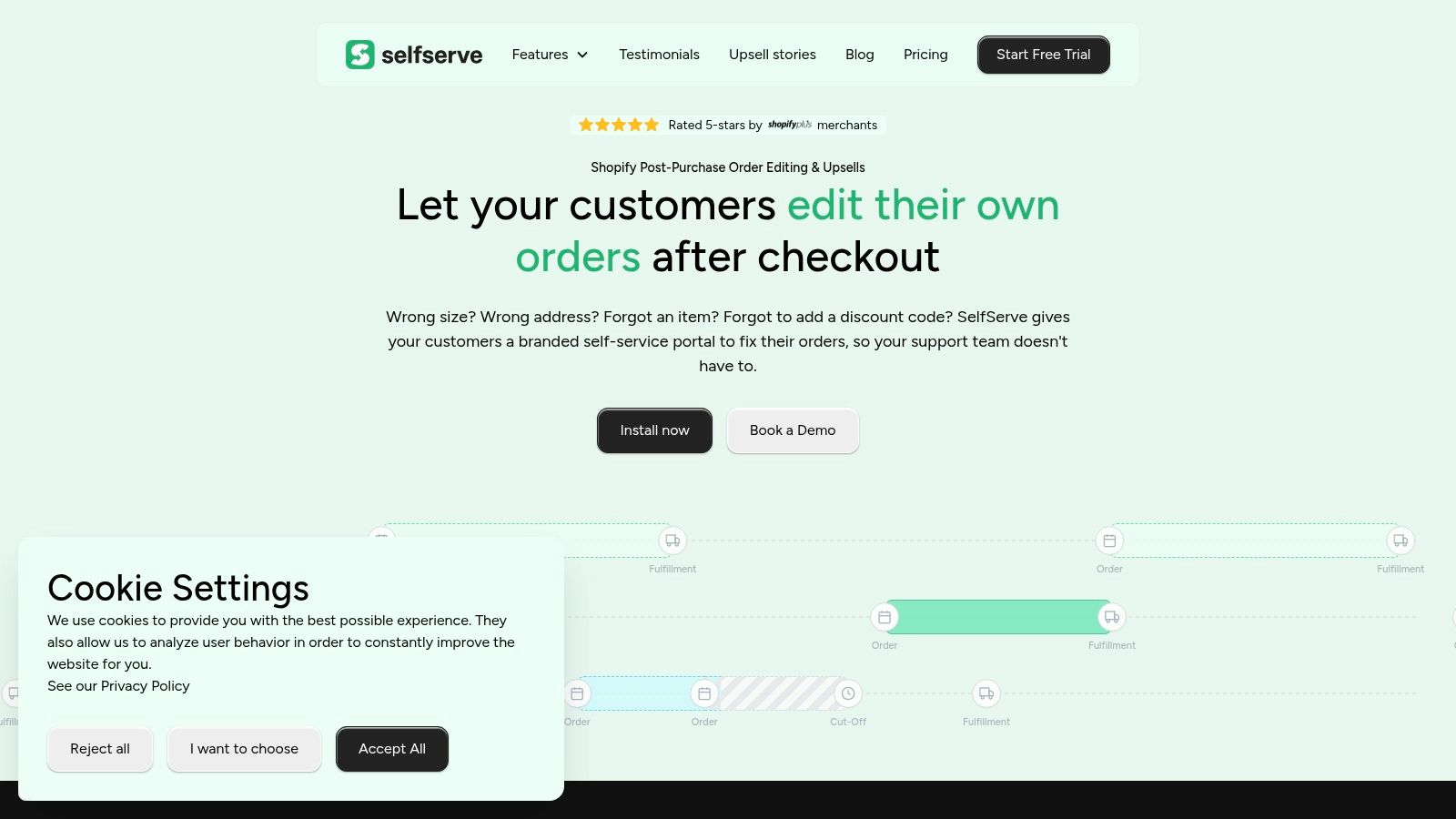
This is especially useful around USPS post office holidays because the order often sits in that editable state longer than it would on a normal weekday. If your workflow supports safe automation, the holiday no longer has to produce a customer-service bottleneck.
The highest-value self-service actions usually include:
- Address edits: Correcting unit numbers, street details, or destination mistakes before label creation.
- Contact detail updates: Fixing email or phone information so post-purchase notifications still work.
- Order additions: Letting the customer add eligible items while the order remains unshipped.
- Cancellation requests with guardrails: Allowing a request path without forcing support to manually parse every email.
Why this matters more during holiday closures
Holiday closures expose the weakness of support-led change management. A shopper who wants to fix an order isn't asking for bespoke concierge service. They want a safe interface and a clear deadline. When you remove that friction, you protect both the customer experience and your team's time.
The better systems also improve internal discipline. They force teams to define:
| Workflow decision | Why it matters |
|---|---|
| Edit window | Prevents late changes after operational commitment |
| Allowed fields | Reduces risk of changes that break fulfillment |
| Order state rules | Keeps shipped, packed, and held orders separate |
| Approval logic | Lets ops review exceptions without blocking every request |
If you're evaluating what that kind of workflow looks like in practice, this overview of a self-service customer portal for Shopify orders is a good reference point.
The hidden upside is commercial
Most merchants think about post-purchase self-service as a support savings tool. It is that. But holiday windows also create a small sales opportunity. Customers revisit their orders during pauses. If they can edit safely, they're also more likely to add.
That's a better outcome than the usual alternative. Without self-service, the customer either sends a ticket asking to modify the order or gives up entirely. With self-service, the same moment becomes cleaner operationally and more valuable commercially.
The strongest holiday operations aren't the ones that eliminate all friction. They eliminate unnecessary human handoffs.
Finding Local Post Office Hours and Cutoffs
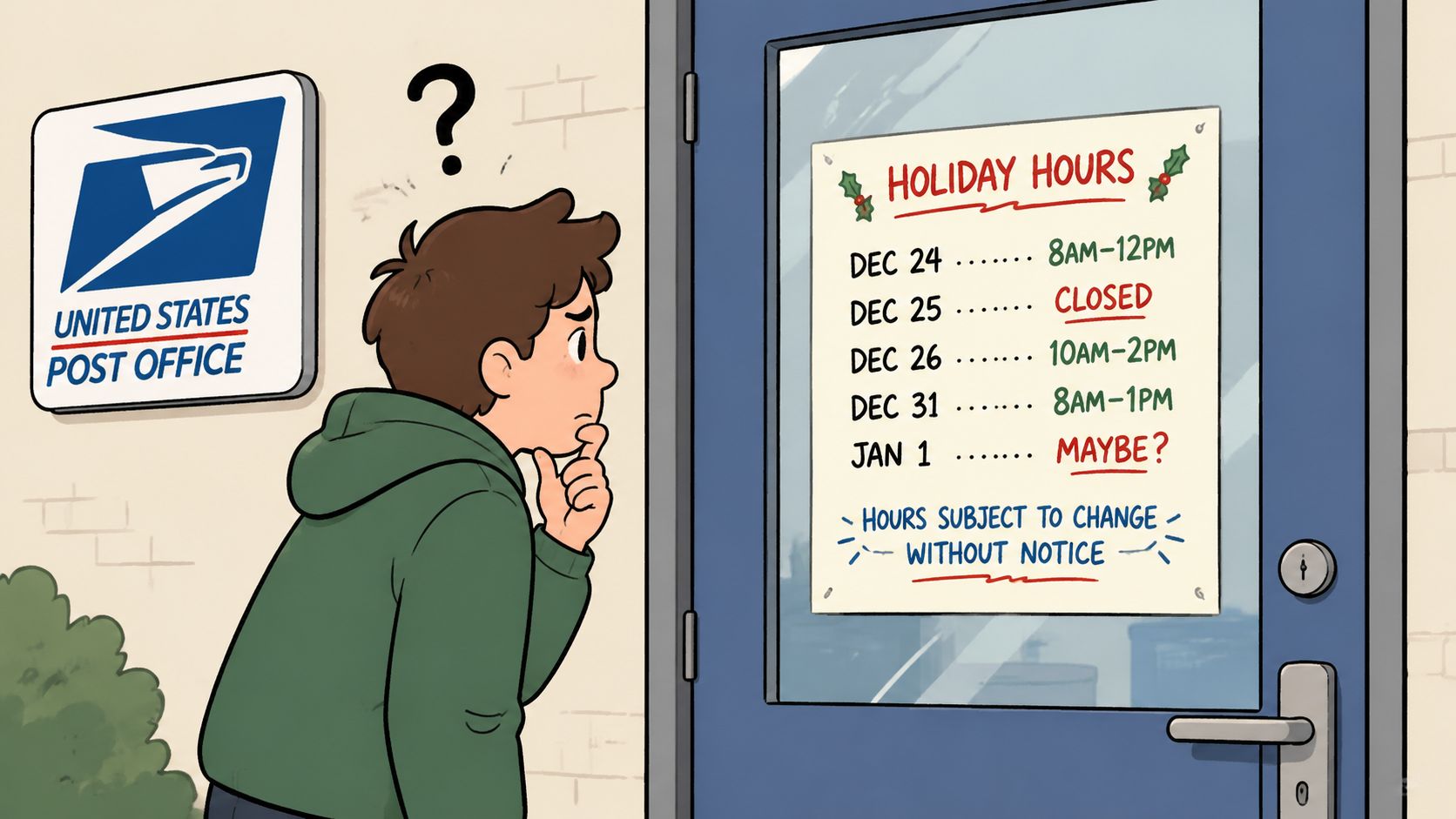
The national holiday schedule gives you the framework. Your local branch gives you the ground truth. That distinction matters because merchants often assume the nearest Post Office will behave exactly like the federal calendar suggests, then discover a different retail counter schedule, a modified pickup time, or a last collection cutoff that arrived earlier than expected.
How to verify local information
Use the official USPS location tools, not old screenshots, map snippets, or forum posts. Start with the USPS locator and check the specific branch you use for drop-off or retail service. Look for listed hours, holiday notes, and any mention of modified operations.
Then confirm the details that matter to fulfillment, not just customer walk-in traffic:
- Retail counter hours: When staff can accept parcels at the desk.
- Last pickup time: The final handoff window for outgoing mail.
- Lobby access: Whether self-service kiosks or drop boxes remain accessible.
- Pre-holiday exceptions: Whether the day before a holiday runs on shortened operations.
What modified hours usually mean for merchants
“Modified hours” is easy to misread. It doesn't tell you whether your workflow is safe. It only tells you that normal timing has changed. For a merchant, that means you should assume less flexibility until you confirm specifics.
A practical process looks like this:
- Check the local branch listing early in the week of the holiday.
- Call if your handoff is time-sensitive or your volume is high enough that a missed pickup hurts.
- Adjust your internal same-day ship promise if the local cutoff is tighter than usual.
- Tell support and warehouse leads the exact final drop-off time they should work from.
If your team ships close to the daily cutoff, local confirmation matters more than the national holiday list.
That small habit prevents a lot of self-inflicted delay.
Common Questions About USPS Holidays
Does USPS deliver on all federal holidays
No for regular mail and standard package delivery. On USPS holidays, Post Office retail counters are generally closed and normal delivery schedules pause, which matters less as a calendar fact than as an operational constraint.
For merchants, a key risk involves treating every USPS service the same. Holiday planning breaks down when checkout says "fast shipping," the label gets created, and the parcel still cannot move the way the customer expects.
What happens when a holiday falls on a Saturday
Do not assume the prior Friday becomes a full USPS shutdown. Observed holidays and operating holidays are not always identical, and that distinction affects whether you should keep packing, buying labels, and tendering shipments.
The safe rule is simple. Check the current USPS holiday and service updates before you change warehouse schedules or block a ship date in checkout. If you guess wrong, you either miss a working day or promise movement that will not happen.
Does overnight shipping still work on a USPS holiday
Sometimes, but only for specific services. The common mistake is grouping every rushed shipment under "overnight" or "expedited" and assuming holiday rules do not apply.
Priority Mail Express is the service merchants usually review first for holiday coverage, but teams still need to confirm the exact acceptance window and local drop-off reality. A label is not the same as a successful handoff. If your branch closes earlier or skips normal intake, your cutoff moves with it.
Are USPS post office holidays the same as UPS and FedEx holidays
No. Carrier holiday calendars, pickup schedules, and retail access often differ. Multi-carrier operations need separate rules for each carrier, especially if your shipping software auto-selects the cheapest service.
In this situation, a generic "carrier delays may occur" banner does not help much. Better results come from carrier-specific messaging tied to the method the customer chose, plus order-routing rules that stop unsupported options from showing during known holiday windows.
Why do customers complain even when the holiday was obvious
Because customers react to the promise they saw, not the internal exception your team discussed in Slack.
If the order confirmation suggests quick movement and tracking sits still for a day or two, support gets the blame. That is why holiday prep is mostly expectation management. Clear delivery messaging, realistic ETAs, and visible post-purchase options prevent a lot of "Where is my order?" tickets before they start.
What should merchants check first before a holiday
Start with the points that change customer outcomes and warehouse decisions:
- Checkout delivery promises: Remove transit language your team cannot support during the closure window.
- Allowed USPS services: Disable methods that create false urgency or unclear expectations.
- Warehouse cutoff times: Match pack deadlines to the actual handoff schedule for your local branch.
- Support macros and auto-replies: Update them before the ticket spike starts.
- Post-purchase edit rules: Keep address changes, order edits, and cancellations clear while orders are still unshipped.
I treat this as a pre-holiday control check. If these five items are current, USPS holidays stay manageable. If they are not, the same closure creates avoidable delays, refund requests, and manual support work.
Holiday shipping gets easier when customers can fix simple post-purchase issues on their own instead of opening tickets your team has to untangle after a closure. SelfServe gives Shopify merchants a controlled way to let shoppers edit order details, reduce support workload, and capture post-purchase upsell revenue without losing operational control.