What Does AOV Mean in Business? a Guide for Ecommerce 2026
AOV means Average Order Value, and the formula is simple: Total Revenue divided by Number of Orders. In ecommerce, that number matters because moving a store from an AOV of $50 to $55 can turn $100,000 from 2,000 orders into $110,000 in revenue from the same customer base.
That's why new ops managers often feel confused at first. Traffic looks healthy, orders are coming in, the team is busy, yet profit still feels thin. The missing piece is usually not more sessions or another discount campaign. It's understanding what each order is worth, and then improving that value without creating operational chaos.
Most articles answering what does AOV mean in business stop at the formula. That's useful, but incomplete. In practice, AOV is not just a reporting metric. It's a profitability lever, a merchandising signal, and, for Shopify Plus brands, a post-purchase growth channel.
Your Store Has Traffic But Where Is the Profit
A common pattern shows up in growing Shopify stores. Paid social is driving visits. Search is bringing in intent. Conversion rate is acceptable. Then finance reviews the month and asks a harder question: if orders are coming in, why doesn't the margin feel stronger?

The answer is often hidden inside order composition. A store can be “selling” and still struggle if too many customers buy the cheapest item, skip add-ons, or place small orders that barely cover shipping, pick-and-pack, and acquisition costs. Ops teams feel this first because support load rises, fulfillment keeps moving, and the financial payoff doesn't match the effort.
What low-profit growth usually looks like
You'll recognize the pattern quickly:
- Ads are working, but not efficiently: Customer acquisition keeps consuming margin, so every small basket feels expensive. If you're reviewing channel performance at the same time, it helps to optimize your ad spend with return-on-ad-spend math instead of treating revenue alone as success.
- Orders are frequent, but shallow: Teams celebrate volume while ignoring the fact that low-value orders can be operationally heavy.
- Support carries the consequences: Customers ask to combine orders, change shipping, or add forgotten items after checkout, and those requests expose where the buying journey is leaking value.
A store doesn't become healthier just because order count rises. It becomes healthier when each order carries enough value to support the cost of acquiring, servicing, and shipping it.
AOV is valuable because it tells you the average size of each order right now. Not what a customer might spend over a year. Not whether brand awareness is rising. Just the immediate economic value of the transactions already happening.
Why ops managers should care early
AOV sits at the intersection of marketing, merchandising, support, and fulfillment. Marketing cares because larger baskets make paid acquisition easier to justify. Merchandising cares because bundles and thresholds can shape what customers add. Support cares because rigid post-purchase policies can turn a good order into a cancellation.
If you've been asking what does AOV mean in business, the practical answer is this: it tells you whether your store is converting demand into profitable orders, not just into activity.
What Is AOV and How Do You Calculate It
Average Order Value is the average amount customers spend per order over a defined period. The clean formula is Total Revenue / Number of Orders. It's a per-order metric, not a per-customer metric, which matters more than many teams realize.
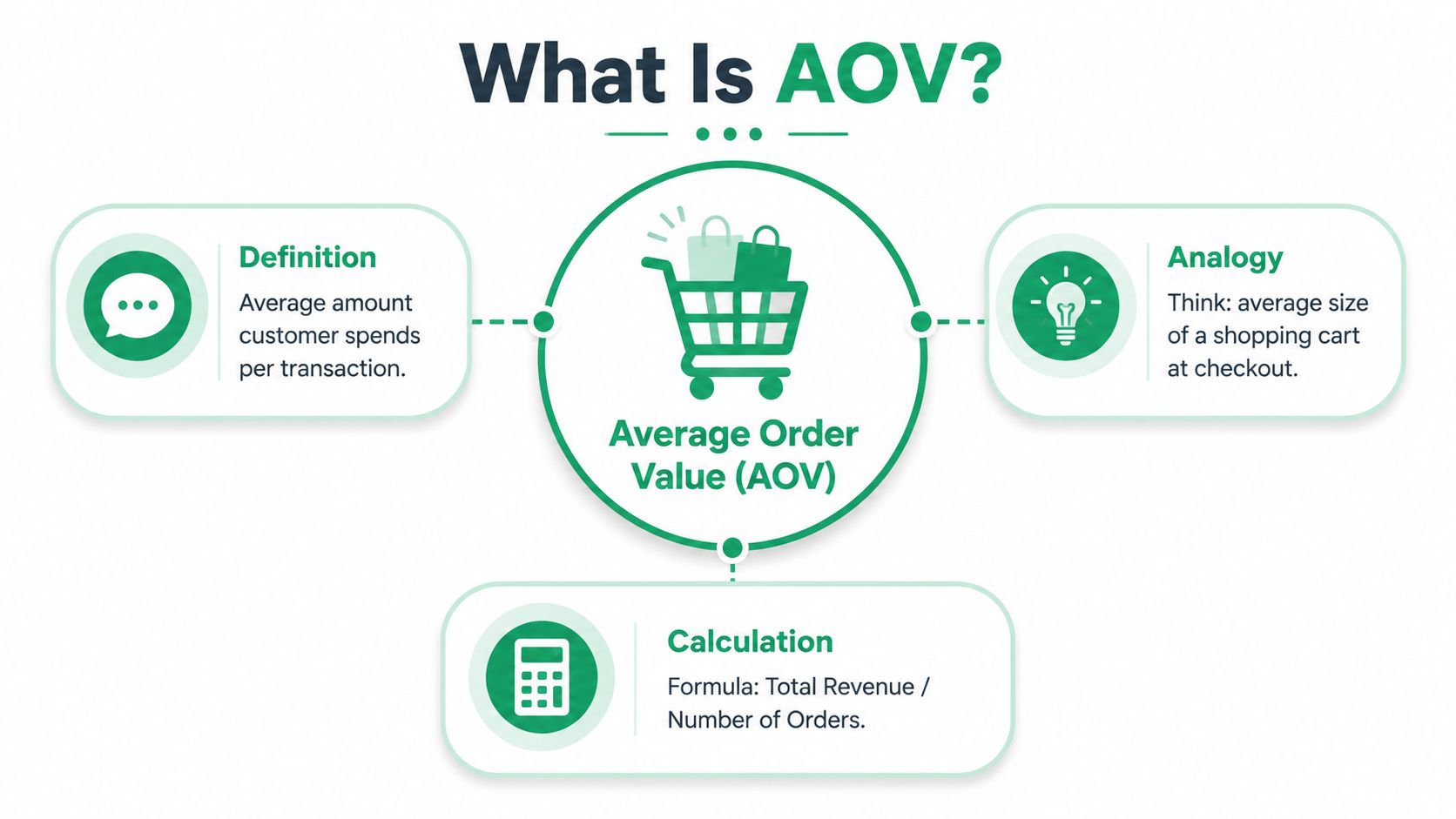
Imagine it as average basket size at checkout. If one customer places three separate orders in a month, those are counted as three orders in the calculation, not one customer relationship. That's why AOV is useful for immediate commercial decisions. It shows how much value the store creates every time checkout happens.
The formula in plain English
Use a consistent timeframe, then divide revenue by orders.
| Metric | Value |
|---|---|
| Total revenue | $100,000 |
| Number of orders | 2,000 |
| AOV | $50 |
That example comes straight from Pipedrive's explanation of AOV. The same example shows why small improvements matter. If that store lifts average order size from $50 to $55, revenue becomes $110,000 from the same order volume.
What AOV is not
AOV is often confused with customer lifetime value. They're related, but they answer different questions.
- AOV answers: How much is the average order worth right now?
- Customer lifetime value answers: How much is a customer worth over time?
- Conversion rate answers: How many visitors turn into buyers?
That distinction keeps teams from making bad decisions. If customer lifetime value is strong but AOV is weak, the brand may have loyal buyers who start with small first orders. If AOV is strong but repeat rate is weak, the first purchase may be healthy while retention needs work.
Practical rule: Use AOV for day-to-day levers like bundling, upsells, shipping thresholds, and post-purchase offers. Use lifetime value for retention planning and acquisition budgeting.
How to calculate it accurately
The formula is simple, but the reporting needs discipline.
- Pick a timeframe: Monthly and quarterly views are easiest to compare.
- Use revenue tied to orders: Keep the period consistent.
- Adjust for refunds and chargebacks where your reporting setup allows: Otherwise you can overstate commercial performance.
- Compare like with like: Don't compare a holiday week to a slow off-season week and call it a trend.
AOV also varies by category. In the same Pipedrive overview, median AOV is described as around $75 for fashion and often above $200 for electronics, which is why category context matters when people ask whether an AOV is “good.” AOV only becomes useful when it's compared against your pricing model, your margin profile, and your order mix.
Why AOV Is a Critical Ecommerce Metric
AOV matters because a lot of ecommerce costs don't rise neatly with order value. Shipping, packaging, support effort, and customer acquisition often hit per order, not as a perfect percentage of basket size. When the order is larger, those fixed costs consume a smaller share of the sale.
That's why finance teams care about AOV long before they care about vanity growth charts. Inflow Inventory's overview of AOV notes that increasing AOV by $10 can improve net profit margin by 5% to 8%, assuming stable conversion rates. The same source places average AOV at approximately $59 in the United States and about $48 in Europe.
Why profit responds faster than traffic
Teams often default to “we need more traffic.” Sometimes that's true. But more traffic usually means more spend, more variability, and more pressure on conversion. AOV is different because it improves the economics of orders you're already generating.
Consider what changes when order value rises:
- Acquisition gets easier to justify: You can tolerate more CAC when each checkout is worth more.
- Fulfillment works harder for the same order count: The warehouse doesn't need more picks just because the basket includes a better mix.
- Pricing strategy becomes visible: AOV can reveal whether bundles, thresholds, and merchandising are changing shopper behavior.
The operational side most teams miss
AOV is also a planning metric. If customers consistently buy higher-value combinations, ops can read that as a signal about product mix, inventory needs, and packaging requirements. If AOV falls, the issue may not be traffic quality alone. It can point to weak bundling, excessive discounting, or a product page experience that funnels everyone into entry-level items.
Rising AOV usually means the store is persuading customers to buy better combinations, not just more units.
There's also a regional lens. If your US store and EU store behave differently, benchmark expectations should differ too. Using one “target AOV” across all markets can mislead both marketing and operations.
When AOV becomes a competitive advantage
A store with a healthier AOV can often compete harder in paid channels because every conversion is worth more. That doesn't guarantee efficient growth, but it changes the math in your favor. It also gives teams room to test better customer experiences instead of relying on blunt discounting.
For an ops manager, that's the “so what?” behind the metric. AOV is not just a dashboard number. It affects whether growth is expensive and fragile, or durable and profitable.
How to Track Your AOV in Shopify
You can't manage AOV if you only glance at topline revenue. Shopify makes the metric accessible, but the value comes from how you read it, not from finding the widget on the dashboard.
Start in Shopify Analytics and look for Average Order Value in the overview. Then stop treating it as a single score. The better habit is to read it in context: timeframe, channel, campaign type, product mix, and support activity.
A simple reporting workflow
Use a repeatable routine each week:
- Check the default analytics view: Look at current AOV for the selected period.
- Compare periods: This month versus last month is usually more useful than random date ranges.
- Segment by channel: Paid social, email, direct, and organic often produce different basket behavior.
- Review by product mix or collection: AOV changes can come from what people buy, not just how much they buy.
- Pair it with operational notes: Promotions, shipping changes, stockouts, and support policy shifts all influence AOV.
If your team needs a broader walkthrough of Shopify reporting, this guide on how to track and understand Shopify analytics for smarter decisions is a useful reference point.
What to look for inside the numbers
AOV becomes actionable when you connect it to decisions. If paid traffic has solid conversion but weak AOV, the problem may be campaign intent or the landing page offer. If email has higher AOV, that usually means existing customers respond well to curated product sets or stronger merchandising context.
A short review table can help:
| If you see this | Look here first |
|---|---|
| AOV falls after a promotion | Discount structure and product mix |
| AOV rises but margin doesn't | Shipping subsidy or bundle discounting |
| One channel has much higher AOV | Creative promise and landing page alignment |
| AOV drops with more support tickets | Checkout confusion or rigid post-purchase policies |
Common tracking mistakes
Teams usually get tripped up by interpretation, not by math.
- Reading AOV in isolation: A higher AOV with weaker margin can still be a bad trade.
- Ignoring refunds: If refunded orders sit outside your working view, performance can look cleaner than reality.
- Using inconsistent periods: Month-over-month comparisons only help when seasonality and promotions are considered.
- Overreacting to short spikes: One campaign can distort AOV temporarily without changing the store's underlying behavior.
The key is consistency. Review AOV on the same schedule, in the same reporting context, and with the same operational notes. That's how it turns from a dashboard metric into a management tool.
Proven Strategies to Increase Your AOV
Most AOV gains come from a small set of tactics applied well. The mistake is stacking every app and every offer at once. Customers don't need more prompts. They need clearer value.

The classic levers still work because they match buyer psychology. Customers respond when the next item feels relevant, the threshold feels attainable, and the offer improves the purchase rather than interrupting it.
Start with threshold and bundle logic
One of the cleanest AOV levers is the free shipping threshold. Inflow Inventory notes that 72% of online shoppers were more likely to add items to reach a free shipping limit, boosting AOV by an average of 18%. This works best when the threshold sits close enough to the shopper's current basket to feel achievable.
Bundling is the next reliable lever. Strong bundles don't mash random products together. They solve a purchase problem. A skincare set, a supplement stack, or a camera accessory pack works because the customer already sees the relationship.
Here's a useful explainer on implementation details for how to increase average order value without overcomplicating the experience.
Use upsells where intent is already high
Cross-sells and upsells work when they're specific. “You may also like” is weak. “Add the matching refill” or “upgrade to the larger size” is stronger because it fits the purchase already in motion.
Historical analysis from 2020 to 2023 found that implementing upsell strategies can increase AOV by 15% to 30% on average, and a study of Shopify stores found that a Thank You page upsell module increased average transaction size from $52.40 to $67.80. I'm citing the figures qualitatively here because the linked source already appeared earlier, but the operational lesson is the key point: higher-intent moments usually outperform generic recommendations.
The best upsell is not the most expensive item. It's the add-on that feels obvious once the customer sees it.
This video gives a practical overview of the mechanics behind these tactics:
What works and what usually doesn't
- Works well: Relevant bundles tied to the hero product.
- Works well: Free shipping thresholds that are close enough to motivate one more add-to-cart.
- Often underperforms: Generic sitewide popups offering unrelated products.
- Often backfires: Discounts so aggressive that AOV rises while contribution margin falls.
Another overlooked tactic is customer segmentation. Inflow Inventory reports that merchants using customer segmentation and targeted upsell campaigns maintained an AOV that was 22% higher than those using generic marketing approaches. That result matches what experienced operators already know. Relevance beats volume.
The New Frontier Post-Purchase Upsells and AOV Defense
AOV is often treated as a pre-checkout problem. That's outdated. Some of the most valuable AOV work happens after payment, when the customer has already committed and friction is lower.
Thank You pages and Order Status pages matter because buyer intent hasn't disappeared yet. The order is placed, trust is highest, and a well-positioned add-on can feel helpful instead of intrusive. That's why newer Shopify operations playbooks increasingly include post-purchase offers as part of revenue planning, not just as a retention experiment. If you want a deeper operational view, this article on Shopify post-purchase upsell is a solid starting point.
AOV growth after checkout
There's a practical reason post-purchase upsells work. The customer no longer has to decide whether to buy from you. They've already answered that question. Now the job is simpler: present a complementary item, a relevant collection, or a convenient add-on at the moment when certainty is highest.
Recent Shopify ecosystem data also suggests that post-purchase touches are now responsible for a large share of incremental AOV growth in high-volume stores. Whether a brand uses Thank You page modules or Order Status widgets, the same rule applies. Relevance beats pressure.
One more operational detail matters here. If you send post-purchase email prompts that support these offers, the copy needs to be clean and credible. Even small choices in inbox presentation can affect whether customers engage, which is why teams running these flows should review subject line capitalization best practices before launching them.
AOV defense is as important as AOV growth
The strongest ops teams don't only push AOV upward. They also protect the value already captured.
Recent industry data shows that 42% of DTC brands lose orders due to rigid post-purchase policies, and allowing edits such as address changes or item additions recovers 28% of that lost value. That changes the way ops managers should think about support. Order edits are not just a service convenience. They are an AOV defense mechanism.
A cancellation erases the full value of the order. A controlled edit often keeps the sale, reduces support friction, and may even expand the basket.
When customers can't change a shipping address, swap a variant, or add a forgotten item, they often default to cancel-and-reorder behavior. That creates avoidable revenue loss, support volume, and fulfillment friction. Flexible post-purchase policies reduce those failure points.
For a modern Shopify Plus store, the actual answer to what does AOV mean in business is broader than “average basket size.” It means how much value you create per order, and how well your operation preserves or expands that value after checkout.
If your team wants to improve AOV without adding support chaos, SelfServe is built for exactly that post-purchase window. It lets customers make approved order changes on their own and supports upsell modules on Thank You and Order Status pages, so you can protect revenue, reduce ticket volume, and turn post-purchase moments into profitable ones.