What Is Average Order Value? a 2026 Guide for Merchants
Average Order Value is the average amount a customer spends each time they place an order on your site, and the formula is simple: Total Revenue ÷ Number of Orders. If you increase AOV by 10%, profit can rise by up to 50% because that extra revenue often comes without much additional acquisition or fulfillment cost.
If your Shopify store feels stuck, this is usually where the ceiling shows up. Traffic is steady. Ads still bring people in. Orders are coming through. But revenue growth has slowed, and every attempt to push harder on acquisition gets more expensive.
That's why AOV matters so much. It helps you grow revenue from shoppers you already convinced to buy. And for many stores, the most overlooked opportunity isn't on the product page or in the cart. It's after checkout, where thoughtful post-purchase offers and smoother self-service options can increase order value without making the buying experience feel heavier.
Understanding Average Order Value
A lot of merchants start asking what is average order value when they realize more traffic isn't fixing the problem. You can keep improving paid social, search, and email, but if each order stays flat, you're still forcing growth through a narrow channel.
Average Order Value, or AOV, is the average amount spent each time a customer places an order on your site. The formula is straightforward:
Total Revenue ÷ Number of Orders = AOV
That sounds basic, but the metric is more useful than it first appears. AOV tells you how much value your store creates per transaction. It also reveals whether your merchandising, pricing, bundling, and checkout experience are helping customers build a larger basket or capping them at a single-item purchase.
Why merchants watch AOV closely
AOV is one of the few metrics that can improve revenue without requiring more sessions. That's why experienced operators don't treat it like a reporting number. They treat it like a lever.
For example, if your store sells replenishable products, a higher AOV might come from multi-pack offers. If you sell apparel, it might come from complete-the-look recommendations. If you sell accessories or add-ons, the opportunity often shows up after checkout, when the customer has already committed.
Practical rule: AOV matters most when you connect it to profit, not when you chase a bigger basket for its own sake.
If you want a broader framework for thinking about average order value strategies, start with the methods that increase order size while still feeling useful to the customer. The stores that do this well don't just sell more. They make the next relevant purchase easier.
How to Calculate Your AOV Accurately
Most merchants know the formula. Fewer calculate it cleanly enough to make decisions from it.
Use the right revenue number
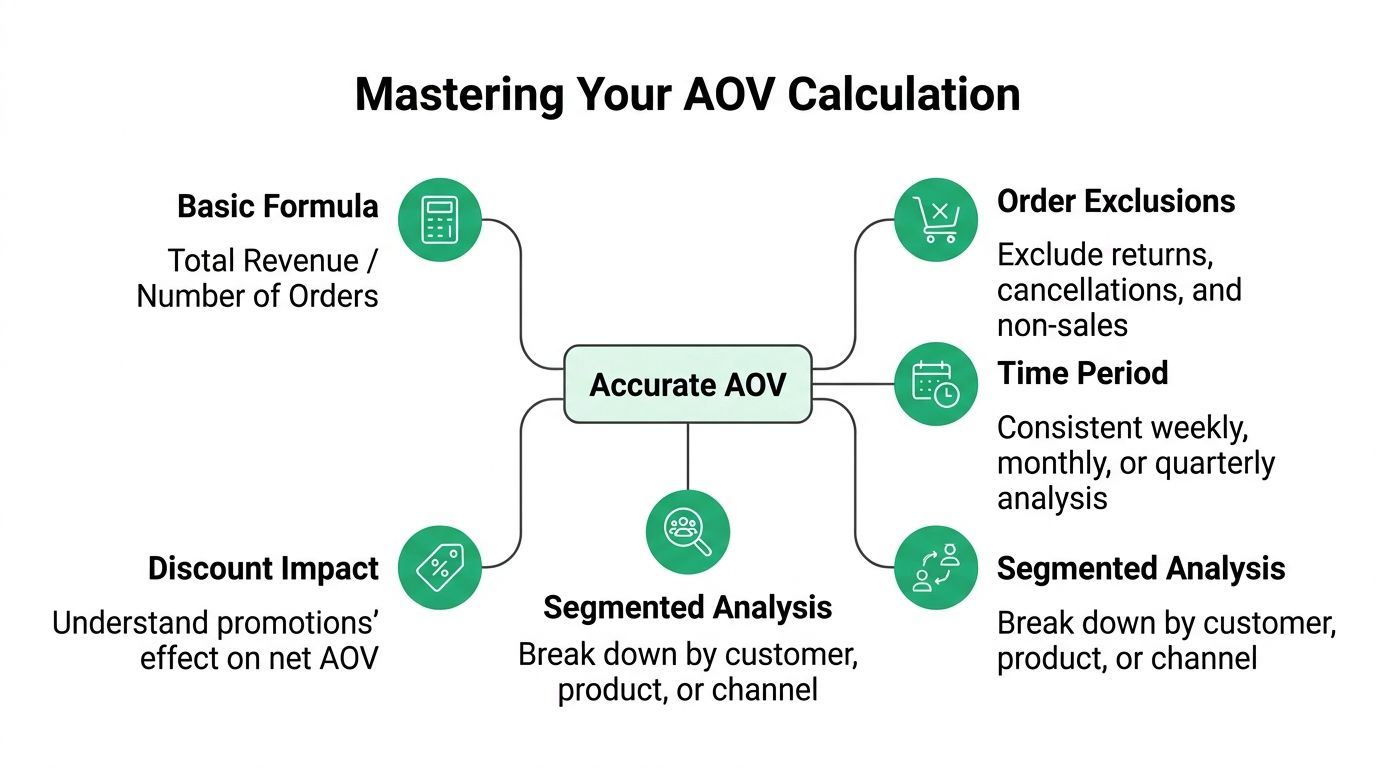
For AOV, use the revenue that reflects what customers bought from your catalog. In practice, that usually means product revenue after discounts. Be careful not to inflate the number by mixing in amounts that don't reflect product purchasing behavior.
A clean calculation usually follows this logic:
- Pull total product revenue for the period.
- Exclude canceled orders and refunded orders that shouldn't count as completed purchases.
- Divide that figure by the number of completed orders in the same period.
Shipping charges, taxes, and similar line items can muddy the picture because they aren't signs that customers chose more products. Returns also need special handling. If you ignore them, your AOV can look healthier than the business really is.
Use one consistent time frame. AOV becomes useful when you compare like with like across the same reporting window.
Two simple examples
Here's how the formula works in real store scenarios.
Example 1. Small boutique
A boutique reviews a recent period and totals product revenue after discounts. It then removes canceled and refunded orders, and divides by completed orders. That gives the store a baseline AOV it can compare before and after launching a bundle or free shipping threshold.
Example 2. High-volume store
A larger Shopify brand does the same calculation, but segments the result by channel, device, and customer type. That matters because a blended AOV can hide what's really happening. Returning customers may build bigger carts, while a paid social campaign might bring in lower-intent single-item orders.
Accuracy beats convenience
If you rely only on the default top-line numbers in your dashboard, check how the platform is defining revenue and orders before using that figure in strategy discussions. A strong guide to tracking and understanding Shopify analytics for smarter decisions can help you align reporting with how your store operates.
The goal isn't a perfect spreadsheet. It's a consistent definition you can trust when testing what changes basket size.
Why AOV Is a Critical Ecommerce Metric
AOV works a lot like the average bill at a restaurant. If each table spends more, the business grows without adding more tables. Ecommerce works the same way. If each order is worth more, your store can produce more revenue from the same customer flow.
AOV changes the economics of growth
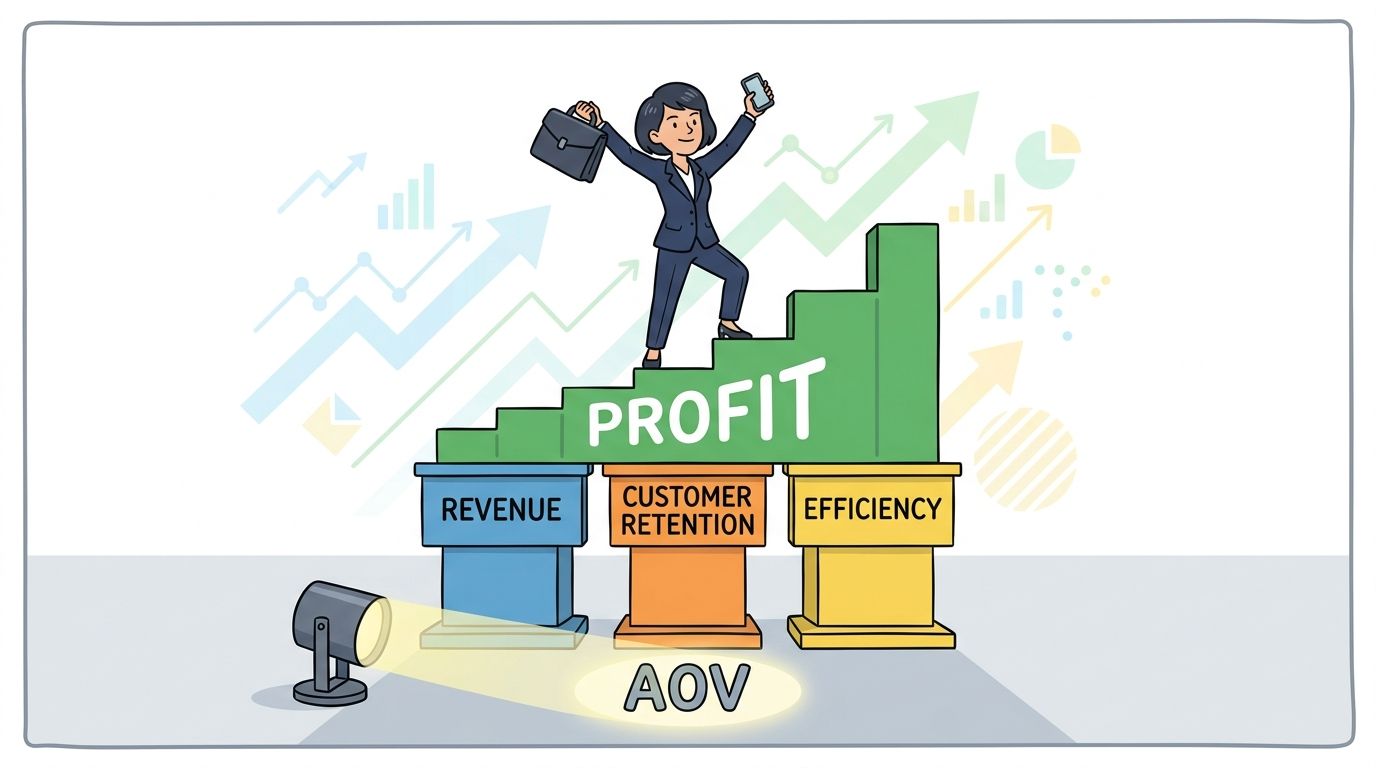
AOV shifts from being merely a dashboard metric to a financial one. According to Forbes' cited analysis of AOV and profit, ecommerce brands that increase their AOV by just 10% can see a corresponding profit increase of up to 50%, because the extra revenue often comes with minimal additional acquisition or fulfillment costs.
That's why so many operators focus on basket-building before they increase ad spend. If you can earn more from each completed order, your paid channels become more forgiving. You don't need every campaign to perform perfectly when your store captures more value from the customers you already paid to acquire.
It sharpens your marketing decisions
AOV also changes how you judge channel performance. A campaign with a lower conversion rate can still be attractive if it brings in shoppers who place larger orders. On the other hand, a campaign that looks efficient on surface-level conversion data may be weaker than it appears if it drives mostly low-value orders.
That's why merchants should review AOV alongside other e-commerce performance metrics. Looking at one metric in isolation often leads to the wrong fix. AOV gives context to conversion, merchandising, and customer quality.
It points toward long-term value
There's also a customer insight angle. Higher AOV doesn't automatically mean stronger lifetime value, but it often tells you something useful about buying intent, product fit, and category expansion. Customers who buy across multiple product types usually behave differently from customers who purchase one low-commitment item and disappear.
AOV is one of the fastest ways to tell whether your store is winning on order quality, not just order count.
That distinction matters when growth gets expensive. More orders can be noisy. Better orders tend to show up in the bottom line.
Five Actionable Strategies to Increase Your AOV
The best AOV tactics don't force customers into a bigger cart. They remove friction from purchases people were already close to making.
1. Set a free shipping threshold customers can realistically reach
Free shipping thresholds still work when the gap feels achievable. If the target is too high, customers often ignore it or abandon the cart instead of adding more.
A strong threshold usually sits close enough to the current basket that one relevant item can bridge the gap. Accessories, refills, travel sizes, and low-friction add-ons tend to work best here. Random filler products don't.
What works: a progress cue in cart and items that naturally complement what's already there.
What doesn't: forcing shoppers to hunt your catalog for something they don't want.
2. Build bundles that solve a complete use case
Bundles increase AOV when the grouping makes immediate sense. Skincare routines, starter kits, and product-plus-accessory pairings are all practical because they reduce decision fatigue.
The mistake is discounting too aggressively just to make the bundle look attractive. If the bundle trains customers to wait for markdowns, your AOV may rise while margin quality falls.
A quick rule of thumb is simple. Bundle around convenience and compatibility first. Use price as support, not as the entire reason to buy.
3. Upgrade the product mix on the product page
Some stores focus so much on upsells that they forget merchandising basics. If you offer good, better, best versions of a product, the comparison has to be obvious. Customers need to understand why the premium option is worth it.
That doesn't mean adding clutter. It means making the trade-off clear. Better materials, larger formats, expanded functionality, or longer-use versions often lift order value when presented cleanly.
If you're refining recommendation logic, this guide to the definition of personalization for marketers is useful because the strongest upsells feel relevant, not generic.
4. Use post-purchase offers where intent is highest
This is the most underused AOV lever on Shopify.
Once a customer has completed payment, the buying resistance changes. They're no longer deciding whether to trust your store enough to check out. They've already crossed that line. That's why Shopify's post-purchase upsell analysis notes that post-purchase offers convert at an average rate of 10-15%, compared with 3-5% for pre-purchase upsells.
The difference is practical, not magical. Post-purchase offers work because they appear after the main decision is complete. The customer doesn't feel that the checkout flow is being interrupted or made more complicated.
The key is relevance. Offer a refill, add-on, protection item, accessory, or complementary product that fits the original purchase. Don't throw a broad catalog recommendation onto the thank-you flow and expect it to perform.
The best post-purchase upsell feels like a helpful reminder, not a second sales pitch.
For stores working on this area, these cross-sell strategies for ecommerce are a good reference point for choosing products that naturally complement each other.
A short walkthrough helps if you're evaluating how these offers should appear in the post-checkout journey:
5. Let customers modify orders without creating support friction
This one is often missed because merchants think of AOV only as a merchandising problem. In reality, customer experience after checkout affects whether shoppers are willing to add to an order.
If customers can easily fix an address typo, update contact details, or make permitted changes without waiting on support, they're more likely to stay engaged with the order rather than treat checkout as the end of the relationship. That creates a better environment for thoughtful post-purchase add-ons.
Operationally, this matters because support-heavy stores often avoid post-purchase merchandising out of fear that changes will create chaos. Better self-service removes some of that tension.
AOV Benchmarks and Common Pitfalls
Merchants always want a benchmark, but often, AOV analysis goes wrong. A benchmark can provide context. It shouldn't become your target if it ignores your margin structure, product line, and buying behavior.
A simple benchmark table
Because benchmark figures vary widely by catalog, price point, and business model, treat the table below as a framework for organizing your own internal comparison rather than a universal scoreboard.
| Industry | Average Order Value (USD) |
|---|---|
| Fashion | Varies by brand mix and price point |
| Beauty | Varies by replenishment behavior and bundling |
| Home goods | Varies by category depth and shipping constraints |
| Electronics accessories | Varies by attach rate and product compatibility |
| Health and wellness | Varies by subscription mix and pack size |
That may feel less satisfying than a benchmark number, but it's more honest and more useful. For most Shopify stores, your best benchmark is your own historical trend, segmented by category, acquisition source, and customer type.
Where merchants hurt profit while chasing AOV
Three patterns show up repeatedly.
- Discount-heavy bundles: Merchants create bundles that raise order value on paper but strip out too much margin. If the customer only buys because the discount is steep, the bundle may not be helping the business.
- Unreachable free shipping thresholds: When the gap is too large, shoppers don't add products. They leave.
- No segmentation: A blended AOV can hide major differences between new and returning customers, or between search traffic and loyalty traffic.
What a healthy AOV strategy looks like
A healthy AOV program increases basket size while preserving relevance and margin discipline. It also respects customer intent. Not every session should be pushed toward a larger order.
If a tactic raises AOV but creates confusion, more returns, or support friction, it's probably not an AOV win. It's a reporting illusion.
The stores that improve this metric sustainably usually make small, compounding changes. Better bundles. Better recommendation placement. Better post-purchase flow. Better measurement.
Connect AOV Growth with a Better Customer Experience
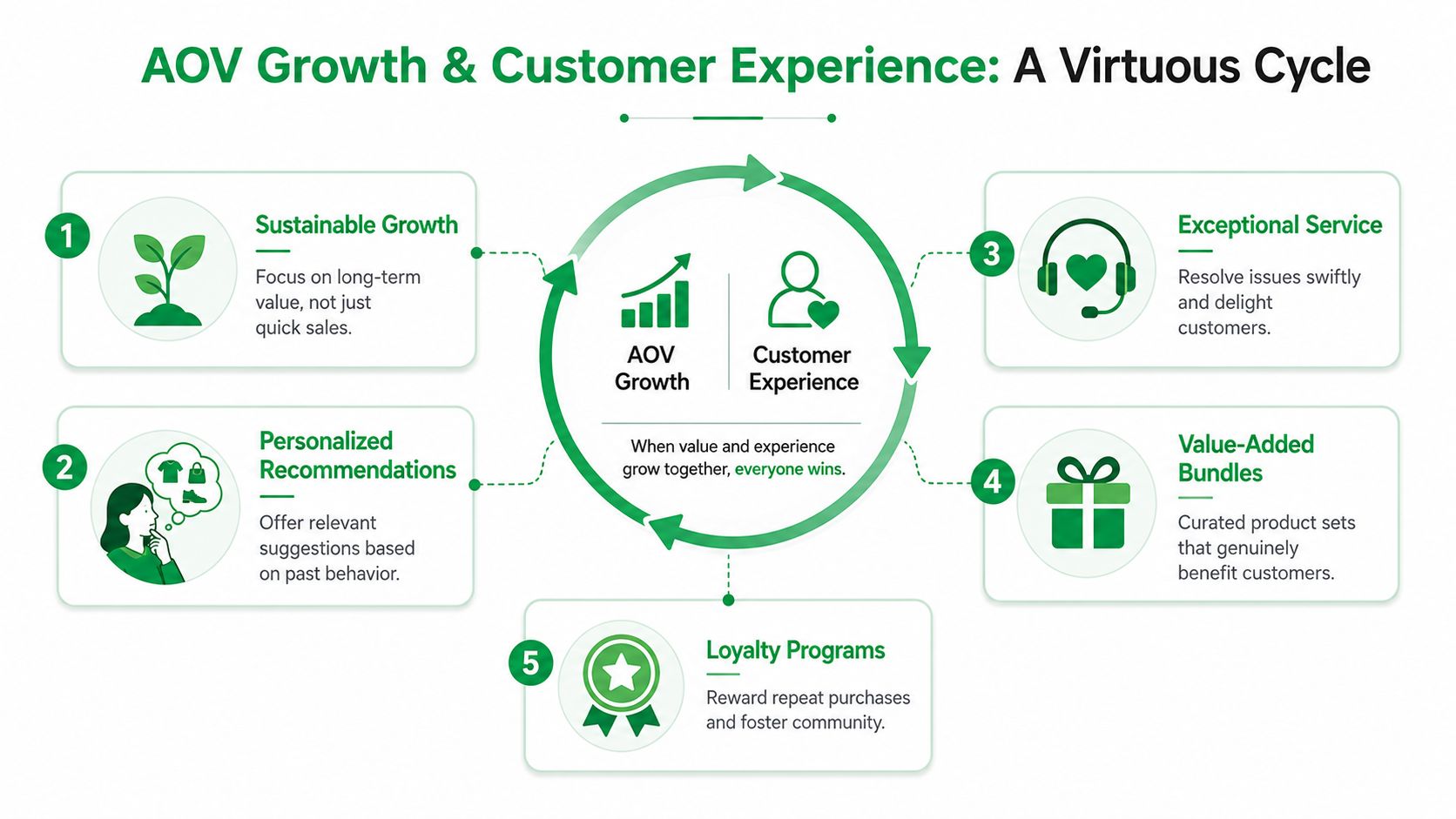
The strongest AOV gains come from helping customers buy more of what fits, not from pressuring them into more. That's the difference between short-term extraction and long-term growth.
A forced upsell can increase basket size today and reduce trust tomorrow. A useful add-on, a smart bundle, or a convenient post-purchase option does the opposite. It makes the order feel more complete.
Better experience supports better order value
This is especially true after checkout. When customers can manage simple changes on their own, the post-purchase experience feels less fragile. That lowers frustration for the shopper and reduces operational drag for your team.
For merchants thinking beyond checkout conversion, this perspective on post-purchase customer experience is worth reviewing. The post-purchase window isn't just a service moment. It's a trust-building moment.
The takeaway for your store
If you're asking what is average order value, the practical answer is this. It's a profitability metric, a merchandising signal, and a customer experience test all at once.
When AOV grows for the right reasons, your store gets more efficient. Your marketing spend works harder. Your customers get more relevant offers. And your support team spends less time cleaning up preventable friction.
If you want to improve AOV without making checkout feel pushy, SelfServe gives Shopify merchants a practical way to do it. You can combine post-purchase upsells with customer self-service order editing, reduce support load, and create a smoother experience that makes additional revenue feel helpful instead of forced.