What Is Cheaper UPS or USPS? a 2026 Cost Analysis
USPS is usually cheaper for packages under 2 pounds, while UPS often becomes the better value for heavier shipments. But that rule is dangerously incomplete in 2026, because the actual answer depends on weight, destination, service level, and one cost most merchants ignore: residential surcharges.
That last part matters more than most “UPS vs USPS” guides admit. If you run a Shopify brand shipping mostly to homes, base label price is only half the story. A carrier that looks cheaper on paper can become more expensive once the full delivery cost hits your margin.
UPS vs USPS Which Carrier Is Actually Cheaper in 2026
The lazy answer to “what is cheaper UPS or USPS” is simple: USPS for light packages, UPS for heavy ones. That advice used to be good enough. It isn't anymore.
Recent rate changes narrowed the gap for the awkward middle of the parcel world. ClickPost's 2026 comparison notes that many guides still lean on the old 2-pound rule while missing that projected 2026 rate changes, USPS Ground Advantage up 7.8% and UPS up 5.9%, have made 2 to 10 pound shipments much closer than older articles suggest. Their example is the important one: a 5-pound package comes in at about $9.80 with USPS Ground Advantage versus $10.25 with UPS Ground, only a 4.5% gap.
That's not a rounding error, but it's also not a clear winner.
Why the old rule breaks down
A merchant shipping T-shirts, supplements, candles, and small home goods doesn't live in neat weight buckets. You ship to apartments, suburbs, PO boxes, and commercial addresses. Some orders need cheap delivery. Some need stronger tracking. Some are bulky enough that dimensional pricing changes the economics.
Here's the practical problem: older advice trains merchants to choose one carrier as a default. Smart operators don't do that. They treat carrier selection like margin management.
| Shipment profile | Usually cheaper choice | Why |
|---|---|---|
| Under 2 lbs, residential | USPS | Lower base rates and no residential surcharge |
| Mid-weight parcels | Depends | The gap can be small enough that address type and service level decide it |
| Heavy or bulky items | UPS | Better economics for larger shipments and broader handling capability |
| Very heavy parcels | UPS | USPS has stricter weight limits |
Practical rule: Stop asking which carrier is cheaper in general. Ask which carrier is cheaper for this exact parcel, going to this exact address, with this exact promise to the customer.
What experienced merchants do differently
They separate base rate from total landed shipping cost.
That means looking at:
- Weight bands: especially under 2 lbs, mid-weight, and heavy parcels
- Destination type: home delivery and business delivery don't behave the same
- Package shape: bulky cartons can shift pricing fast
- Service expectations: guaranteed delivery and better tracking can justify higher spend
If you're still choosing carriers with a single blanket rule, you're probably overspending on part of your order mix and underestimating where margin leaks happen.
An Overview of Core Ecommerce Shipping Services
Before comparing prices, it helps to think in terms of what each service is built to do.
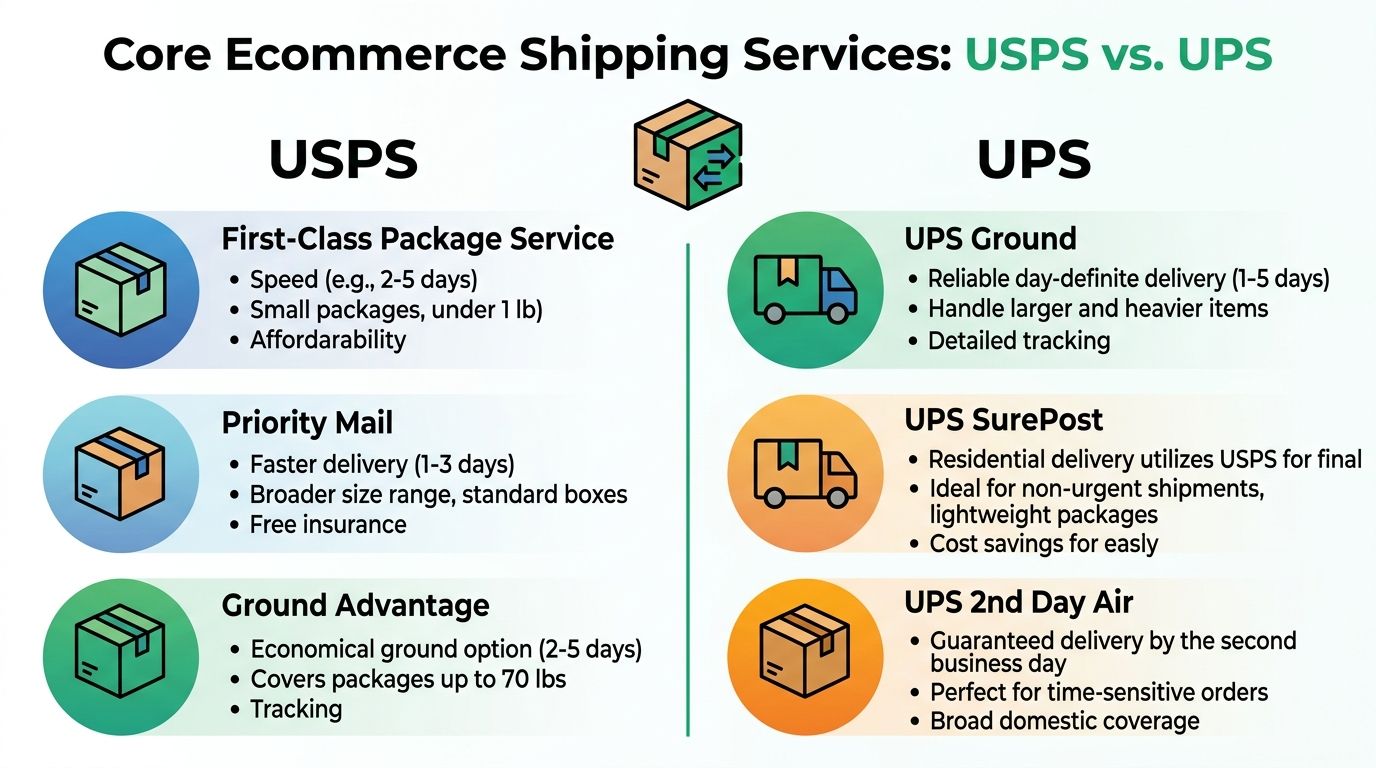
USPS services most Shopify brands actually use
Ground Advantage is the workhorse for low-cost domestic shipping. Merchants lean on it when they need affordable delivery for everyday ecommerce orders and don't need premium speed.
First-Class Package Service is the classic play for very light parcels. If you sell accessories, cosmetics, or small replacement parts, this is often where USPS earns its keep.
Priority Mail sits in the middle. It's useful when you want faster transit or predictable packaging options, especially when flat-rate packaging fits the product.
UPS services that matter in practice
UPS Ground is the standard option for merchants shipping heavier parcels, more expensive items, or orders where tracking consistency matters. It's the dependable default once package size and value climb.
UPS Ground Saver (SurePost) is UPS's lower-cost residential play. It can make sense when speed is less critical and you're willing to trade some transit certainty for a cheaper option.
UPS 2nd Day Air comes into play when the shipping promise matters enough that you'll pay for it. Brands use it for urgent replacements, high-value orders, or customer segments that expect a tighter delivery window.
The service name matters less than the job. Cheap lightweight delivery, predictable flat-rate packaging, heavy-parcel ground, and guaranteed faster transit are four different jobs. Merchants lose money when they treat them as interchangeable.
How to think about the menu
Use this lens when you're deciding:
- Low value, light parcel: start with USPS
- Heavier standard carton: compare USPS and UPS side by side
- Bulky or premium item: lean toward UPS
- Need tighter delivery commitment: look at UPS's expedited services first
Most stores don't need one “best” carrier. They need a short list of service types matched to their catalog.
Cost Comparison for Lightweight Shipments Under 2 Lbs
For lightweight ecommerce orders, the cheapest label is rarely the full answer. The key question is total landed cost to the customer's door, especially for residential deliveries. On that measure, USPS usually has the edge under 2 pounds because the base rate starts lower and the surcharge stack is thinner.
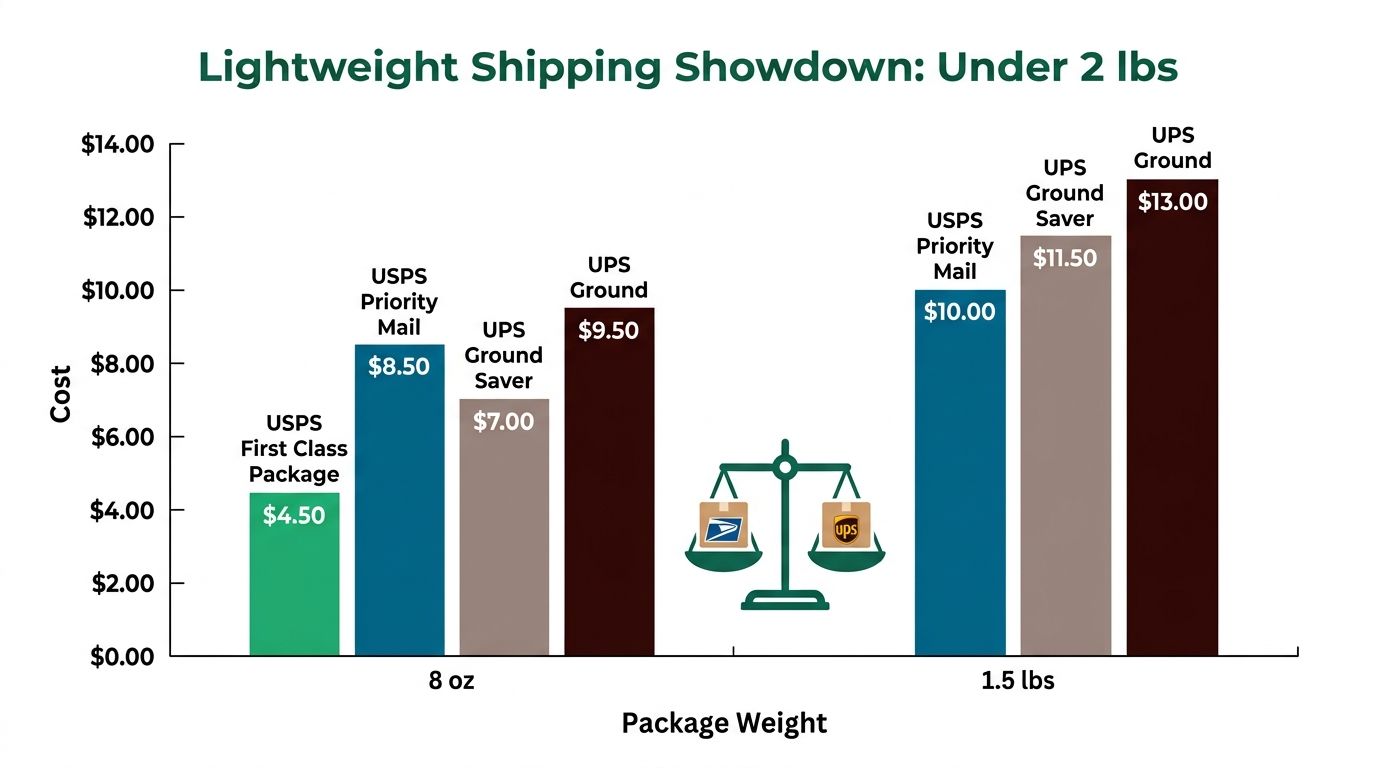
Shipware's 2026 comparison of UPS and USPS rates puts USPS Ground Advantage at about $4 to $7 for packages under 1 pound, while UPS Ground retail rates for the same weight range run about $10 to $15. For a Shopify brand shipping 500 lightweight orders per month, that spread is not a rounding error. It can decide whether free shipping is financially workable or whether every first order starts in a margin hole.
Why lightweight shipping math favors USPS
The usual rule of thumb is “USPS for light parcels.” That rule is directionally right, but incomplete. A merchant shipping phone cases, T-shirts, supplements, cosmetics, or small accessories usually sends those orders to homes, not warehouses. Residential delivery changes the economics.
Easyship's UPS vs USPS comparison notes that USPS is generally cheaper for smaller, lighter packages, particularly under 2 lbs, while UPS becomes more competitive as shipment weight and dimensions increase. That broad pattern matters because lightweight DTC orders are often low enough in margin that a few dollars in carrier cost can erase the profit on the shipment.
The hidden factor is surcharge exposure. UPS often looks less expensive than it is if you compare only headline transportation rates and ignore home delivery fees and accessorials. USPS does not burden lightweight residential shipments the same way, which is one reason many DTC brands still route low-weight orders through USPS even after negotiating UPS discounts.
A simple merchant example
Take a 12-ounce skincare order going to a residential address.
The base rate matters. The delivery destination matters just as much. If the order value is modest, a higher-cost UPS label can eat through contribution margin faster than many founders expect. On a replenishment order, that may be tolerable. On a customer acquisition order, it often is not.
This is why lightweight shipping decisions belong in margin planning, not just in the warehouse. If your blended gross margin is healthy, you have room to buy speed. If it is tight, protecting shipping cost on sub-2-pound orders is often more valuable than shaving a day off transit.
If you're also deciding whether fixed-price packaging makes sense for your mix, this guide on flat rate vs Priority Mail helps clarify when predictable packaging costs beat pure weight-based pricing.
Weight discipline still matters at this end of the catalog. Teams comparing product weight, packaging weight, and billed shipment weight should also compare gross and net freight so they do not underprice shipping at checkout.
A simple snapshot makes the cost gap easier to see:
| Lightweight scenario | USPS | UPS |
|---|---|---|
| Under 1 lb retail range | About $4 to $7 | About $10 to $15 |
| Typical sub-2 lb DTC parcel | Usually lower-cost | Often higher, especially to residences |
| Residential surcharge exposure | Lower | Higher |
Here's a walkthrough if you want another angle on small-parcel shipping decisions:
If most of your orders ship under 2 pounds to residential customers, USPS is usually the safer default for margin protection. Compare UPS only after factoring in the full landed cost, not just the label price.
Analyzing Costs for Heavy and Bulky Items
Once package weight climbs, the conversation changes. USPS stops being the obvious answer, and UPS starts looking more practical, especially when the item is large, awkward, or expensive enough that tracking quality and service guarantees matter.
Lojistic's in-depth UPS vs USPS comparison says UPS becomes more cost-effective for heavier shipments, typically those exceeding 10 to 20 pounds, and it's also the only viable option for packages over 70 pounds, going up to 150 lbs, because USPS has stricter weight limits. The same comparison notes that UPS uses dimensional weight pricing, which can offer better value for bulky but lightweight items.
Heavy doesn't always mean dense
Many merchants frequently make poor assumptions. A box of metal parts and a box of oversized pillows can have the same scale weight problem in reverse. One is dense. The other is bulky. Carriers price those differently.
If your products live in cartons that are physically large relative to their actual weight, dimensional pricing becomes a core part of the cost equation. Merchants selling lighting, helmets, bundled skincare kits, small furniture parts, and consumer electronics accessories run into this all the time.
To tighten up carton planning, ops teams should understand how carriers view shipment weight. This guide on how to compare gross and net freight is a helpful refresher when you're trying to separate product weight from packaging-driven shipping cost.
When UPS earns the higher price
There are situations where UPS doesn't just become competitive. It becomes the safer operational choice.
- Oversized products: USPS limits narrow your options faster than many brands expect.
- High-value shipments: Better tracking visibility and service guarantees can justify paying more.
- Bulky cartons: DIM pricing can make UPS more rational than a simple pounds-only comparison suggests.
- B2B delivery: Business addresses often reduce some of the friction that hurts UPS in residential ecommerce.
The real crossover point
There isn't one magic number that works for every catalog. Weight is only part of it. Box dimensions, destination type, and customer promise all push the decision.
What experienced teams do instead:
- Flag SKUs that regularly ship above the lightweight range.
- Separate dense heavy items from bulky light ones.
- Route high-risk, high-value orders toward the carrier with stronger tracking and delivery control.
That's why the question isn't just whether UPS or USPS is cheaper. For large-item merchants, the better question is which carrier creates the lowest total risk-adjusted cost.
The Hidden Surcharges Beyond the Shipping Label
Most merchants compare the number printed next to the service name and stop there. That's where shipping analysis goes wrong.
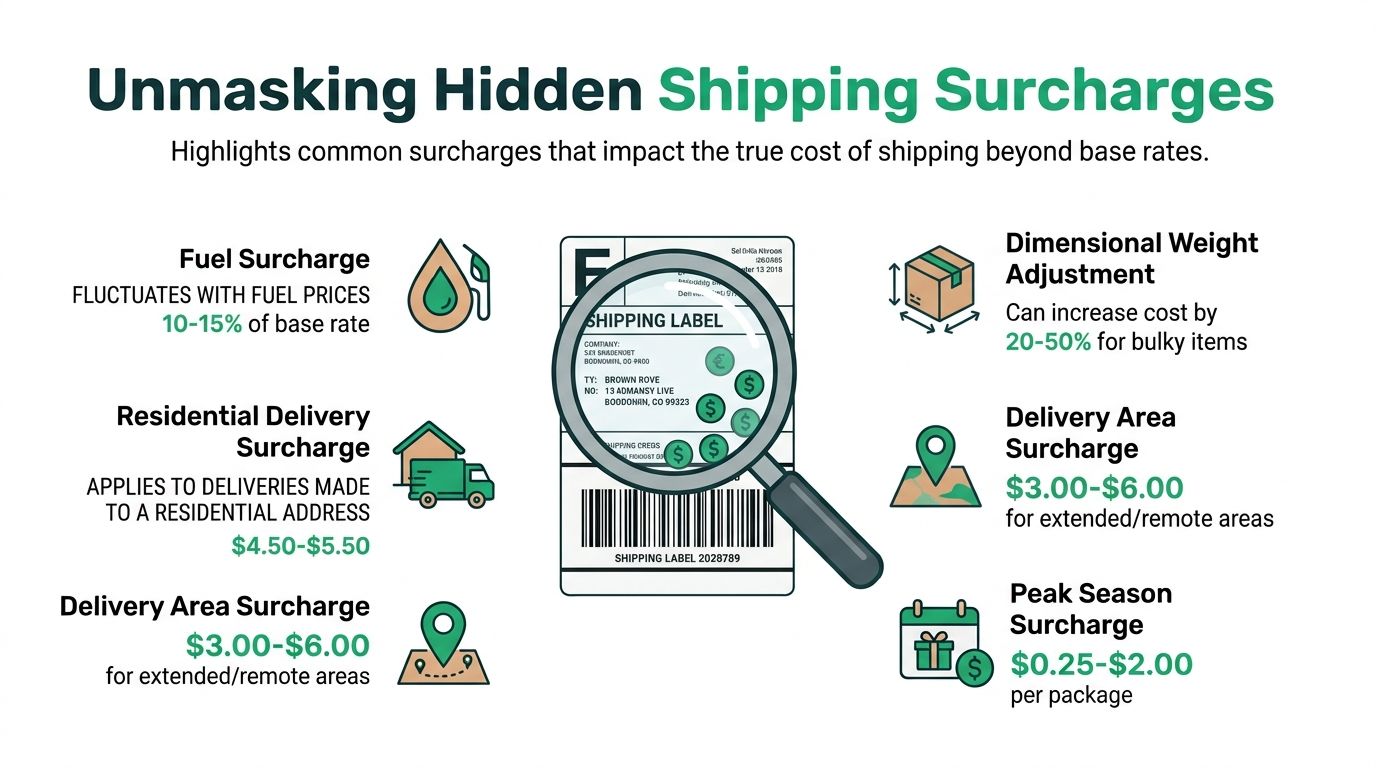
The full cost sits beyond the label. Residential fees, area-based fees, seasonal charges, and packaging-driven price changes can wipe out an apparent savings almost instantly. For direct-to-consumer brands, the biggest trap is usually the residential delivery surcharge.
The surcharge that distorts the whole comparison
GoBolt's comparison of USPS, UPS, and FedEx points out that hidden surcharge questions are often poorly answered, especially around residential delivery fees of $6.45 to $6.95 per package for UPS and FedEx, which USPS doesn't charge. That same analysis says these fees can erase UPS's weight-based savings for shipments under 20 lbs, and notes that emerging 2025 to 2026 data shows 68% of ecommerce orders are residential.
If your business is shipping mostly to homes, that's not a minor detail. It's the center of the decision.
What total landed shipping cost actually means
A smart shipping calculation includes:
- Base transportation rate
- Residential delivery fees
- Any destination-related extras
- Packaging impact on price
- Service upgrades required by customer promise
That's why a carrier can look cheaper in a rate card and still cost more in actual fulfillment.
Margin check: If most of your customers are residential, evaluate every UPS comparison with surcharge-inclusive math, not headline label rates.
A practical way to price the shipment correctly
For Shopify operators, the cleanest process is simple:
- Classify the order address first. Residential and commercial deliveries shouldn't be lumped together.
- Model the true parcel profile. Weight alone isn't enough if the carton is bulky.
- Compare final cost, not displayed rate. If a surcharge applies, include it before picking the carrier.
- Review edge cases. Mid-weight parcels often look close until the extra fee lands.
If your team is still manually piecing this together, this walkthrough on calculating UPS charges is a useful reference because it forces you to think beyond the visible label price.
One reason many brands misread carrier economics is that they optimize around shipment weight while ignoring destination mix. For a DTC brand, destination mix often drives the better decision.
Making the Right Choice A Decision Framework
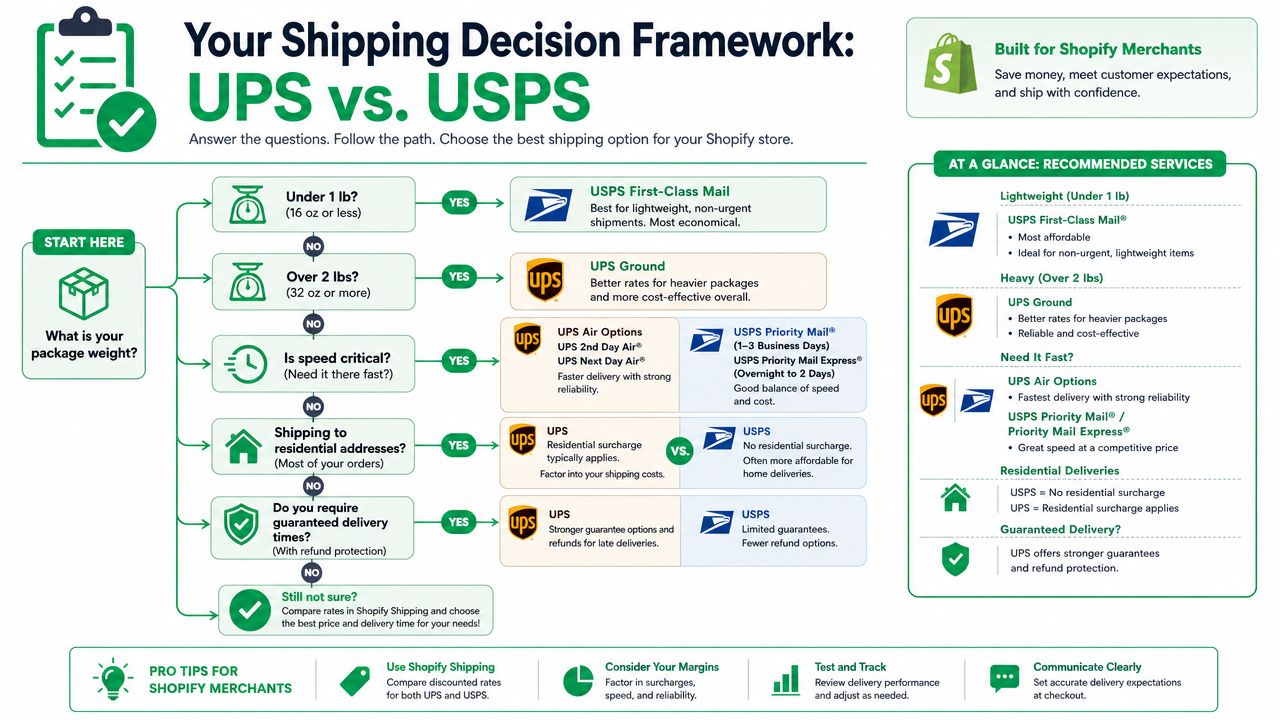
Most merchants don't need a thesis on carrier economics. They need a repeatable rule set their team can use without overthinking each order.
Start with the package profile
Ask these questions in order.
Is the parcel under 2 pounds?
If yes, USPS is usually your first look, especially for residential ecommerce deliveries.
Is the item heavy or bulky?
If yes, UPS deserves serious consideration because larger parcels behave differently than lightweight DTC shipments.
Is the shipment going to a home or a business?
A residential delivery changes the economics. A business address can make UPS more attractive than it first appears.
Then factor in operational priorities
The carrier choice also depends on what you're protecting.
| Priority | Better fit |
|---|---|
| Lowest cost on lightweight residential orders | USPS |
| Better fit for large or heavy cartons | UPS |
| Stronger tracking and delivery guarantees | UPS |
| Predictable flat-rate option for smaller products | USPS |
A working set of if-then rules
Use this as a policy draft for your shipping team:
- If the package is very light and going to a residence, choose USPS first.
- If the order is mid-weight, compare both carriers before buying the label.
- If the item is large, bulky, or high value, check UPS early.
- If the customer paid for speed or needs a tighter delivery commitment, prioritize the service reliability, not just the lowest rate.
- If the order is going to a commercial address, don't assume USPS automatically wins.
Choose a carrier by order type, not by habit. Hybrid carrier logic usually beats single-carrier loyalty.
What this means for the question itself
So, what is cheaper, UPS or USPS?
The honest answer is:
- USPS is usually cheaper for lightweight residential ecommerce shipments.
- UPS often becomes the smarter choice as package weight, size, and service requirements increase.
- The wrong answer comes from comparing base rates without considering the full cost to deliver that order profitably.
That last point is what separates rate shopping from actual shipping strategy.
How Shopify Merchants Can Lower Shipping Spend
Lower shipping spend rarely comes from negotiating one more point off your carrier contract. It comes from controlling total landed cost. For a Shopify brand, that means looking past the label price and cutting the avoidable charges around it: residential fees, oversized packaging, address corrections, reships, and service upgrades that the customer never asked for.
Packaging is usually the fastest win. A box that is even slightly too large can push an order into higher billed dimensions, especially with UPS, and it also increases the chance that a lightweight parcel stops being a lightweight parcel in pricing terms. If the item can ship safely in a smaller carton or a mailer, test that first. The cheapest rate chart means little if your packaging forces you into more expensive tiers.
Service selection is the next leak. Many Shopify teams pay for speed to reduce internal support anxiety, then give away margin on orders that could have moved by a slower service without hurting the customer experience. Set service rules around the promised delivery window, product value, and replacement cost. A late package is expensive. An unnecessarily upgraded package is expensive on every order.
A few changes usually produce measurable savings:
- Standardize packaging by SKU: Map each product or bundle to the smallest safe package, then review cartons that trigger dimensional pricing or surcharge exposure.
- Use flat-rate only where the math works: Flat-rate services can be a strong fit for dense, compact items with consistent packaging. They are less useful when your catalog has wide size variation or when custom packaging keeps the parcel below flat-rate pricing.
- Route by order profile, not carrier loyalty: A multi-carrier shipping solution lets your team send lightweight residential orders one way and heavier or larger cartons another way, instead of forcing every shipment through the same pricing logic.
- Audit residential delivery fees: For DTC brands, home delivery is the default. That makes residential surcharges a margin issue, not a minor line item. Review which orders are profitable after those fees, not before them.
- Reduce address errors before label purchase: Bad addresses create corrections, exceptions, support tickets, and reships. Those costs belong in your shipping analysis even if they never appear on the original label.
One practical test helps. Pull the last 100 shipped orders and compare label cost against fully loaded shipping cost. Include packaging, surcharges, refunds, and reshipments. Many merchants find that a carrier that looked cheaper on base rates was more expensive after residential delivery fees and exception handling.
The brands with the lowest shipping spend treat carrier selection as one part of a margin system. They control packaging, set clear service rules, and measure the delivered cost of each order.
SelfServe helps Shopify brands reduce costly shipping mistakes before they happen. Customers can update shipping details after purchase, real-time address validation catches errors early, and support teams handle fewer manual change requests. If you want fewer reships, cleaner operations, and more margin protection after checkout, take a look at SelfServe.