What Is Language Localization: Boost Global UX & Revenue
Language localization means adapting your store so it feels native to the customer, not merely translated. That matters because 72.1% of consumers spend most or all of their time on websites in their own language, and 40% won't buy if a product or service isn't offered in their language.
If you're a Shopify merchant, you've probably seen a version of this already. Traffic starts showing up from a new country. Product interest looks promising. Then customers stall at checkout, hesitate on shipping details, or open support tickets because the order page feels slightly off.
That's the core idea behind what is language localization. It's speaking your customer's cultural language, not just their verbal one. Translation changes words. Localization changes the experience so the store, checkout, confirmation flow, and post-purchase journey feel like they were built for that customer from the start.
Going Global Is More Than Just Translation
A customer in Germany lands on your Shopify store after clicking an ad. Your product page is in German, so far so good. Then they hit a shipping note that still sounds like English translated by software. The delivery estimate looks unfamiliar. The confirmation email mixes currencies. The address form feels built for someone in another country.
Nothing is technically broken. But trust drops.
That's where many merchants get stuck. They think global expansion starts and ends with translating product descriptions. In reality, a translated store can still feel foreign. And when a store feels foreign, shoppers slow down.
Localization is the native-feeling version of your store
A simple way to think about it is this: translation is swapping the words on the label. Localization is making the whole shopping experience feel local.
That includes things like:
- Tone and phrasing: Formal in one market, conversational in another.
- Currency and formatting: Prices, dates, and numbers shown the way local shoppers expect.
- Visual cues: Images, icons, and layouts that don't feel imported.
- Operational details: Shipping messages, address fields, and order updates that make sense in context.
A lot of merchants discover this only after support volume rises. Customers ask whether prices are final, whether dates are month-first or day-first, or whether they can trust the shipping estimate. Those aren't translation problems. They're localization problems.
Practical rule: If a customer has to stop and interpret your interface, your store isn't localized yet.
This is also why localization works best when it's treated as part of the product experience, not as a last-minute content task. Teams building global storefronts often benefit from the same thinking behind Bruce and Eddy's approach to web solutions, where the experience is customized for the business and audience rather than copied from a generic template.
Why Shopify merchants feel this problem fast
Shopify makes it easier to sell internationally. But ease of setup can create false confidence. You can launch in a new market quickly, while still missing the details that shape buyer confidence.
For a busy merchant, the better question isn't “Can we translate this?” It's “Will this feel normal to the buyer on the other side?”
That's the standard localization aims for.
Translation vs Localization The Critical Difference
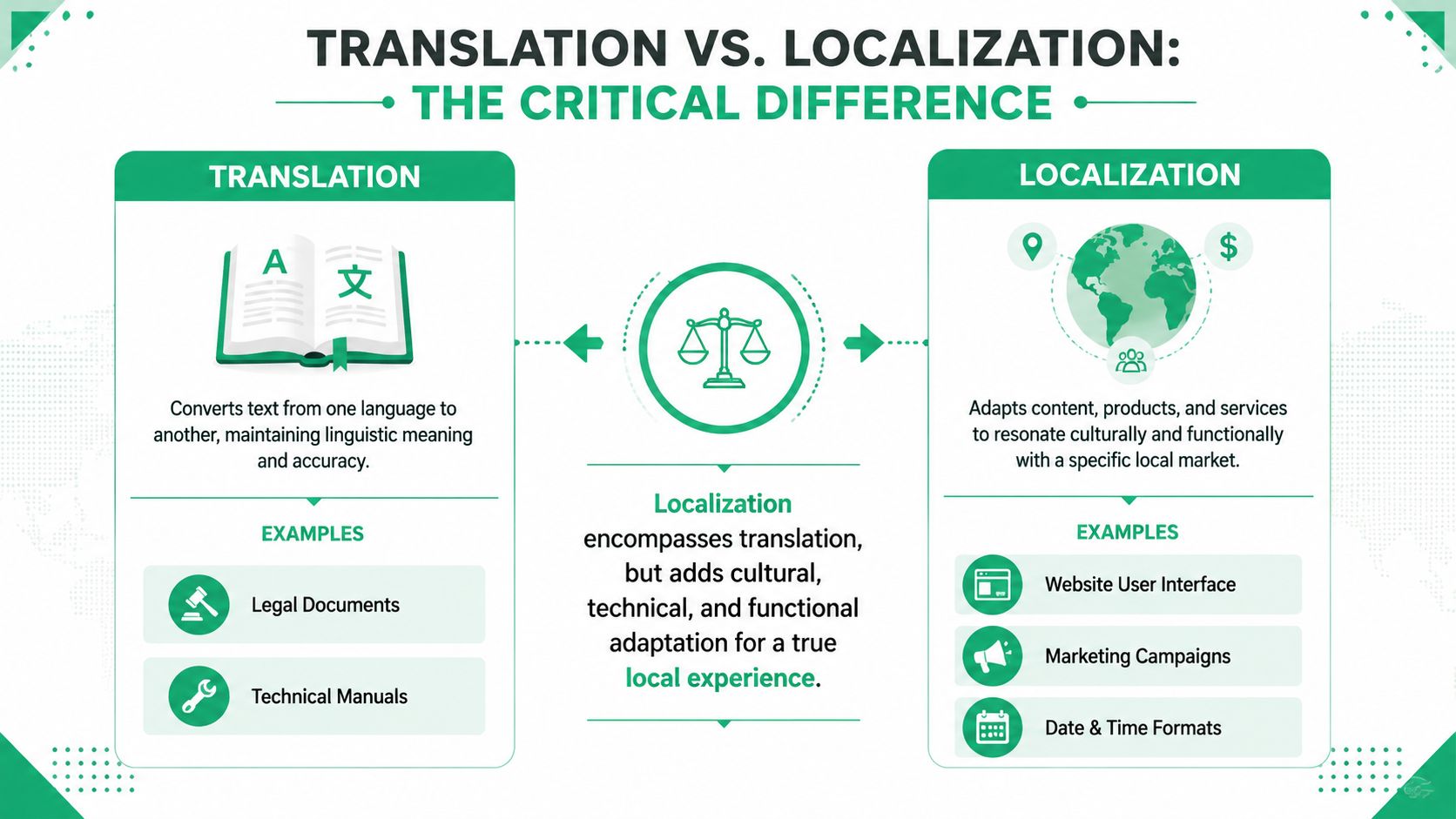
Translation and localization are related, but they aren't interchangeable.
Translation answers one question: “What are these words in another language?” Localization answers a broader one: “How should this experience work for people in this market?”
A simple analogy that clears it up
Think about inviting someone to dinner.
If you translate, you keep the same invitation and rewrite it in another language.
If you localize, you also change the tone, level of formality, time format, food references, and even the way directions are given so the invitation feels natural to the person receiving it.
That's the difference in ecommerce too. A button can be translated correctly and still feel wrong. A returns policy can be accurate and still sound unfamiliar. A checkout can be readable and still create friction.
Side by side comparison
| Aspect | Translation | Localization |
|---|---|---|
| Main job | Convert text from one language to another | Adapt the whole experience for a specific market |
| Focus | Linguistic accuracy | Cultural relevance and functional usability |
| Best fit | Static documents, manuals, basic content | Storefronts, apps, checkout flows, marketing, support |
| Handles currency, dates, UI behavior | Usually no | Yes |
| Handles local expectations | Limited | Central goal |
Where merchants usually get confused
The biggest misunderstanding is thinking localization only matters for marketing copy. It also applies to the interface itself.
According to Wikipedia's overview of language localisation, 72% of users abandon interfaces with non-localized functional text even if the main content is translated. That's why buttons, form labels, validation messages, and order-edit screens matter just as much as headlines and product descriptions.
A translated “Edit order” button is still a poor experience if:
- The form rejects a local address format
- The date picker uses an unfamiliar format
- The currency symbol appears in the wrong style
- The error message sounds unnatural or unclear
Localization also works within one language
Another place merchants get tripped up is assuming localization only matters when moving from one language to another.
It doesn't.
Spanish for Spain and Spanish for Mexico may share a language, but shoppers don't always expect the same wording, idioms, or formatting. The same goes for English across the US and UK. Localization often means adapting within a language, not just across languages.
A store can be translated and still feel imported. Localization is what makes it feel local.
That's why the better mental model is this: translation is one layer inside localization, not a replacement for it.
Why Localization Drives Global Ecommerce Growth
A shopper in Germany adds a product to cart on your Shopify store. The product page looks fine in German, but the return policy sounds machine translated, the checkout fields feel slightly off, and the order confirmation email arrives in English. Nothing is broken. But the store feels imported, not local. That gap is often where global growth slows down.
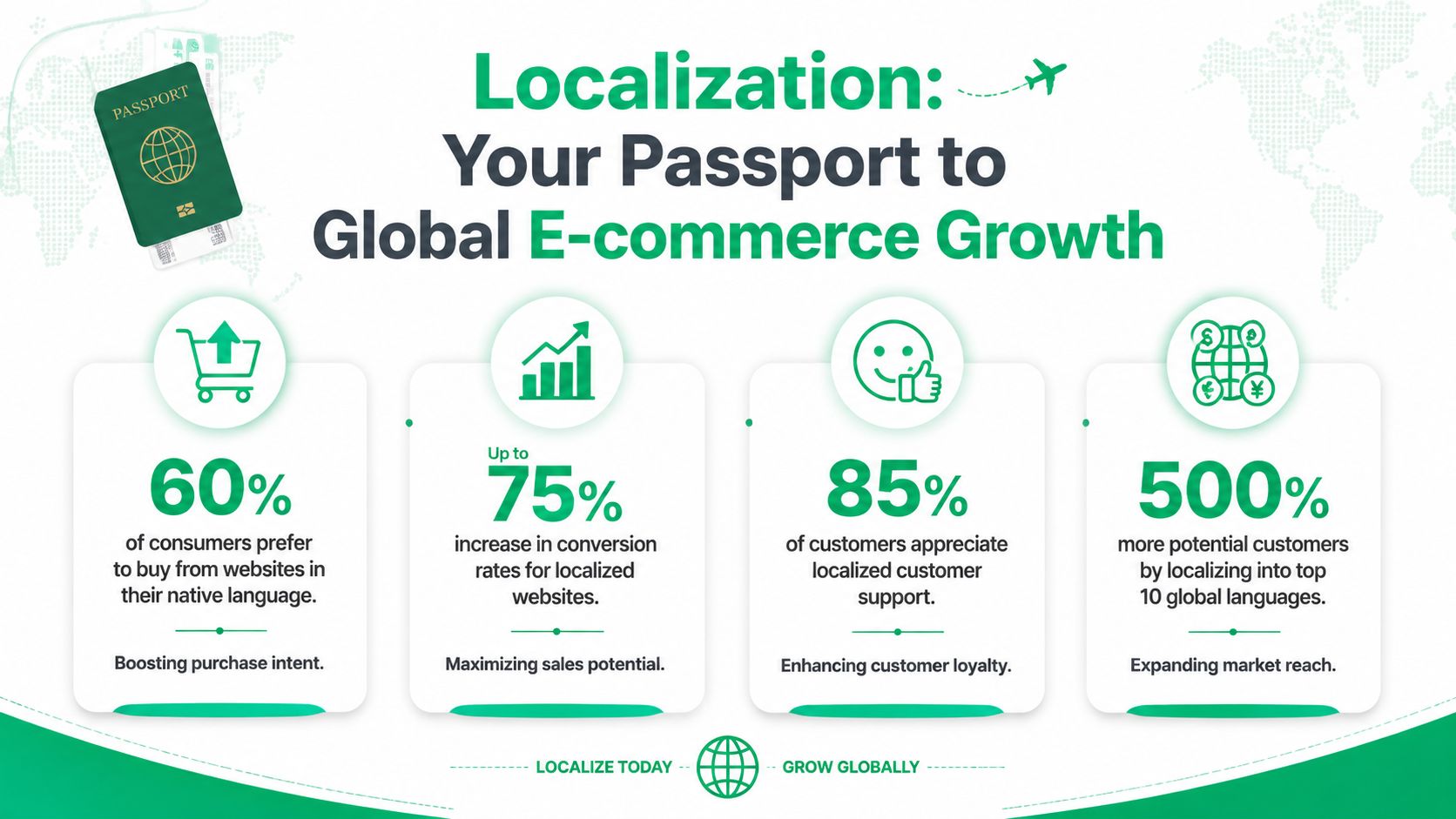
Localization improves growth because it reduces hesitation at every stage of the customer journey. Analysts compiling localization industry statistics found that the global language services market was valued at $71.62 billion in 2023 and is projected to reach $112.98 billion by 2030. The same compilation notes that 72.1% of consumers spend most or all of their time on websites in their own language and 40% will not buy from sites that are not in their native language.
Customers read language as a trust signal
Buyers do not separate language quality from store quality. If your shipping policy, checkout prompts, and support copy read naturally, customers assume your operations are reliable too. If those elements feel awkward, they start asking quiet questions. Will support understand me? Can I fix my order if I made a mistake? Will a return be painful?
That trust effect matters for Shopify merchants because the buying decision rarely happens on the product page alone. A store grows faster when customers can move from browsing to checkout to post-purchase actions without having to decode what you mean. Localization works like clear store signage in a physical shop. Good signage does not sell the product by itself, but it removes doubt, speeds decisions, and helps people act with confidence.
For merchants building out regional storefronts, these localization best practices for ecommerce brands are a useful reference point.
Growth comes from removing small points of friction
International conversion drops often look like pricing issues or weak demand. Sometimes the problem is simpler. Customers hesitate when the store asks them to do extra mental work.
That friction shows up in familiar places:
- Return and refund terms feel harder to interpret than the product page
- Shipping promises sound vague or unnatural
- Checkout and payment formatting feel unfamiliar
- Support content uses a different tone from the rest of the store
- Post-purchase messages make order changes or issue resolution feel risky
Each moment is small on its own. Together, they can lower conversion rates, reduce completed checkouts, and weaken repeat purchase intent.
Search visibility plays a role here too. Localized growth starts before the first click, which is why tools like SEO Agent can help merchants plan for region-specific discovery alongside on-site localization.
A short explainer helps make the business case tangible:
Localization protects revenue after checkout
This matters even more after the sale. Many brands spend heavily to get an international customer, then lose trust in the post-purchase experience.
If order confirmation emails, shipping updates, self-service order editing, upsell offers, or support replies switch back to generic English, the customer notices right away. The purchase still happened, but the relationship weakens. For Shopify merchants, that means localization is not only a conversion project. It is also an operations project tied to support load, repeat orders, and how confidently customers handle changes after they buy.
The Anatomy of True Language Localization
Most merchants start by localizing text. That's only one layer.
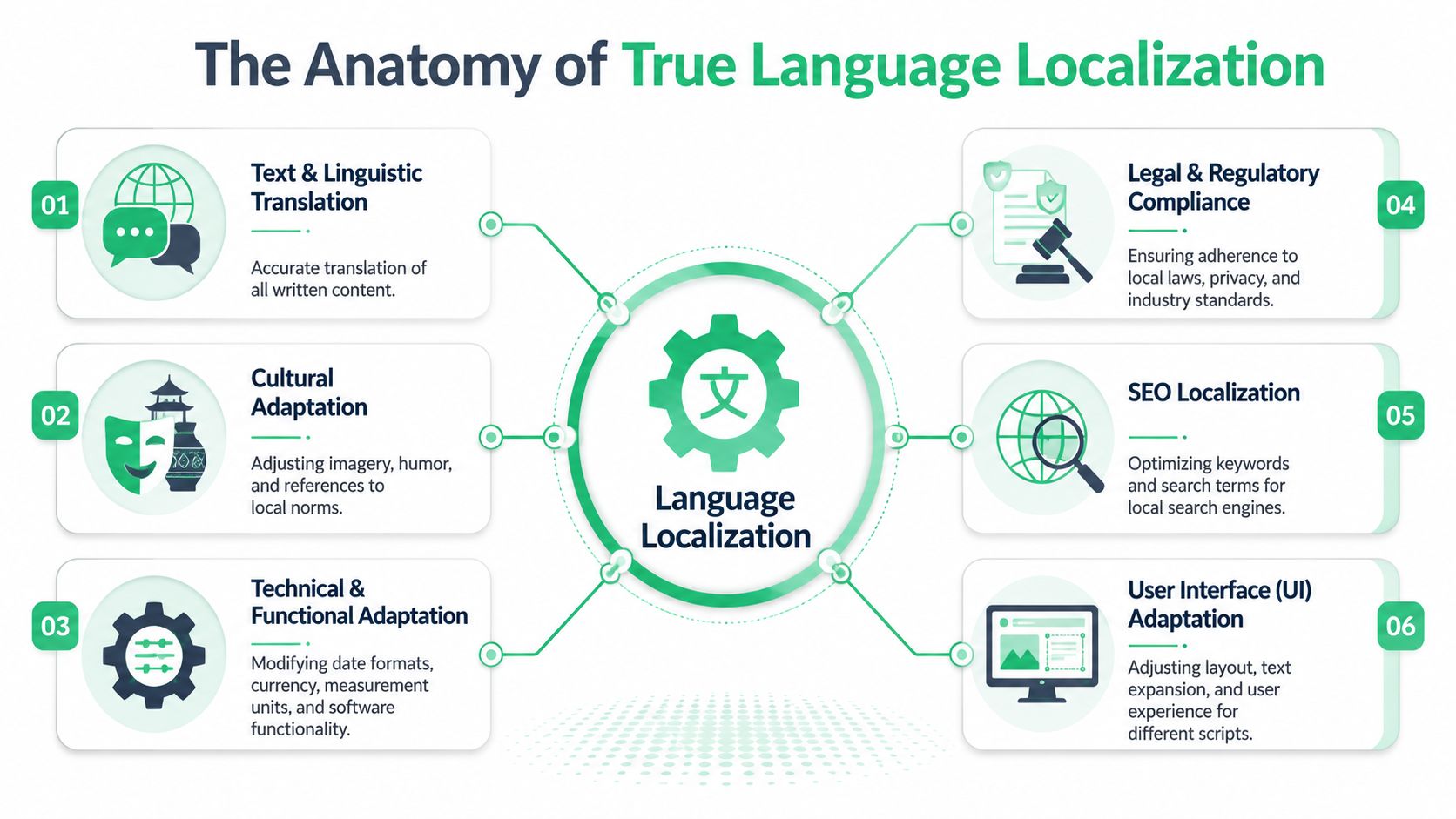
True localization touches language, design, technical settings, legal details, and the way customers interact with your store. If even one of those feels off, buyers notice.
The six parts merchants need to check
Text and linguistic adaptation
This is the obvious part. Product titles, descriptions, buttons, navigation, policies, and support content all need accurate translation.
But accuracy alone isn't enough. Word choice, tone, formality, and regional phrasing all matter. “Free shipping” may translate cleanly while still sounding awkward in a local market.
Cultural fit
A store also communicates through examples, references, humor, and imagery.
That means asking practical questions. Does your promo language sound too casual? Do your visuals feel relevant to local buyers? Does a holiday campaign assume a calendar your audience doesn't share?
Technical and functional adaptation
At this stage, localization becomes operational.
Dates, times, currencies, measurement units, address fields, and payment expectations all need local handling. The same goes for product details like apparel sizing, delivery windows, and tax presentation.
If the customer understands your headline but struggles with the form, you localized the copy but not the experience.
User interface adaptation
Interface design has to flex across languages and scripts.
Buttons may need more space. Menus may wrap differently. Some languages read right to left, which can affect layout logic across the entire storefront or app. Functional text such as error states and validation messages needs the same care as marketing copy.
Legal and regulatory alignment
Policies often need local adaptation too.
Privacy notices, returns language, product disclosures, and consent flows can't always be copied market to market. Even when legal teams own the final review, merchants still need localization built into the process.
Search behavior and discovery
Localization also affects how people find you.
Customers in different regions don't always search with direct translations of your English keywords. They may use different product terms, abbreviations, or buying phrases. That's why localized search strategy matters alongside localized page copy.
For a more implementation-focused checklist, this guide on localization best practices for ecommerce teams is a useful companion.
A merchant-friendly checklist
Use this as a quick audit before launching a new market:
- Storefront text: Navigation, PDPs, cart, checkout, and emails
- Formatting: Currency, date, time, number separators
- Forms: Address structure, validation, field labels
- Visuals: Imagery, symbols, promotional references
- Policies: Returns, privacy, consent, tax language
- Search language: Local keyword phrasing and terminology
That's the anatomy of what is language localization in practice. It's a systems job, not just a copy job.
A Practical Guide to Shopify Localization
Shopify merchants don't need to localize everything at once. The smartest rollouts start with the parts of the buying journey that shape trust fastest.
A useful sequence is store, checkout, transactional messaging, and then post-purchase operations. That order keeps your team focused on customer-facing friction first.
Start with market structure
Before translating anything, decide how each market will operate.
That means defining:
- Which countries matter first
- Which languages each market needs
- Which currencies and payment options should appear
- Whether the same catalog, pricing, and policies apply everywhere
For many Shopify teams, this planning lives inside Shopify Markets and related storefront settings. The point isn't just administration. It's consistency. If the storefront says one thing and the payment or fulfillment flow says another, customers feel the mismatch immediately.
If you're configuring payments and pricing across regions, this walkthrough on setting up multi-currency and international payment options for Shopify merchants is a practical reference.
Prepare the store for localization technically
Good localization breaks if the codebase isn't ready for it.
According to Lokalise's technical localization guide, developers should place all user-facing text in external resource files and use locale-specific formatting for dates, numbers, and currencies with standards like BCP 47 such as en-GB and en-US. The same guide notes that German text can run 30% to 40% longer than English, which means layouts need enough room to expand without breaking.
That has real Shopify implications for:
- Theme components: Buttons, menus, banners, account pages
- App blocks: Widgets, messages, promotions, validation states
- Email templates: Subject lines and content blocks that expand in translation
- Form handling: Country-specific address and phone expectations
Localize the high-friction moments first
Not every string has equal value. Prioritize the moments where confusion hurts revenue or support most.
A strong order of operations looks like this:
- Product and cart clarity: Titles, variant labels, shipping notes, promo language
- Checkout confidence: Payment wording, tax explanation, delivery estimates
- Transactional communication: Order confirmation, shipping updates, status messaging
- Self-service actions: Address edits, contact changes, cancellation requests, returns paths
Test like a buyer, not like a builder
Most localization mistakes survive because teams test for correctness, not naturalness.
Run through the journey as if you were a first-time buyer in that market. Use local addresses. Read every button out loud. Check spacing on mobile. Try to trigger errors on purpose and see if the messages still make sense.
Merchant shortcut: If your support team already knows the top five questions from international buyers, localize those moments first.
Shopify localization works best when operations, support, and development review the journey together. The customer experiences it as one system, so your team should test it the same way.
Beyond the Buy Button Post-Purchase Localization
Many localization guides stop at the storefront and checkout. Customers don't.
After purchase, they still read confirmation pages, shipping updates, order status screens, address forms, cancellation flows, and upsell offers. If those touchpoints feel less local than the buying journey, the brand experience drops right when the customer expects reassurance.
This is where small mismatches create real work
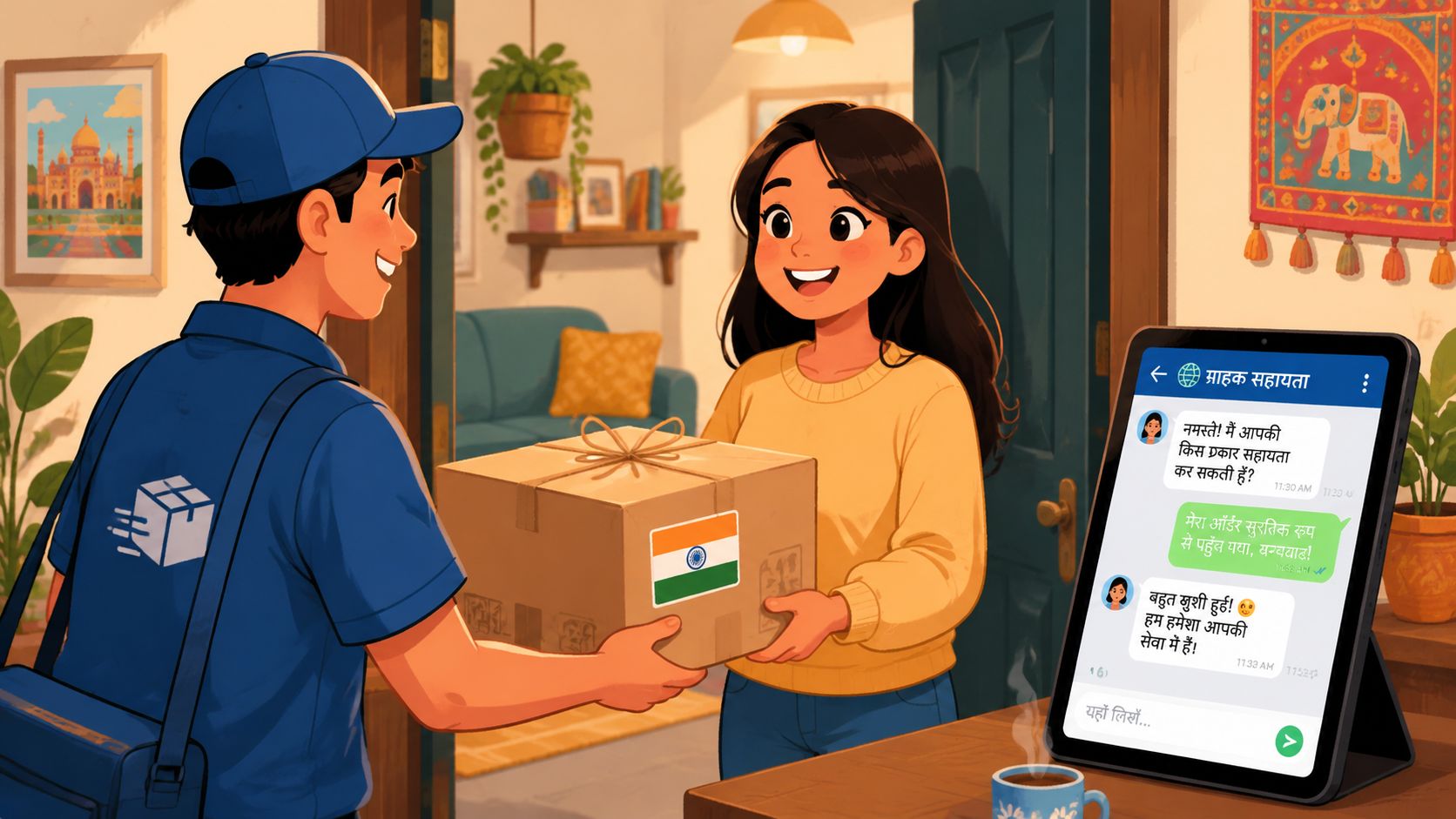
The localization gap is often sharpest after checkout. Amara's explanation of localization notes that mislocalized date formats, currency symbols, or address fields in post-purchase workflows create confusion and support tickets. The same source says 25.3% of global consumers prefer content in their specific regional dialect, not just a generic language version.
That matters more than many merchants realize.
A customer who already paid is no longer deciding whether to trust your product. They're deciding whether to trust your operation. If the order status page uses unnatural wording, the delivery window is hard to parse, or the address editor doesn't reflect local formatting, support gets pulled in to fix issues the interface should have handled.
Post-purchase localization includes functional details
This part of the journey isn't mostly about marketing language. It's about usability.
Here's where localization often matters most after purchase:
- Order status pages: Delivery language, date presentation, tracking cues
- Address updates: Field order, auto-complete behavior, local validation expectations
- Order editing: Product names, button labels, inventory messaging, timing windows
- Upsell modules: Offer copy, pricing display, and relevance to the local shopper
- Support deflection flows: Help text, error states, and next-step instructions
A post-purchase flow can be fully translated and still fail if it assumes the wrong address structure or displays dates in a confusing format. That's why this stage deserves the same attention as acquisition and checkout.
The operational payoff is bigger than it looks
For ecommerce teams, post-purchase localization isn't just a UX polish task. It changes internal workload.
When customers can interpret status updates correctly, edit details confidently, and understand options without contacting support, operations run cleaner. Ticket volume falls. Agents spend less time clarifying basics. Customers feel like the brand knows how to serve them in their market.
For merchants refining this part of the journey, this piece on improving the post-purchase customer experience is worth reviewing.
The post-purchase experience is where brand promises become operational reality.
That's why any serious answer to what is language localization has to include the moments after the order is placed, not just the pages that lead to the sale.
Common Pitfalls and Measuring Success
A Shopify store can look ready for a new market and still create extra work the moment orders start coming in.
A shopper places an order without trouble. Then the confirmation email switches back to English, the address form rejects a format that is normal in their country, and the order edit page uses stiff phrasing that makes them hesitate before changing a delivery detail. Nothing is broken in a technical sense. But trust drops, support tickets rise, and your team ends up fixing avoidable confusion by hand.
That pattern shows up in the same places again and again.
The mistakes that create the most friction
Localization works like opening a physical store in a new country. Translating the sign on the front door helps. It does not help much if the returns desk uses unfamiliar instructions, the receipts use the wrong date format, and the staff cannot explain what happens after purchase.
For Shopify merchants, the common misses usually look like this:
- Treating localization as a copy project: Product pages get translated, but forms, validation rules, system messages, and notification emails stay unchanged.
- Reusing one language version across multiple markets: Spanish for Spain and Spanish for Mexico may share a language, but they often differ in word choice, tone, and buyer expectations.
- Skipping native review: Internal teams approve text that is grammatically correct but sounds unnatural in a checkout, support, or post-purchase context.
- Leaving post-purchase behind: The storefront feels local, while order edits, support flows, and upsells feel imported from another market.
- Launching without QA: Buttons wrap badly, labels get cut off, fallback text appears, and error messages stop matching the rest of the experience.
In technical documentation and other high-stakes content, expert localization using native speakers and cultural experts can reduce support tickets by up to 40%, according to LanguageWire's guidance on technical localization. The same source says a Translation Management System with automated QA can increase localization efficiency by 50% and reduce error rates to below 1%.
Those figures matter because they point to a practical lesson for ecommerce teams. Better localization does not only improve how your brand sounds. It also reduces the number of moments where customers need help after the sale.
What to measure in a Shopify store
You do not need a large reporting setup to judge whether localization is working. Start with a short scorecard tied to revenue, service load, and customer confusion.
Revenue and conversion signals
Check performance by country, language, and market version. A localized store should do more than attract traffic. It should help people complete purchases and accept relevant offers.
- Conversion rate by market: Compare localized versions against non-localized ones.
- Cart abandonment by language: Look for places where one language version loses buyers earlier than another.
- Average order value by locale: Measure whether localized upsells and cross-sells are being accepted.
Service and operations signals
This is the area many merchants miss.
If localization is doing its job, customers should need less help with routine post-purchase tasks. They should understand shipping updates, edit order details with confidence, and recognize the next step without opening a ticket.
Track:
- Support tickets by market: Especially repeated questions about shipping status, address changes, delivery timing, or policy details
- Order edit error rates: Failed submissions, abandoned edits, or repeated attempts on the same field
- Refund and cancellation reasons: Watch for patterns tied to misunderstanding, not product dissatisfaction
Quality signals
These metrics catch problems before they turn into support volume.
- Broken string checks: Overflow, truncation, missing translations
- Fallback language incidents: Cases where English or another default language appears unexpectedly
- Native review corrections: How often reviewers need to rewrite text for clarity or local fit
The strongest localization programs improve one friction point at a time. A merchant might start with product pages, then fix checkout, then clean up post-purchase flows where support teams feel the pain every day. That order makes sense because localization is not only a marketing task. For Shopify brands, it is also an operations task.
If your Shopify team wants to localize the post-purchase experience, not just the storefront, SelfServe helps customers edit orders, update details, and view upsells in their own language while your team keeps control over rules, timing, and operations. It's a practical way to reduce support burden and deliver a more native-feeling experience after checkout.