How to Increase Aov Ecommerce
A Shopify store's average order value can sit near $85 overall, while the top 20% of Shopify stores reach $192 and the top 10% reach $311, according to 2026 ecommerce AOV benchmarks. That gap exists without assuming a different traffic source or a radically different product catalog. It usually comes from better basket design, more relevant offers, and a post-purchase experience that keeps selling after payment.
If you're working out how to increase AOV ecommerce revenue, don't start by adding random recommendation widgets. Start with diagnosis, rank the available levers by likely impact and effort, improve the cart and checkout sequence, then add a post-purchase offer that doesn't compete with the original purchase. The number to optimize isn't revenue at any cost. It's profitable revenue per completed order.
Why AOV Is the Highest-Impact Growth Number in 2026
AOV measures revenue per completed order, so it shows how much value your store captures from demand you already paid to acquire. Benchmark data reports a global average AOV of $192, with EMEA at $219, the Americas at $159, and APAC at $120. A separate benchmark places the cross-industry global average closer to $172, while Shopify stores average about $85 overall. Category, geography, merchandising, and offer structure explain much of that variation. The figures are reported in Speed Commerce's ecommerce AOV benchmark analysis.
For a DTC operator, AOV belongs near the top of the growth scorecard. More traffic brings acquisition costs, creative testing, landing-page work, and uncertain attribution. A larger order from a customer who has already decided to buy often requires less persuasion than converting a cold visitor. Higher order value can also spread fulfillment and handling costs across more revenue, although added product, discount, and shipping expense still belongs in the margin calculation.
Operator's rule: Don't ask only whether an offer raises AOV. Ask whether it raises contribution profit per order without increasing refunds or support demand.
The gap is usually in the basket
Shopify store performance varies sharply. The top 20% reach $192, and the top 10% reach $311, compared with the overall Shopify average of about $85, according to the benchmark cited above. Treat that spread as a merchandising signal, not a promise that every store should match the highest tier. The practical question is whether the typical order can include a more complete solution without making the initial purchase harder.
Bundles and threshold offers usually belong on the PDP or in the cart. Cart recommendations can add a relevant complement, while a post-purchase offer can introduce replenishment after payment without interrupting checkout. Each surface has a different job. The strongest offer answers a clear customer need. The weakest adds friction, delays completion, or discounts an item the buyer would have purchased anyway.
A benchmark snapshot
Regional averages
| Region | Reported average AOV |
|---|---|
| Global | $192 |
| EMEA | $219 |
| Americas | $159 |
| APAC | $120 |
Shopify store percentiles
| Shopify store group | Reported AOV |
|---|---|
| Overall average | About $85 |
| Top 20% | $192 |
| Top 10% | $311 |
The two groups answer different questions. Regional averages provide market context, while Shopify percentiles show how stores compare within the platform benchmark. Neither replaces your own baseline, especially when product mix, discounts, shipping rules, and customer geography differ.
Use the average order value guide from SelfServe to align the metric definition across marketing, finance, and merchandising. Then rank tests by likely impact and effort. Start with the PDP and cart, protect checkout completion, and use the Thank You page for an offer that follows payment rather than competing with the original order. Measure profitable lift, not AOV in isolation.
Diagnose Your Current AOV Before Touching Anything
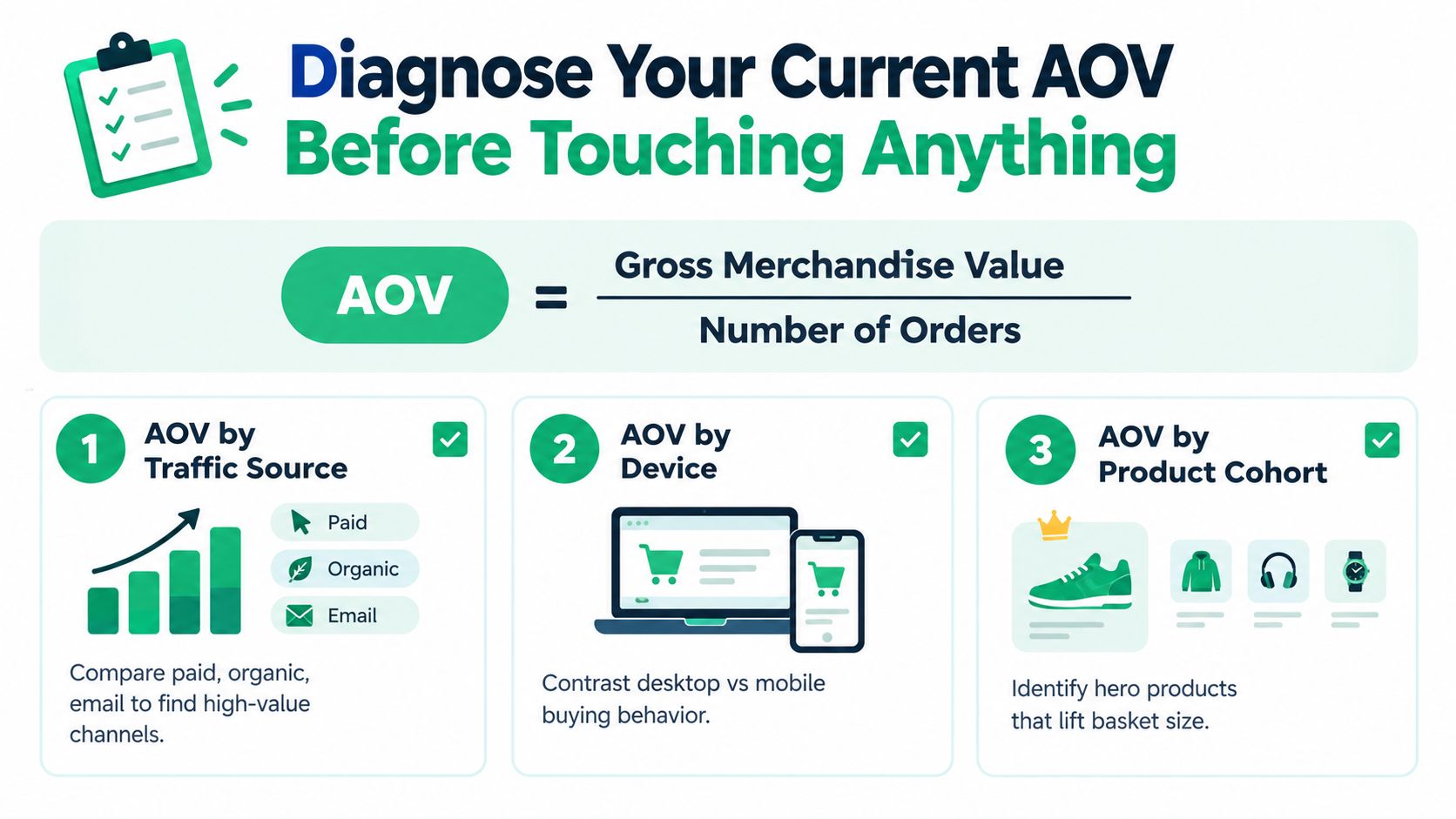
AOV is simple to calculate, but teams often calculate different versions of it. Use AOV = Gross Merchandise Value divided by Number of Orders. Count orders, not units, and agree on whether taxes, shipping, gift cards, discounts, returns, and cancellations belong in the reporting definition before comparing periods.
For a practical operating baseline, use a rolling 90-day window as your primary view. A trailing 30-day view is useful for spotting recent changes, but paid social volatility, promotions, and product launches can distort it. The longer window smooths those swings and gives you a stable comparison for later tests.
Build the one-page baseline
Pull the figures from Shopify Analytics, ShopifyQL, or your warehouse view in BigQuery or Snowflake. Keep the first version narrow enough that someone can refresh it without an analyst.
- Total AOV: Gross merchandise value divided by completed orders for the selected window.
- Discount-excluded AOV: Recalculate after removing discount-code orders so promotion-heavy periods don't hide the underlying basket value.
- Top-five SKU AOV: Compare orders containing each leading product with the blended store result.
- Offer attach rate: Record how often shoppers accept an existing bundle, upsell, subscription, or add-on.
- Order mix: Separate single-item orders from multi-item orders and note which products appear together.
Then segment AOV by traffic source, device class, and customer status. Paid, organic, email, affiliate, and direct traffic often bring different buying intent. Desktop and mobile shoppers may respond differently to cart layout, product photography, and sticky add buttons. New and returning customers need separate analysis because a returning buyer may already understand the product range and trust the brand more.
A useful diagnostic question is not “Which channel has the highest AOV?” It's “Which channel produces a high-value order after discounts, product costs, and fulfillment are considered?” That distinction prevents you from shifting spend toward a channel that creates large but weak-margin baskets. For additional formula guidance, Carti's resource on improving AOV provides a complementary reference.
Baseline checkpoint: Save the date range, formula, segments, top products, and existing offer attach rates in one document. Every later experiment should be compared with this same baseline.
Rank the Levers That Actually Move AOV
Not every AOV tactic deserves equal priority. The practical ranking below weighs expected lift against implementation effort, with the important caveat that the result depends on catalog economics, product adjacency, and customer intent.
| Lever | Shopify surface | Expected impact | Implementation effort |
|---|---|---|---|
| Bundles | PDP, collection, cart | High | Medium |
| Threshold free shipping | Cart drawer, cart page | High | Low |
| Cart upsells and cross-sells | Cart page | High | Low |
| PDP upsell modules | Product page | Medium | Low |
| Post-purchase one-click offers | Thank You, Order Status | Medium | Medium |
| Payment and financing options | Checkout | Variable | Medium |
| Pricing and quantity breaks | PDP, cart | Variable | High |
Bundles deserve the first serious test because they change the buying decision itself. A complete kit can make a larger purchase feel easier than assembling individual items. Benchmark content reports that bundles typically lift AOV by 20% to 35%, with best-in-class implementations reaching 55%, while upsells can lift AOV by 10% to 30%, as documented in the 2026 ecommerce AOV statistics report from Ringly. Treat those figures as external benchmarks, not a forecast for your store.
Threshold free shipping is usually easier to ship than a recommendation engine. It sets a clear spending floor and works especially well when the catalog contains affordable complements. Cart-page cross-sells come next, but they need product logic. A relevant accessory can help. A rotating list of best-sellers usually adds visual noise.
Effort rises as the funnel gets closer to payment
PDP modules are relatively straightforward to test, but they can distract from the primary product decision. Post-purchase offers sit further right on the effort axis because they require checkout configuration, fulfillment rules, order editing logic, and careful measurement. They also have a structural advantage: the original purchase has already been completed.
Pricing changes can create substantial movement when the catalog is small and the economics are understood. They can also damage reference prices, train customers to wait for discounts, or shift customers from profitable single units into low-margin volume tiers.

For most Shopify stores, the sensible sequence is bundles and threshold shipping first, cart recommendations next, and a post-purchase widget such as SelfServe in the third week once the on-site funnel has a clean baseline. Revisit pricing after you know whether the store has a merchandising problem or a weak offer sequence.
On-Site Playbook for the Cart and Checkout
The cart should answer three questions quickly: what has been added, what is missing from the solution, and what benefit comes from increasing the basket. Keep the experience especially clear on mobile, where a crowded drawer can make the primary checkout action harder to find.

Set the shipping threshold from observed behavior
Start with current AOV and choose a free-shipping threshold 30% to 40% above it, then validate the result against product margin and shipping cost. If current AOV is $60, a first threshold could sit between $78 and $84. If it's $80, test a threshold between $104 and $112. If it's $120, test between $156 and $168. Those are calculation examples, not performance claims.
Show progress in the cart drawer and full cart page. Dynamic copy such as “You're $12 away from free shipping” tells the shopper what action to take. A useful response to “Why isn't shipping free already?” is direct and transparent: “Add a qualifying item to reach free shipping, or continue with standard shipping.” Don't hide the shipping condition until checkout.
Make bundles feel like a decision, not a discount trap
Present a bundle as a named solution, such as “The Daily Routine” or “Starter Kit,” with a clear list of included items. If you show a comparison price, make sure the individual prices are genuine and the bundle discount preserves contribution margin. A single bundle SKU simplifies inventory and reporting, but component-level inventory still needs monitoring.
Cart-page cross-sells should come from purchase associations or tightly defined merchandising rules. Cap the visible recommendations at two so the shopper can make a quick decision. “Complete your cleaning routine” is stronger than “You may also like,” because it explains the relationship between the original item and the add-on.
Shopify's guide to modifying the checkout page can help your team understand which checkout surfaces are configurable and which changes require Shopify's checkout extensibility approach.
Place a checkout add-on under 25% of the cart total when the product is inexpensive, relevant, and easy to accept. The important variable is not the percentage alone. It's whether the offer adds utility without introducing a new consideration cycle.
If shoppers abandon after seeing delivery costs, improve the cart explanation before adding more urgency. A practical abandoned cart recovery strategy guide from YipSMS Inc. can complement the on-site work, but recovery messages shouldn't compensate for unclear threshold rules or irrelevant recommendations.
Post-Purchase Upsells and SelfServe on the Thank You Page
The post-purchase opportunity begins after the customer has paid. On Shopify, the relevant surfaces include the Thank You page and the Order Status page, where a merchant can present a carefully selected addition without interrupting the original checkout decision.
Benchmark conversion for post-purchase one-click upsells typically falls around 3% to 8%, while strong execution can reach 10% to 15% or higher, according to SelfServe's post-purchase upsell benchmark analysis. A merchant-scale benchmark cited in the same source reports an average 4.7% take rate across more than 40,000 merchants, a 5.6% AOV uplift, and 28.3% conversion among the top 5% of offers. These are benchmark figures, not a guarantee, and the top-offer result shouldn't be used as an average expectation.
Choose the offer by product relationship
The best post-purchase offer is usually complementary, useful, and easy to understand. Don't show the exact item the customer just bought unless the proposition is a useful second unit or replenishment.
Three offer archetypes work across many catalog structures:
- Consumable refill: “Add your next refill to this order while we're already preparing it.”
- Protection plan: “Protect this purchase with coverage for damage or defects.”
- Higher-tier variant: “Upgrade the item you ordered to the premium version.”
A post-purchase price commonly sits at 20% to 40% of the original order value, based on the supplied implementation guidance. Set the discount ceiling from contribution margin, not from a competitor's promotion. If the item has expensive fulfillment, a large discount may turn incremental revenue into incremental work with little profit.
Sequence the offer so it doesn't cannibalize the funnel
The sequence matters. Show the primary bundle and relevant cross-sell on the PDP or cart first. Use checkout for a small, low-friction addition. Only then use the Thank You page for a complementary offer that the shopper didn't need to evaluate before paying.
A one-click flow works because the customer doesn't need to re-enter payment details. On Shopify Plus, implementation may involve Checkout UI extensions and apps that support the Thank You or Order Status page. Confirm compatibility with the store's checkout setup, subscription platform, fulfillment workflow, and discount logic before launch.
The SelfServe widget can render a post-purchase offer on checkout and order-status surfaces, allowing merchants to configure product restrictions, order tagging, and curated additions. Treat it as one layer in the sequence, not as a replacement for a weak cart experience.
Protect margin and customer trust
Start with one offer and one audience rule. Measure acceptance rate, incremental revenue per session, and the effect on refunds, cancellations, delivery changes, and support tickets. A high gross take rate can still be unprofitable if the add-on creates split shipments, confusion, or return requests.
Guardrail: If the post-purchase offer raises basket value but also raises refund handling or customer-service work, the offer needs redesign before expansion.
Use clear decline language and preserve the original order confirmation. Customers should know exactly what was added, what it costs, and whether it ships with the initial order. The page should feel like a useful final recommendation, not a second checkout obstacle.
Measuring Lift Without Fooling Yourself
AOV alone is a weak success metric. A bundle can raise the average while shifting customers into lower-margin products, and an upsell can look productive while creating refund or support costs. Every experiment needs a small KPI set that connects revenue to operational reality.
Track these measures together:
- AOV: Use the agreed gross or net definition consistently.
- Offer take rate: Count accepted offers against the eligible audience, not just shoppers who saw the offer.
- Incremental revenue per session: This avoids inflating the result by dividing only by buyers.
- Blended gross margin per order: Include product cost, discounts, shipping subsidy, and relevant fulfillment expense.
- Refund rate: Review the original product and the add-on separately where possible.
- Support tickets per 100 orders: Watch for confusion, address changes, cancellations, and duplicate shipments.
The most useful dashboard pairs the headline metric with a cohort view. Break results down by new versus returning customer, device class, traffic source, product family, and order size band. If mobile shoppers accept the offer less often but produce stronger margin, the decision may be a UX adjustment rather than an immediate shutdown.
For revenue and order-level reporting, SelfServe's revenue analytics resource offers a relevant framework for connecting post-purchase activity with broader store performance.
Design the test before switching it on
Use a treatment and holdout group at the traffic-source, customer, or checkout level. Run the test for at least two weeks so it covers two weekday cycles, and use a 95% confidence bar before calling a result conclusive. Pre-register one primary metric, such as incremental revenue per session or blended gross margin per order, then label the other measures as guardrails.
Several false positives appear repeatedly:
- New-customer bias: A promotion may attract a different audience with a naturally different basket.
- Seasonality overlap: A sale, payday period, launch, or holiday can make a weak offer look strong.
- Eligibility bias: Logged-in customers may see a post-purchase offer while guest customers don't.
- Mix distortion: A bundle can change SKU mix enough to make blended AOV misleading.
A winner is an offer that improves the primary metric while keeping refunds, margin, and service impact within the pre-agreed limits.
Your 30-60-90 Day AOV Rollout Plan
A disciplined rollout keeps the team from launching every lever at once. The first month is for clean measurement and one high-visibility cart improvement. The second adds merchandising depth and a controlled post-purchase test. The third turns the process into an operating cadence.
Days 1-30
- Finish the diagnostic: Record gross AOV, discount-excluded AOV, product-level AOV, channel, device, customer status, and existing offer attach rates.
- Launch threshold shipping: Add a progress bar to the cart drawer and full cart page, with copy that states the remaining amount and the alternative shipping option.
- Set the measurement layer: Align Shopify Analytics and GA4 event names, save the baseline window, and define the primary KPI and guardrails for the next test.
- Review margin: Confirm the threshold won't encourage baskets that cost more to ship than the offer can support.
Days 31-60
Launch bundles on the top three SKUs where product relationships are obvious. Keep the bundle story focused on a complete use case, and report component sales, discount cost, and contribution margin separately.
Add cart-page cross-sells based on purchase associations or explicit merchandising rules. Then turn on SelfServe with one low-risk post-purchase offer, such as a consumable refill or warranty. Use a holdout group and measure incremental revenue per session rather than accepting take rate as proof of success.
Days 61-90
Layer in a checkout add-on only after the cart and post-purchase tests have stable baselines. Test threshold copy, recommendation order, and offer framing one variable at a time. Retire offers that don't clear the margin or customer-service guardrails, even if their acceptance rate looks attractive.
Document the winning rules in a quarterly review: which products qualify, which audiences see each offer, how discounts interact, and when the offer is suppressed. Avoid these common mistakes:
- Stacking too many offers: Customers lose the primary path to checkout.
- Ignoring bundle margin: Revenue growth can conceal weaker contribution profit.
- Setting thresholds too high: Shoppers may abandon rather than add.
- Skipping control groups: Before-and-after comparisons confuse seasonality with lift.
- Treating take rate as a vanity win: Refund rate, support tickets, and customer satisfaction still decide whether the offer stays.
The most reliable way to increase AOV ecommerce stores can sustain is to build a sequence, not a pile of widgets. Start with the baseline, improve the basket before payment, then use the Thank You page to capture a relevant addition without reopening the original buying decision.
SelfServe gives Shopify merchants a configurable post-purchase layer for one-click product and collection offers on the Thank You and Order Status pages, alongside controlled order-editing workflows. If you're ready to test a relevant add-on without disrupting your PDP and cart sequence, visit SelfServe and start with one measurable offer.